THIS POST MAY CONTAIN AFFILIATE LINKS. PLEASE READ MY DISCLOSURE FOR MORE INFO.
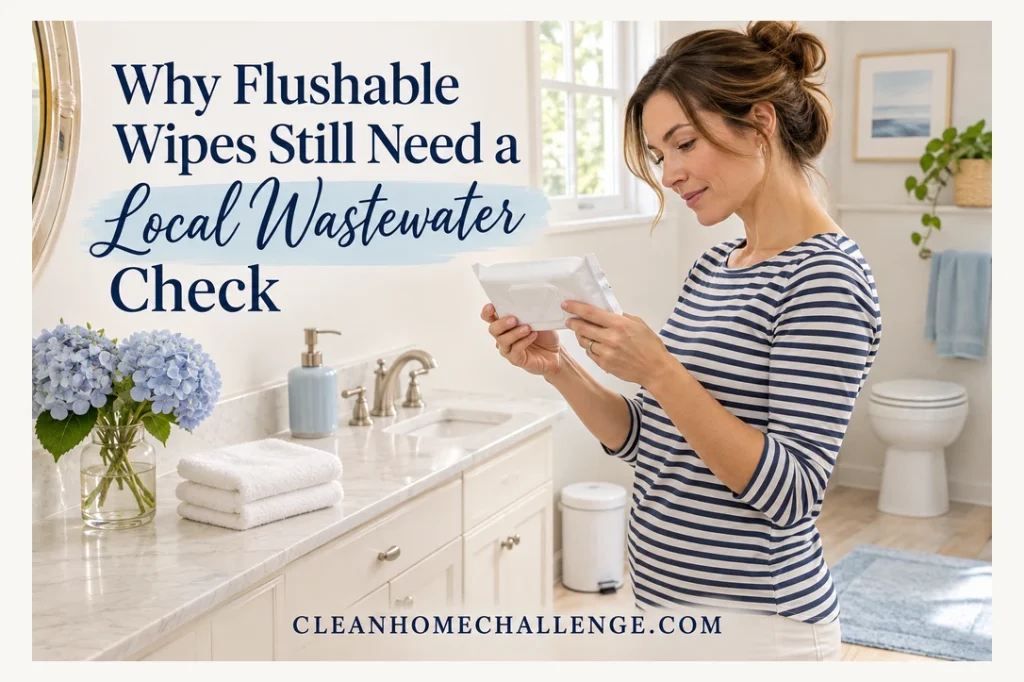
The word “flushable” can make a wipe sound like an easy bathroom shortcut. But the package is only one place to look. Your wastewater provider may tell households to put all wipes in the trash, while another provider accepts specific products that meet a named standard. A label bought in one place is not a complete disposal plan for every home.
The easy default: put used wipes in the trash and flush only human waste and toilet paper while you check your own provider’s advice. Never flush a wipe marked “do not flush.” You do not need to stop using every convenient product overnight; start by making its disposal clear.
This guide explains why flushable wipes still need a local wastewater check, where to find useful instructions, and how to make the right habit easier for children, guests, and tired adults. It includes a free record sheet for saving your household’s answer.
Disclosure: This post may contain affiliate links. As an Amazon Associate, Clean Home Challenge earns from qualifying purchases. If you make a purchase through these links, we may earn a small commission at no extra cost to you. This helps us keep creating practical cleaning tips, routines and resources for busy families! 🧽
Why the Package Is Only Part of the Answer

Getting past the bowl is not the whole journey
When something disappears after a flush, you have seen only the beginning of its trip. It still has to pass through the building’s plumbing and the system beyond it. Wipes can contribute to blockages, and a toilet that clears today does not prove a product is suitable for repeated disposal that way.
Portland’s wastewater authority tells residents to keep wipes out of toilets even when they are marketed as flushable. It warns that inappropriate items can clog pipes and contribute to sewer backups. That is a local instruction worth following if you live in its service area, rather than substituting a package claim. Read its official guide to what can and cannot be flushed.
Standards and local instructions answer different questions
Australia and New Zealand have a flushable-products standard, AS/NZS 5328:2022. Standards New Zealand describes it as a framework of tests covering the product’s journey through wastewater systems. A statement about that standard is more specific than an unexplained marketing word, but it is still important to check the provider serving your property. See the standards body’s explanation for background.
For example, Sydney Water’s current guidance recognizes products meeting AS/NZS 5328:2022 alongside the usual human-waste-and-toilet-paper rule. Its advice does not mean that every packet called flushable qualifies. Central Coast Council’s current campaign, meanwhile, tells residents to bag and bin wipes, including those labeled flushable. These examples were checked on November 3, 2026; they illustrate why neighboring areas should not be treated as interchangeable.
Check the Sydney Water wastewater-blockage guidance or Central Coast Council’s sewage-treatment advice if either serves your home. Otherwise, find your own provider below.
Read disposal claims separately from material claims
Words such as plant-based, biodegradable, plastic-free, or compostable describe different product characteristics. None should be treated as permission from your local wastewater provider. Likewise, a toilet-use wipe and a surface-cleaning wipe are different products; directions for one packet do not apply to another.
Do not use a bowl, jar, or sink experiment to certify a wipe at home. A piece tearing when you stir it does not reproduce a complete wastewater test or establish that your building’s plumbing can handle it. The practical question is whether the exact product and your local instructions agree. If the answer remains unclear, keep using the trash.
How to Check Your Local Wastewater Advice

Set aside about five minutes for the first search. It may take longer if you need to ask a landlord or service provider which system serves the address. You only need your phone, the exact wipe packet, and a place to record the answer.
- Identify who handles wastewater for the property. Start with the sewer-service section of your water bill, your council’s website, or your rental information. The company supplying drinking water is not always the organization responsible for wastewater. If you have a septic system, note that instead of assuming the municipal sewer page applies.
- Find the provider’s own website. Search its name together with “what not to flush,” “wipes,” or “wastewater blockages.” Open the actual authority page, rather than relying on a retailer, social post, or search-result summary. Check that the page covers your service area.
- Read the whole wipe instruction. Look for a general rule, any stated exception, the named standard where relevant, and product or system limitations. Do not stop at a large “three Ps” heading if a footnote adds detail. Equally, a standards article from another region does not override your own provider’s instruction to bin wipes.
- Compare the exact packet. Check the front and back for “do not flush,” a named standard, limits, and plumbing restrictions. Do not assume another size, formulation, or similarly named product has the same directions. Keep the packet available if you need clarification.
- Save the local answer. Write down the authority name, webpage address, date checked, and your household’s disposal rule. A saved bookmark is useful; a short note near the supplies helps everyone act on it.
If the local page is unclear, ask: “At this address, should this exact wipe go in the trash? Does your guidance accept any named standard, and does that apply to our system?” There is no need to flush a sample while waiting. Avoid broad claims such as “all certified wipes are safe everywhere” or “this brand can never cause a blockage.” Neither gives your family a reliable local instruction.
If your home uses septic or specialist plumbing
Use the instructions for your actual system. The US EPA’s septic-care guide advises flushing only human waste and toilet paper. A sewer-network statement is not an approval for a private septic installation. Ask your septic service professional about any uncertainty, and follow the system manufacturer’s directions.
In an apartment, rental, or home with a macerator or other specialist equipment, check the building or equipment instructions too. If they are more restrictive, keep wipes out. Ask the property manager for written guidance when you cannot identify the system; do not open pumps or shared sewer infrastructure yourself.
Save your household’s answer: Download the free Local Wastewater Check and Bathroom Disposal Plan (PDF). It has space for your provider, the exact product, the advice checked, and a family reminder. The printable is free to use without joining anything.
Set Up a Bathroom Routine That Makes Disposal Easy
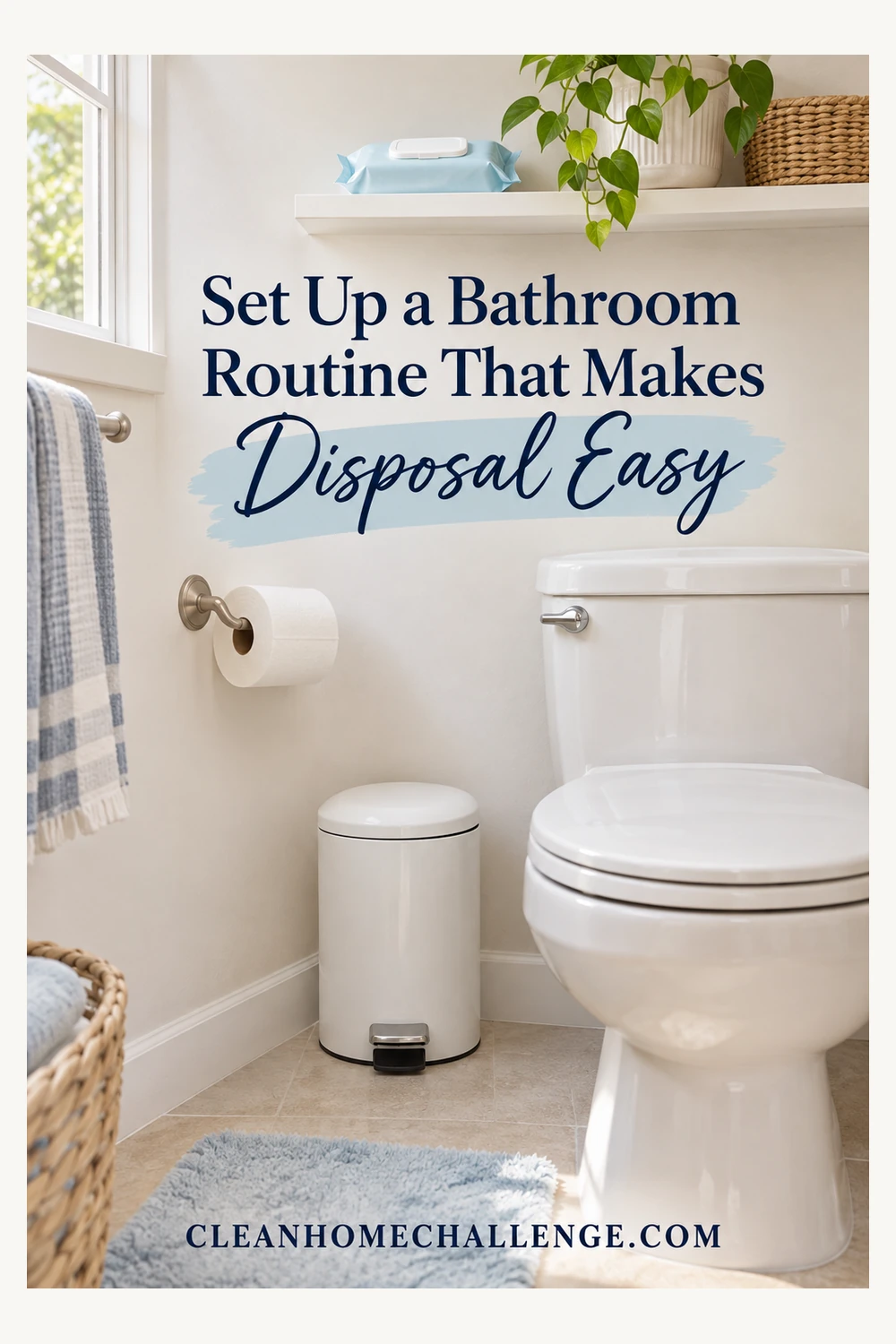
The best reminder is one people can follow without leaving the room. If the only trash can is downstairs, a convenient wipe can easily end up in the wrong place. You can make the alternative straightforward without buying a matching bathroom set.
Give used wipes an obvious destination
- Place a suitable lined trash can within convenient reach, without narrowing the doorway or creating a trip hazard. A lid can help keep waste out of sight; choose a design your household can operate easily.
- Keep unused wipes closed in their original packaging so disposal directions stay with the product. Store cleaning or disinfecting wipes according to their label and out of children’s and pets’ reach.
- Make spare liners easy for the responsible adult to find. Do not leave loose plastic bags where young children can reach them.
- Add a plain reminder: “Used wipes go in the trash.” You do not need a long warning sign beside the toilet.
For ordinary household used wipes, follow the packet and local waste instructions for trash disposal. Do not put them into recycling or a compost collection simply because the packet mentions plant materials. Specially contaminated waste may need different handling; check the relevant local advice rather than applying the bathroom rule to everything.
Empty the can before it becomes another difficult job
Choose a quick daily check when the bathroom is already in use. If the liner is full or waste is causing odor, close it and put it in the appropriate household waste stream. Replace the liner so the next person is not left guessing. Wash your hands after handling waste.
On your weekly bathroom day, empty the can and clean it according to its material and the cleaner’s label. Let it dry before fitting a new liner. Do not add extra disinfectant, bleach, or fragrance to a used-wipe bag, and never mix cleaning products. If you disinfect the can, follow that product’s directions rather than treating a quick spray as a substitute for the required process.
Reduce disposables where it fits your routine
For appropriate household surfaces, a washable cleaning cloth may reduce how often you reach for a disposable wipe. Match the cloth and cleaner to the surface instructions, and keep toilet-cleaning cloths separate from face or kitchen cloths. Launder them appropriately and dry them fully between uses. Personal-care needs are different; choose suitable products for the person and task instead of swapping in a surface-cleaning cloth.
You can start with the can you already own and one clear reminder. If you are looking for reusable supplies for other cleaning jobs, the collection below is an optional place to browse, not a requirement for following this disposal plan.

Keep the Habit Simple for the Whole Family
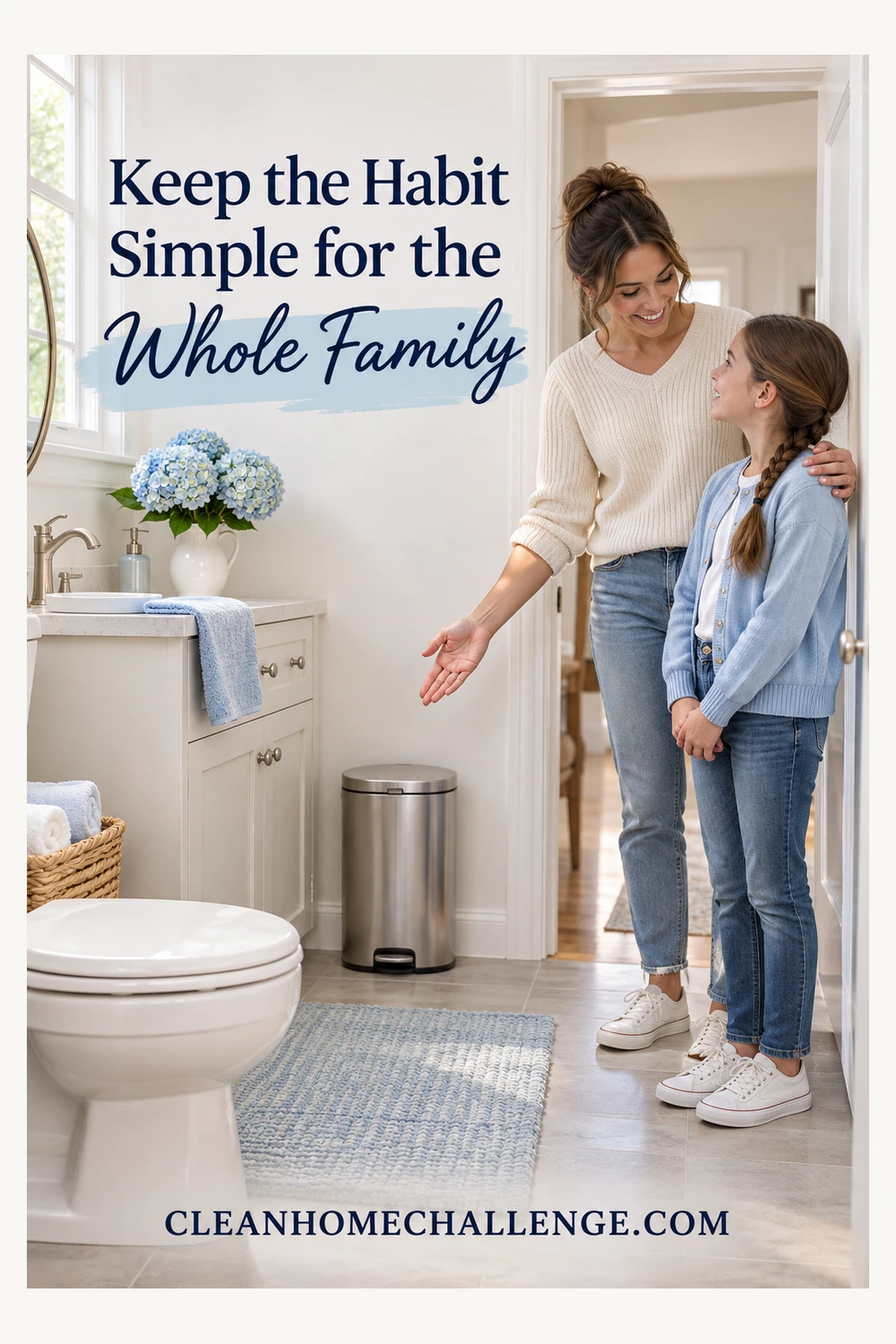
Give everyone the same short instruction and the same convenient setup. “Toilet paper in the toilet; wipes in the trash” is easier to remember than a family debate about marketing terms. A household can choose to bin wipes even where the wastewater provider permits certain qualifying products; no one has to use that exception.
Explain it without blame
For a child learning bathroom independence, show the trash can and practice where an unused demonstration item belongs without putting it in the toilet. For guests, a visible can and discreet note often work better than a spoken reminder. For someone with reduced vision or dexterity, use a consistent can location and a lid or pedal they can manage. Ask what works for them instead of moving supplies around without warning.
If wipes have been flushed in the past, focus on the next habit. You cannot diagnose the condition of a drain from that history alone. If the toilet rises unusually, drains slowly, gurgles, or wastewater backs up, stop flushing to test it and contact a plumber or wastewater provider as appropriate. Keep people and pets away from sewage, and do not mix drain chemicals or attempt to open sewer infrastructure.
Use a small reset when life is busy
If you only have a minute today, put a lined can in place and tell the household that wipes go there. Do the provider check when you have the packet and phone together. Once the answer is recorded, link the trash-can check to your normal bathroom routine instead of creating a separate chore list.
Revisit the note when you move, change products, change plumbing or septic arrangements, or learn that your provider’s guidance has changed. You do not need to research the same unchanged packet every morning.
Keep the free disposal plan with your household notes, and use the simplest rule that fits the official instructions for your home. A clear destination for used wipes is a small change that makes the bathroom easier to manage.
If you would like support turning small jobs into a manageable routine, explore Cleaners Clubhouse for the practical routines, worksheets, and challenges described below.
CLEANERS CLUBHOUSE
Build a Safer, Simpler Cleaning Routine
Clean confidently with practical guidance that helps you choose sensible products and use them correctly. The Cleaners Clubhouse combines safer cleaning support with realistic routines, worksheets and challenges.