THIS POST MAY CONTAIN AFFILIATE LINKS. PLEASE READ MY DISCLOSURE FOR MORE INFO.
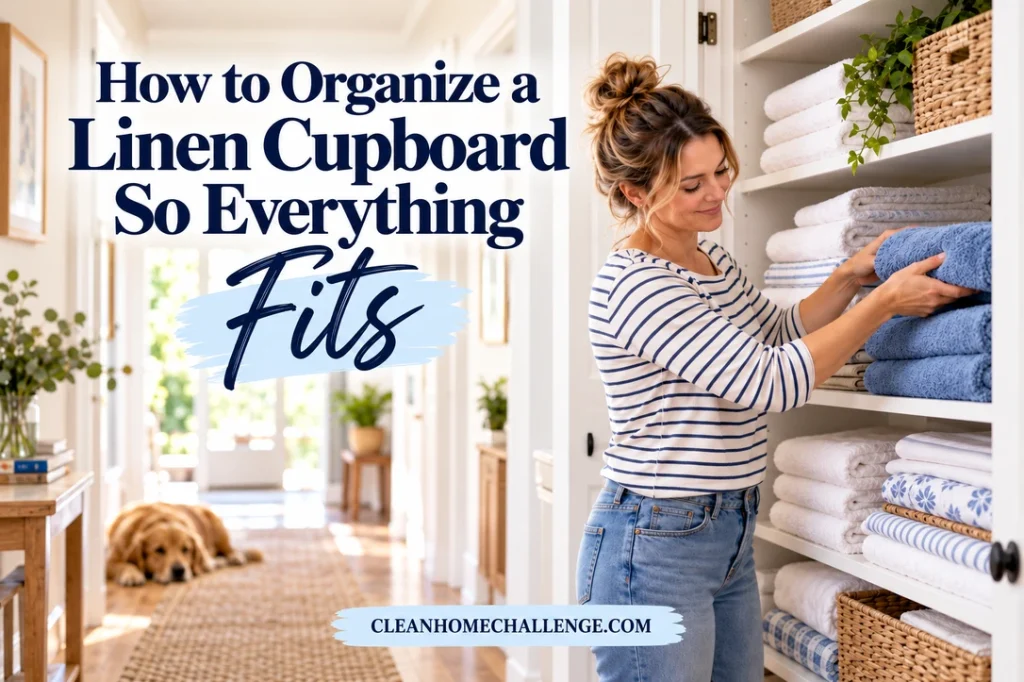
A linen cupboard has to hold more than neatly folded towels. It has to cope with laundry waiting to go away, beds of different sizes, overnight guests, and someone reaching for a washcloth in a hurry. If the shelves only work immediately after a big tidy, the arrangement needs adjusting.
Good linen cupboard organization starts with counting what you actually use, deciding what belongs there, and fitting your folds to the available space. Then give each category a clear home with enough room to take things out and put them back.
You can do this without buying matching baskets or replacing perfectly good towels. Gather a measuring tape, a cloth, paper or removable labels, and a few empty laundry baskets. Try a 15-minute towel-sorting session, or plan a longer block for the whole cupboard; laundry and drying may need separate time. The goal is a cupboard that makes the next laundry day easier.
Disclosure: This post may contain affiliate links. As an Amazon Associate, Clean Home Challenge earns from qualifying purchases. If you make a purchase through these links, we may earn a small commission at no extra cost to you. This helps us keep creating practical cleaning tips, routines and resources for busy families! 🧽
Start With a Linen Inventory
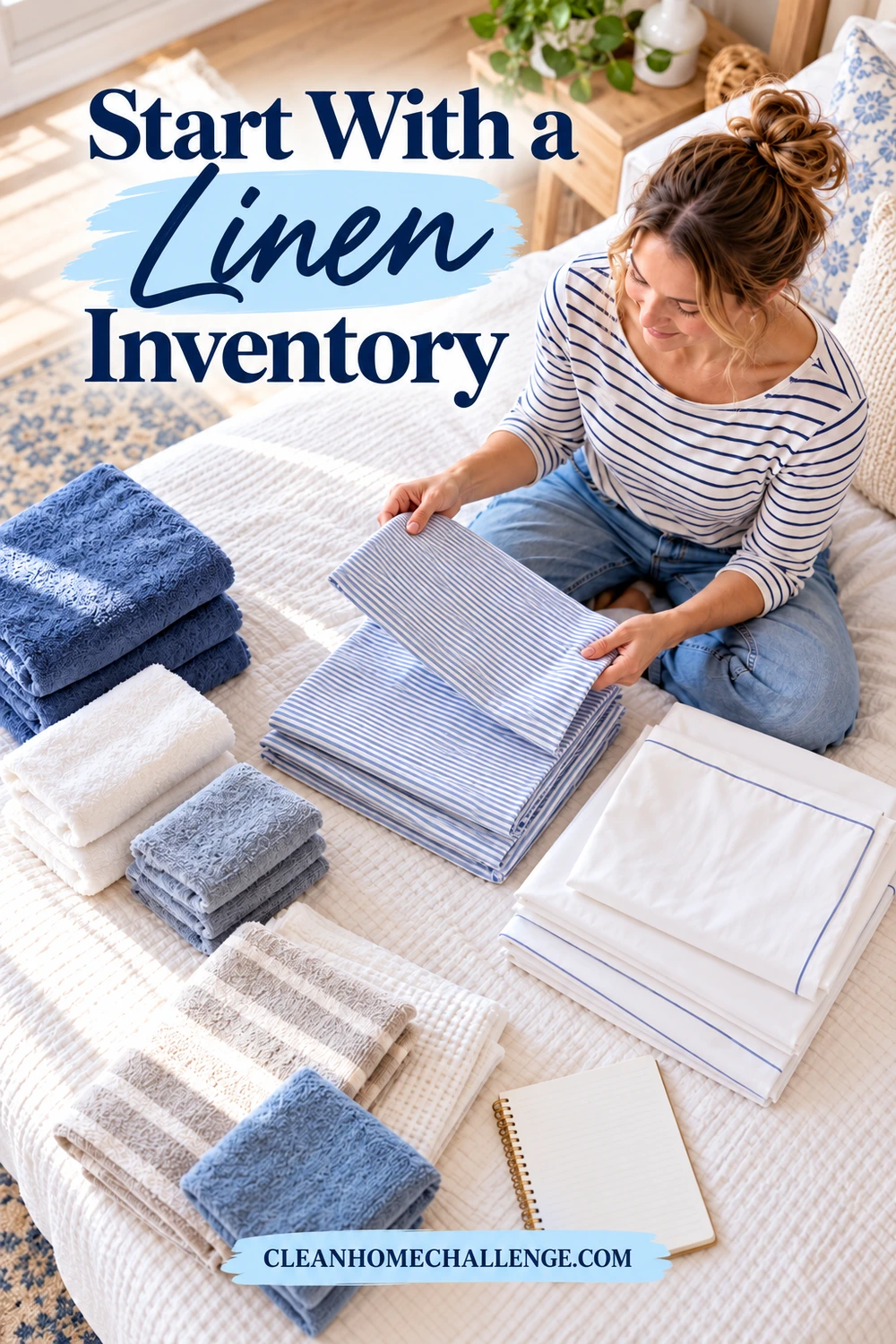
Before you rearrange anything, find out what the cupboard is storing. A shelf full of fabric can hide several complete sheet sets, a collection of unrelated pillowcases, and towels nobody reaches for anymore.
Sort in a space you can clear today
Choose a clean surface near the cupboard. If emptying everything would take over your bedroom for days, remove just one category. Start with bath towels, finish those decisions, then move on to sheets.
Make four temporary groups:
- Keep here: useful linens that belong in this cupboard.
- Keep elsewhere: items needed in another room or season.
- Check or repair: unidentified sizes, missing partners, or a small repair you intend to make.
- Let go: items you no longer need, with donation, textile recycling, or disposal decided separately.
Keep the check pile small. Put a date on it so an undecided sheet does not become permanent storage.
Count the whole household supply
Write down towels by type and sheet sets by mattress size. Include linens already on beds, hanging in bathrooms, in hampers, and waiting to be folded. Otherwise, the cupboard may appear to have spare capacity simply because half its contents are in use.
A useful inventory might read: “Queen bed: one set in use, two complete spare sets, one fitted sheet with no matching pieces.” Matching colors are optional; the important question is whether each combination makes a usable bed.
Check fitted-sheet labels against current mattresses. A sheet from a bed you no longer own does not need a permanent place beside everyday bedding.
Give old linens a realistic destination
Keep a modest, clearly contained supply of old towels for the messy jobs you actually do. Once that space is full, adding more creates another overflow pile.
Check an organization’s current acceptance rules before donating. Animal shelters and charities vary in what they can use, and textile recycling programs have their own requirements. Clean, usable donations help; an unplanned bag that sits beside the cupboard for months does not finish the job.
Keep What Your Laundry Routine Needs
There is no single correct number of towels or sheet sets for every home. Your working supply depends on how many people use them, how often you change them, and how long washing and drying take.
A family using shared laundry facilities may need a different buffer from someone who can wash and dry a load the same morning. Extra bedding can also be genuinely useful during a busy or unpredictable week.
Work backward from the next clean load
For each category, ask:
- What is in use right now?
- How many clean replacements will we need before the next load is washed, fully dried, and put away?
- What additional reserve would cover a realistic delay or unexpected change?
Those answers give you a starting quantity to test, rather than an arbitrary decluttering target.
For example, imagine four people each have one bath towel in use and normally need one replacement before the next towel load returns to the cupboard. That routine uses eight towels across the house. If that household chooses two extra towels as a shared buffer, its trial supply is ten. This example illustrates the counting method; it does not prescribe towel-changing frequency or a universal quantity.
Count sheet sets by the beds you make
Think through a normal bedding change. When one set comes off, what goes on the bed? Will the removed set be ready before another change is needed? If not, include enough additional bedding for that gap.
Count beds of the same size together when their sheets can genuinely be shared. Keep separate labels when mattress depth, pillow size, or a particular person’s preferences mean they cannot.
Guest bedding should reflect your real hosting setup. Keep the pieces needed for the beds or sleeping spaces you actually provide, plus any reserve you choose for the way guests use them.
Test before making final decisions
If you are unsure about reducing a category, put the questionable extras in a labeled temporary holding spot outside the daily shelves. Review them after a few normal laundry cycles. Notice what you retrieve and why.
Keep seasonal linens on the inventory even when stored elsewhere. The aim is to avoid unnecessary duplicates without leaving yourself short or creating pressure to finish laundry at an unrealistic pace.

Clean and Measure the Cupboard
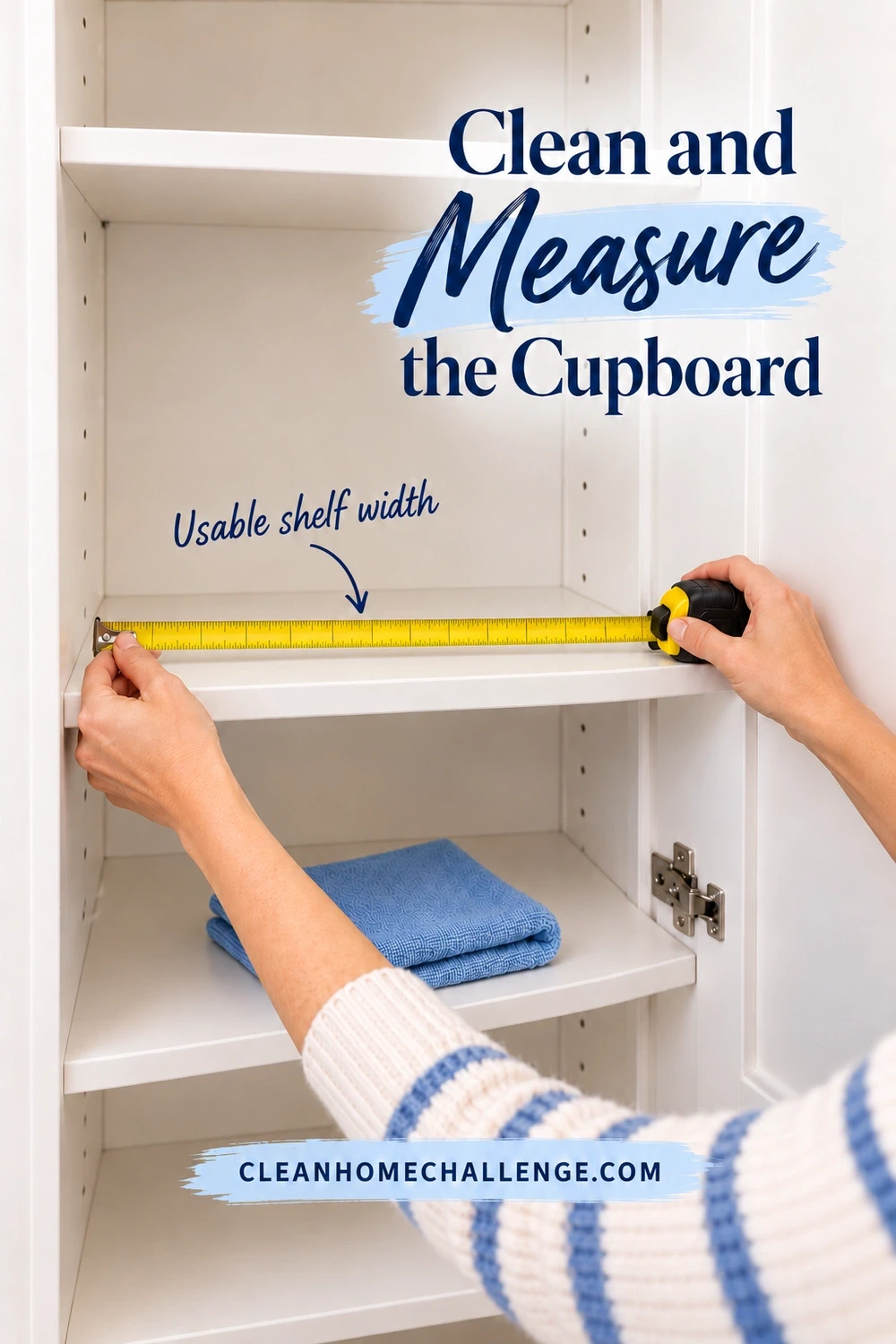
An empty shelf is easier to assess than one hidden beneath towels. Check both its condition and its usable dimensions before bringing everything back.
Start with a dry, sound storage space
Remove loose dust with a dry cloth or a suitable vacuum attachment. If the shelf finish permits damp wiping, follow its care instructions, use a lightly damp cloth, and let the surface dry completely. Avoid soaking unfinished edges, and patch-test an unfamiliar product in an inconspicuous area. Never mix cleaning products.
Do not put clean linens back against damp walls or onto damp shelving. Persistent mustiness, staining, or recurring condensation deserves attention before an organization project continues. EPA guidance emphasizes fixing the moisture source, rather than relying on cleaning alone. Renters should report leaks or persistent moisture to the property manager. See the EPA’s household moisture guidance.
Measure the space that is actually available
Record three measurements for each shelf:
- Usable width: the space between side walls, hinges, and other obstructions.
- Usable depth: the distance from the back to where a stored item can sit without preventing the door from closing.
- Clear height: the space above the shelf, allowing room to lift out a stack or basket.
Also measure the doorway opening. A basket can fit inside a cupboard yet be awkward to get through its narrower door frame.
Check these dimensions with a folded towel and a complete sheet set before shopping. You may discover that changing one fold solves the problem.
Check supports before adding storage
Look for sagging shelves, loose clips, damaged brackets, or missing shelf pins. Unload anything that appears unstable and have it checked before use. Follow the specific shelving system’s installation instructions and load limits; there is no reliable universal weight allowance. IKEA’s shelf instructions, for example, show how permitted loads depend on mounting. ClosetMaid’s installation guidance also emphasizes checking the correct assembly.
For a freestanding linen cabinet, follow its anchoring instructions. The CPSC’s Anchor It guidance covers securing furniture against tip-overs. A tidy cabinet still needs safe installation.
If your cupboard contains a water heater or other equipment, follow the equipment’s required clearances and ventilation instructions. Do not treat service access or ventilation space as spare storage.
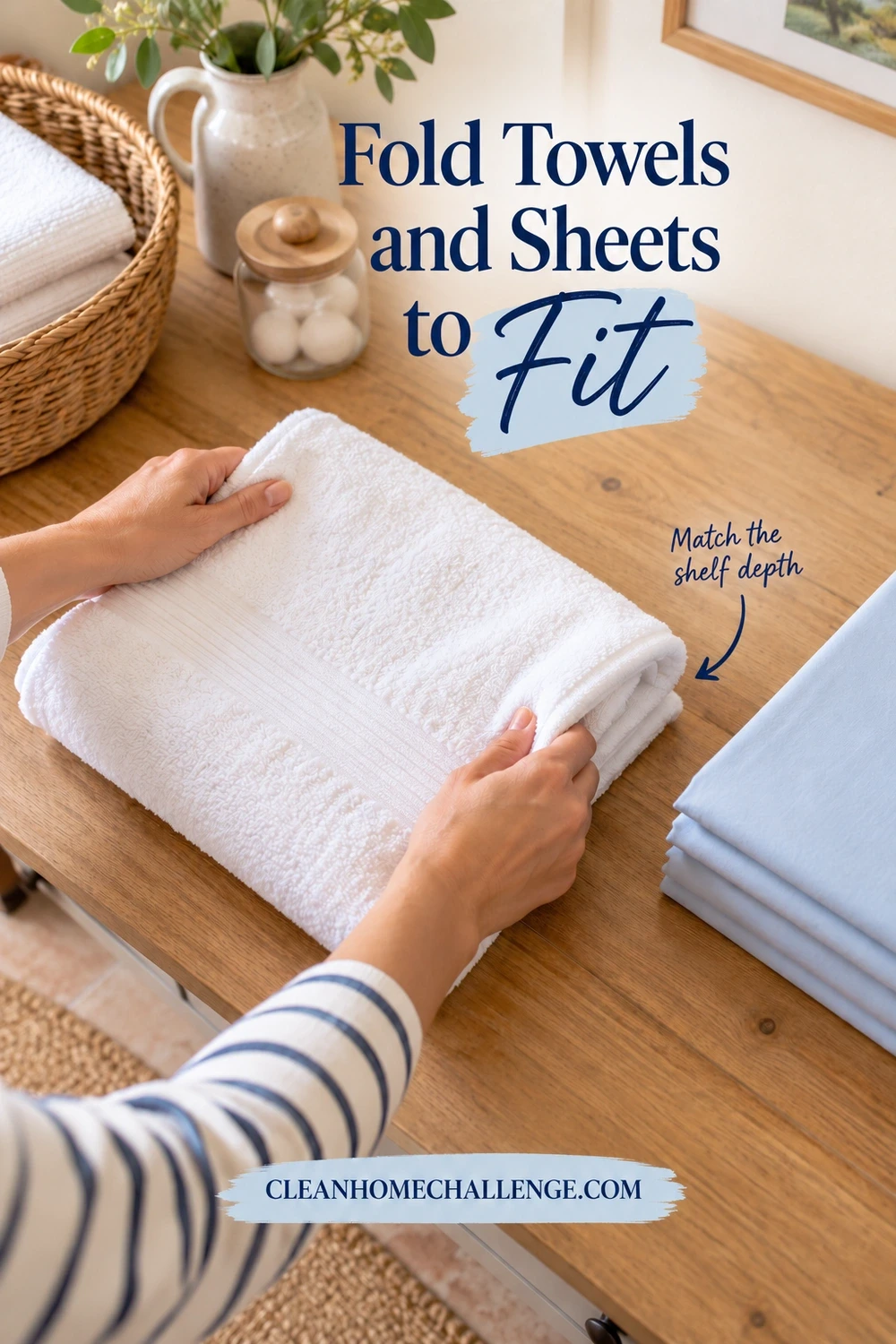
Fold Towels and Sheets to Fit
A good fold produces a shape that fits your shelf and is easy to repeat. Towels do not need identical dimensions, and fitted sheets do not have to look like flat sheets.
Before folding the whole load, make one sample and try it in the cupboard. Check that you can close the door, lift the item out, and return it without moving everything nearby.
Make a shelf-sized towel fold
- Lay a dry towel flat and smooth out bulky bunches.
- Fold the long sides inward to create a strip narrow enough for its allocated space. Halves or thirds may work, depending on the towel.
- Fold the strip across its length until the finished rectangle fits the shelf depth.
- Place the sample on the shelf and adjust if it overhangs or becomes unnecessarily thick.
- Use that shape as a guide for the other towels in the same category.
For a hypothetical 15-inch-deep shelf, a folded towel about 13 inches deep leaves some handling room. That is an example of fit, not a required measurement.
Build shorter stacks that stay upright when someone removes a towel. If a pile repeatedly falls over, divide it or change the fold before assuming you need another organizer.
Bundle the pieces needed for one bed
Fold the flat sheet and pillowcases to roughly the same footprint. For the fitted sheet, bring matching corners together, tuck one elasticized corner into another, and repeat with the remaining corners. Lay the nested sheet down, bring the curved elastic edges inward, and fold the resulting shape into a manageable rectangle.
If this is frustrating, use a simpler fold that you can repeat. A compact, identifiable bundle is useful even with a few uneven edges.
Place the set’s pieces together inside one of its pillowcases, provided they fit without forcing or overstretching it. Alternatively, use a labeled open basket for each bed size. Keep incomplete sets separate until you know which pieces belong together.
Choose rolling only where it helps
Rolled washcloths or hand towels can be easy to see in a shallow basket. Large rolled bath towels may use more room than flat stacks in your particular cupboard. Test both with the same items instead of assuming rolling always saves space.
Only store linens when fully dry, following their care labels. Thick hems and bundled bedding deserve an extra check. The Company Store also recommends letting bedding cool before packing and using a dry storage location. See its seasonal bedding care guide.
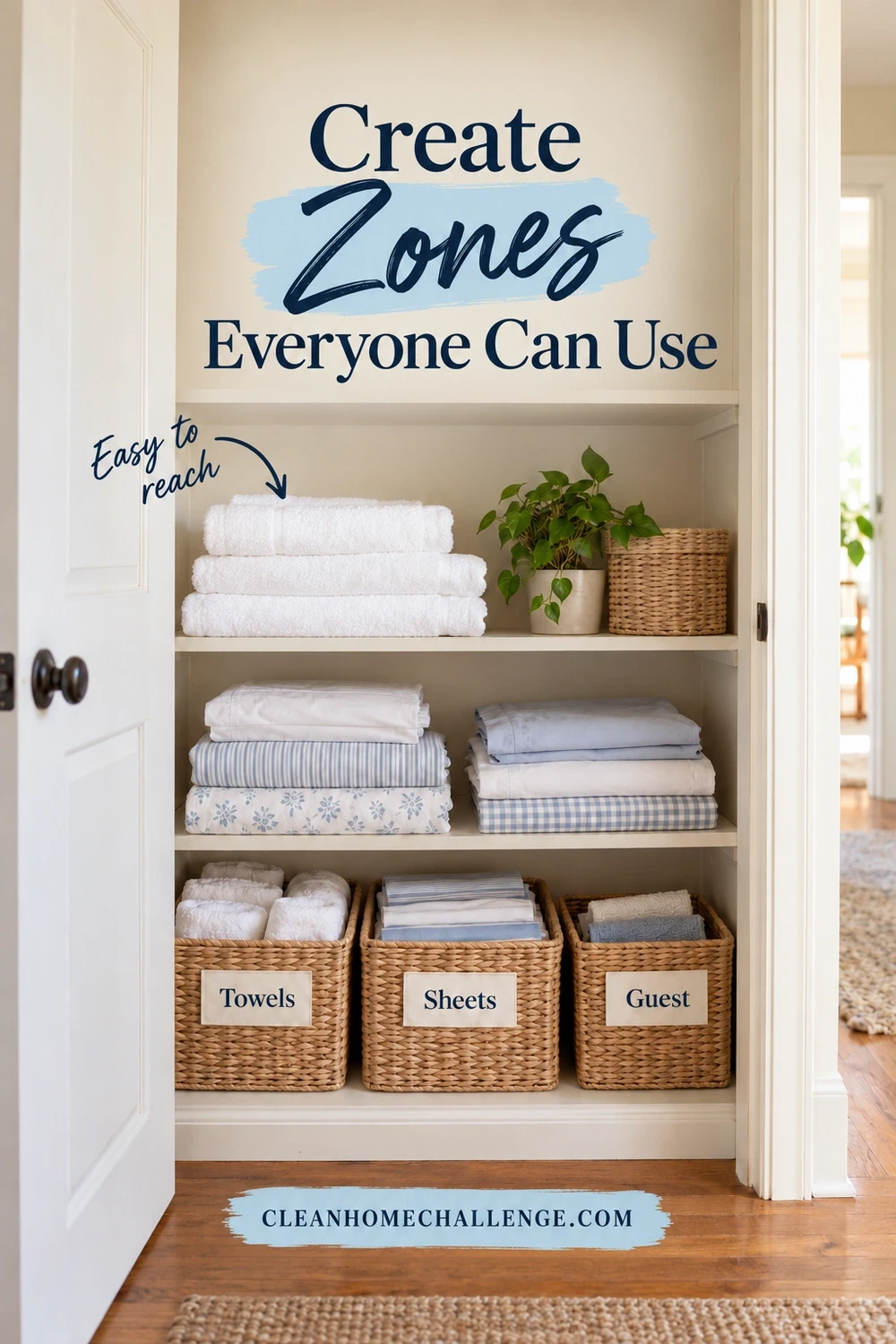
Create Zones Everyone Can Use
Give each category an obvious address. Someone putting away laundry should be able to find the right place without asking the person who organized the cupboard.
Start with the most frequent users and their comfortable reach. Daily linens belong where they are easy to see and retrieve. Heavy items should not require lifting from above your head.
Arrange shelves around everyday jobs
A possible layout is:
- Easy-reach middle shelves: bath towels, hand towels, and frequently used sheet sets.
- A reachable lower shelf: washcloths or another lightweight category children can safely help put away.
- A higher shelf: lightweight, less frequently used linens that adults can retrieve safely.
- A suitable low shelf: heavier bedding or a manageable basket that can be lifted without strain.
Adjust this to the people using the space. Someone who finds bending difficult may need everyday supplies at waist height. Use a proper step stool for high shelves, and never climb cupboard shelving.
Label the decision, not every object
“Queen sheets,” “Guest bedding,” and “Hand towels” are usually more useful than decorative labels that say only “Linens.” For shared household jobs, a clear word or simple picture label can help.
Put labels where they remain visible when the shelf is partly empty. If the arrangement changes, a removable label is easier to update than a permanent one.
Ask another household member to put away a small load. Any hesitation shows where a label or category may need simplifying.
Separate fabric storage from product storage
Prefer a separate, secure place for cleaning liquids and laundry products so a leaking bottle cannot reach bedding or towels. Keep products in their original labeled containers, close them after use, and store them securely away from children and pets, following their labels. These are core American Cleaning Institute laundry safety recommendations.
Do not transfer detergent packets into an attractive jar to match the baskets. An open linen shelf is not a substitute for secure product storage.
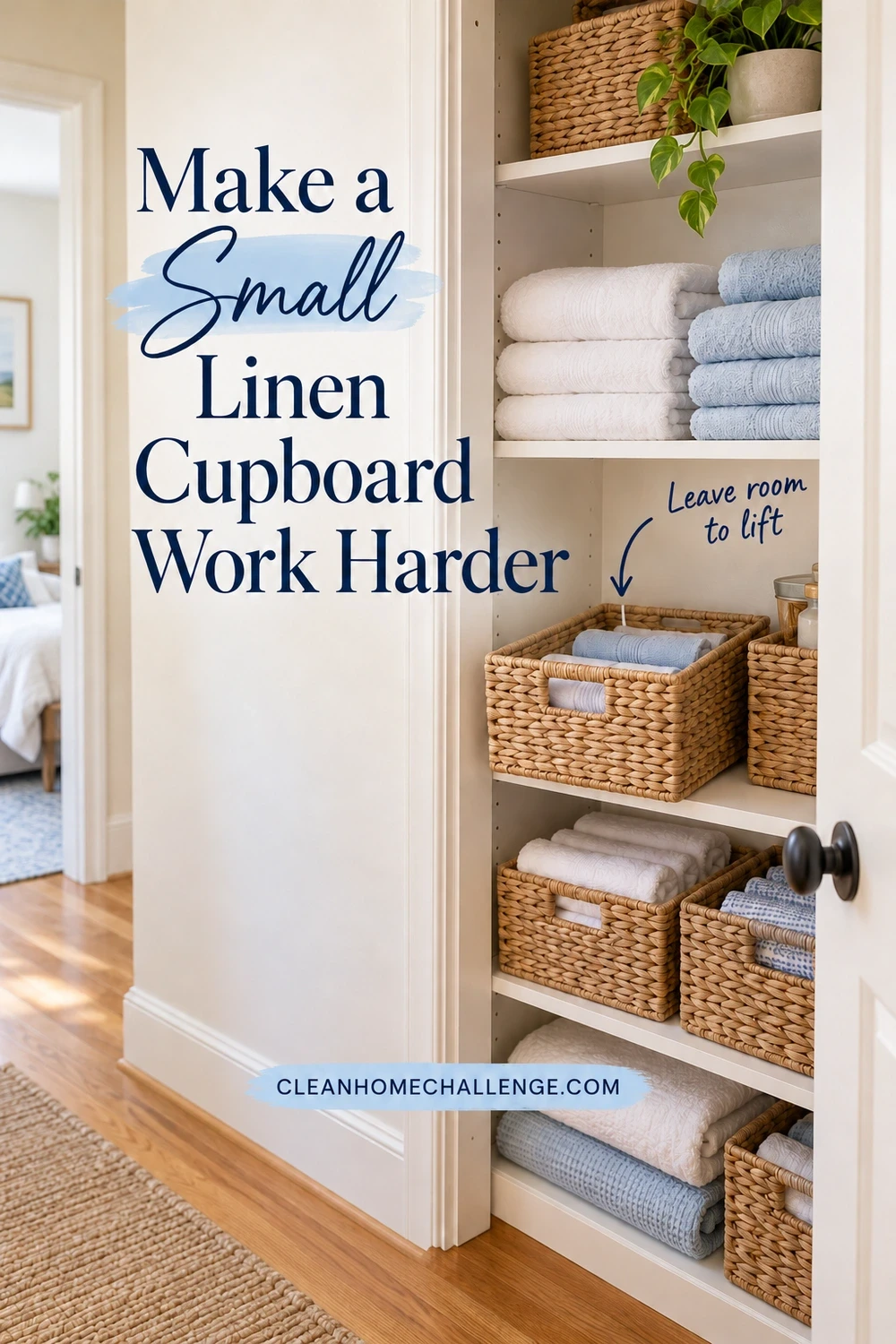
Make a Small Linen Cupboard Work Harder
When space is tight, solve the particular obstruction instead of adding containers everywhere. Every basket has walls and handles that use some of the shelf, so it should make retrieval easier or contain an awkward category.
Deal with deep shelves deliberately
Avoid placing unrelated everyday categories behind one another. If bath towels hide the sheets, both groups will become disorganized whenever someone makes a bed.
Try one pull-out basket for a single category, sized so you can remove it comfortably. Another option is a clearly labeled reserve behind its matching everyday supply, but only if reaching that reserve is manageable. Keep a note on the front label when anything is stored behind it.
Use vertical gaps without building taller piles
If adjustable shelves leave a large empty space above a short stack, reposition them according to the cabinet instructions. A compatible shelf insert can divide an otherwise awkward gap, provided it sits securely and its load limit suits the contents.
Measure first. Adding a riser that leaves too little room for your hand makes the shelf harder to use.
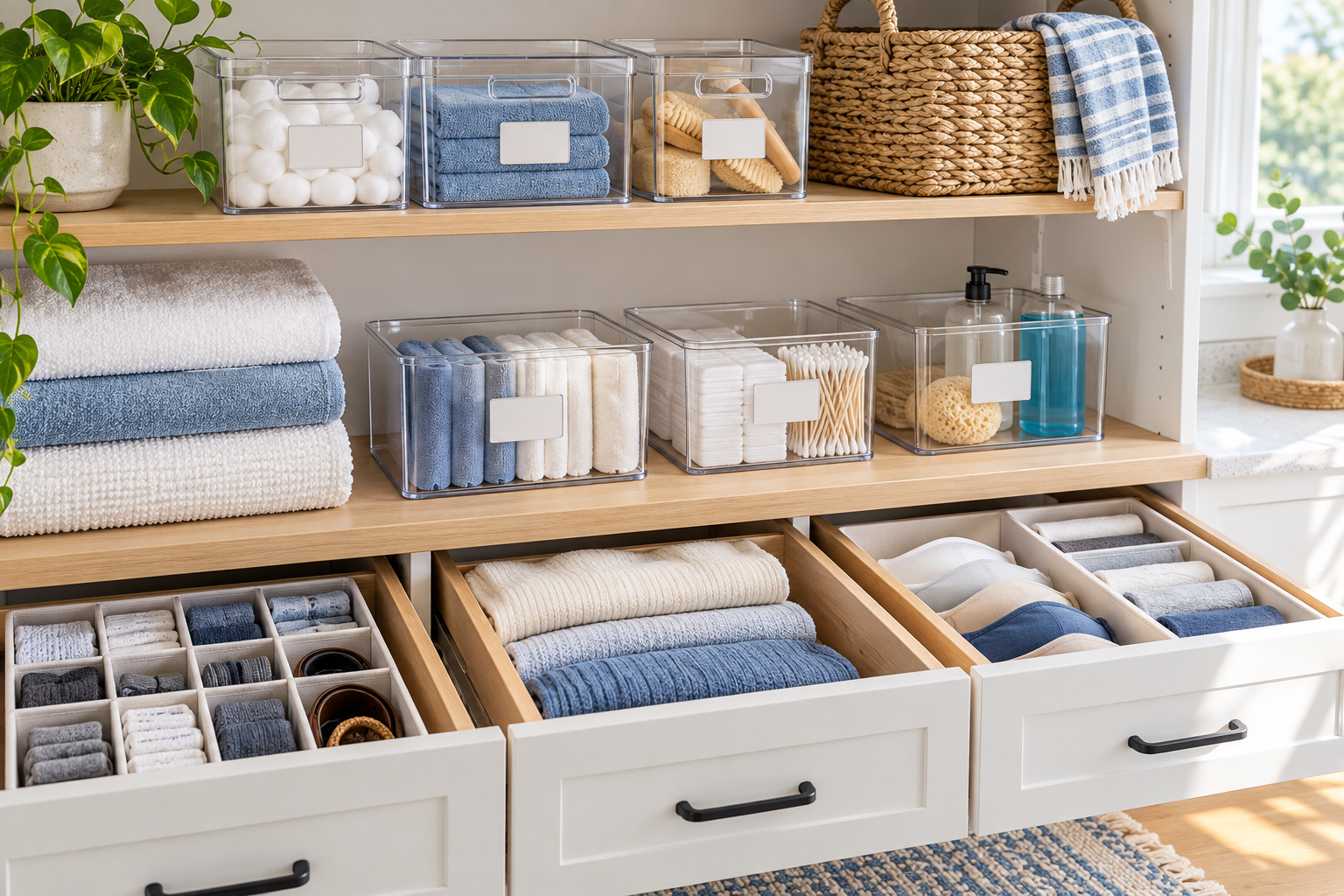
Shelf dividers can support towel stacks on compatible shelving. Smooth, washable bins may be useful for small items. Test containers you already own before buying a coordinated set, and check for rough edges that could snag fabric.
Move bulky or occasional items closer to their use
A bedroom drawer can hold that room’s spare sheets. A suitable dry storage bag under a bed may hold seasonal bedding. Guest linens can live near the guest sleeping space if you have room there.
Choose storage that suits the textile and its manufacturer’s advice. Do not assume a vacuum bag is suitable for every comforter, pillow, or delicate blanket. Check whether compression is allowed before using one.
Keep relocated items on your inventory, with their new location noted. Otherwise, “stored elsewhere” can become “bought again because nobody could find it.”
Leave space for laundry to return
Judge capacity when your full working supply is accounted for, including what is currently on beds and in bathrooms. A cupboard filled to its edges on laundry day has no flexibility.
You do not need a prescribed percentage of empty shelf. You need enough practical room to put away a clean load without squeezing, forcing the door, or unloading a neighboring stack.
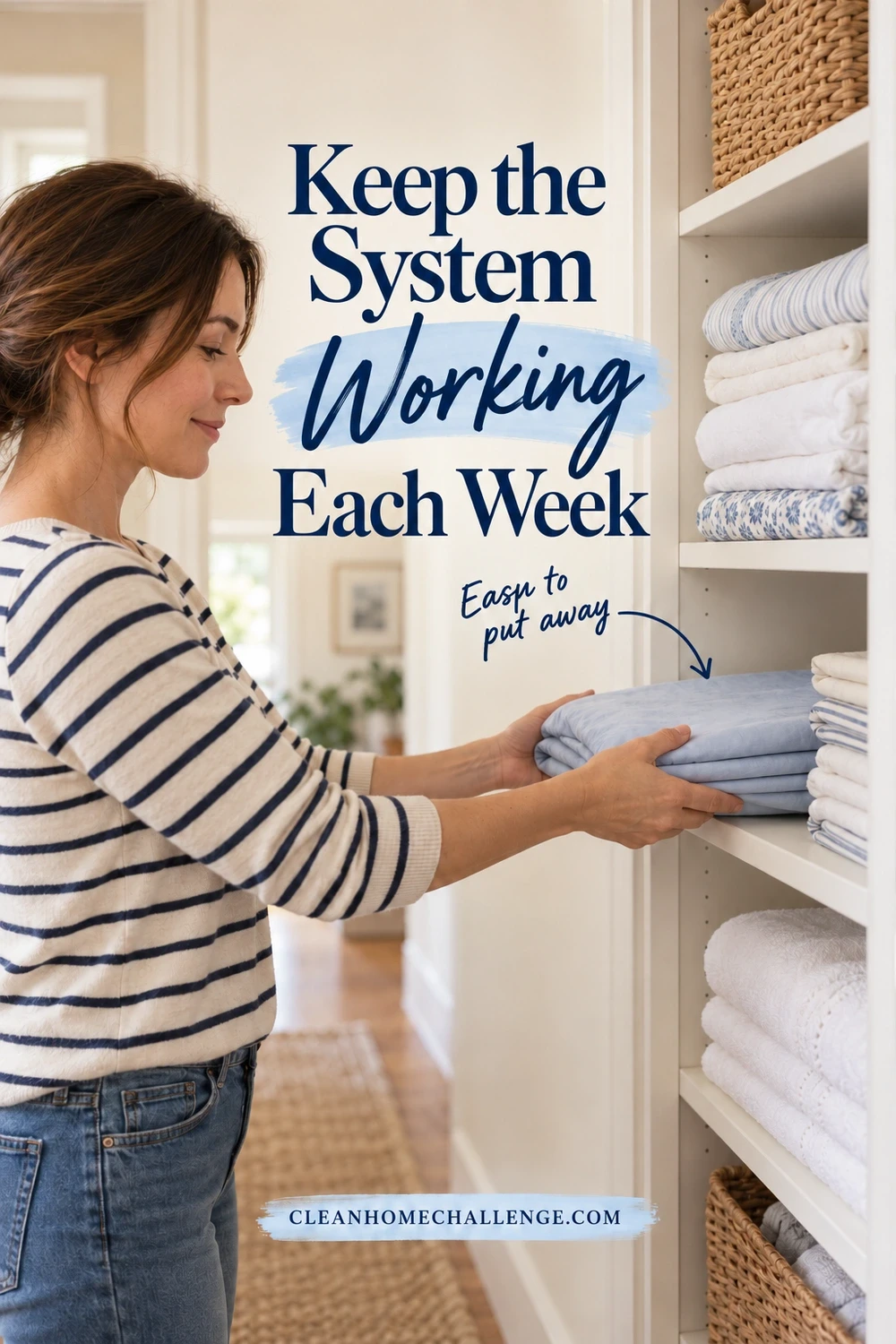
Keep the System Working Each Week
The best maintenance routine is small enough to do while you are already putting laundry away. A cupboard does not need another full makeover every weekend.
Attach a short reset to laundry day
During your usual laundry catch-up, try this quick check:
- Return stray items to their labeled places.
- Straighten only the stacks that are becoming difficult to use.
- Put freshly washed linens behind or beneath older clean ones when convenient, so the same pieces are not always overlooked.
- Notice anything that needs repair, replacement, or a different storage spot.
- Check that doors close freely and no shelf looks overloaded.
If you follow Clean Home Challenge’s weekly routine, Saturday laundry catch-up is a natural place for this reset. It can also happen whenever your household’s clean loads go away.
Fix repeated trouble spots
A basket that is always overflowing may be too small, may contain several unrelated categories, or may be holding more than your current routine needs. Check which problem you have before buying another basket.
If folded sheets keep landing elsewhere, their storage location may be inconvenient. If nobody follows a complicated folding method, simplify the fold. A reliable arrangement should tolerate a busy person putting things away quickly.
Review seasonal bedding when you change it over. Recheck your inventory after a mattress change, a move, or a change in the household. Let the cupboard reflect the life happening now.
Start with one useful improvement
On a low-energy day, choose just one job: identify the sheet sizes, remove items that belong elsewhere, or make space for the next clean towel load. Leave the shelf usable when you stop.
Success is being able to find a fresh towel, locate a complete sheet set, and put laundry away without a struggle. Once those everyday actions work, the cupboard is doing its job.
Sources and Care Guidance
- EPA: A Brief Guide to Mold, Moisture and Your Home
- The Company Store: How to Properly Store Seasonal Bedding
- American Cleaning Institute: Laundry Safety Tips
- ClosetMaid: Installation and Assembly FAQs
- U.S. Consumer Product Safety Commission: Anchor It
- IKEA: LACK Shelf Mounting and Load Instructions
CLEANERS CLUBHOUSE
Ready to Clear the Clutter One Step at a Time?
Join the 30-Day Declutter Challenge and work through your home in small, achievable steps. The Cleaners Clubhouse includes the plan, printable support and encouragement to help you keep going.