THIS POST MAY CONTAIN AFFILIATE LINKS. PLEASE READ MY DISCLOSURE FOR MORE INFO.
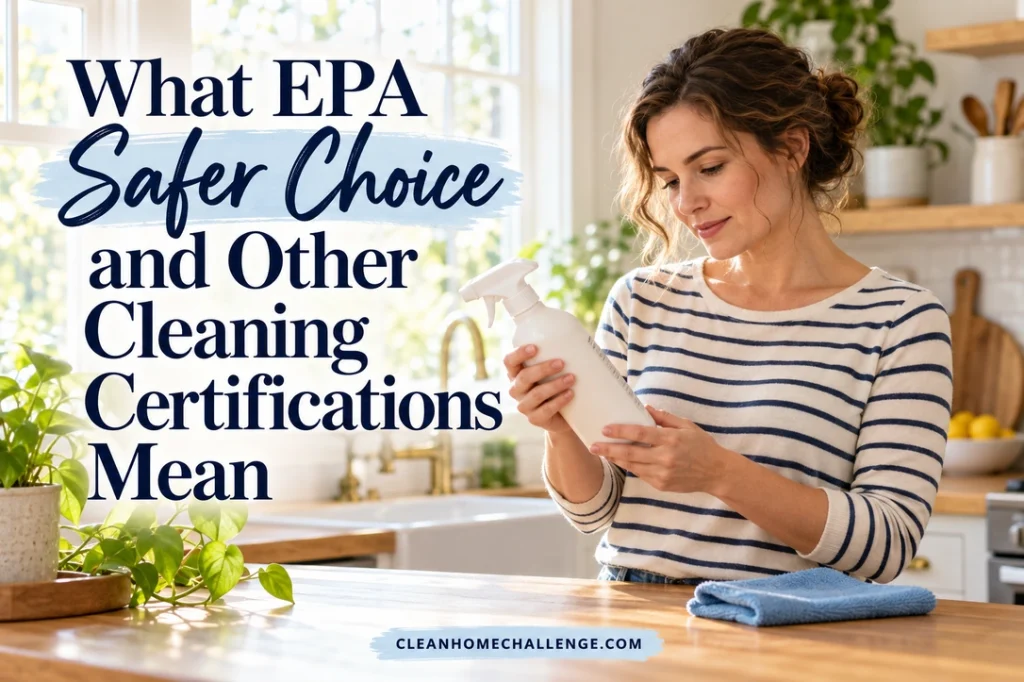
A cleaning bottle can carry a leaf, a reassuring slogan, and three different badges, yet still leave you wondering what has actually been checked. You should not need an afternoon of research just to replace your bathroom cleaner.
Safer cleaning product certifications can make shopping easier when you know what each program evaluates. EPA Safer Choice, Green Seal, UL ECOLOGO, EWG VERIFIED, and USDA Certified Biobased Product labels do not all answer the same question. Some assess ingredients and other product requirements. One focuses on biobased content. Disinfectant claims need a separate check.
The useful habit is simple: identify the program, verify the exact product, and then read the directions for your intended job. A genuine certification helps you narrow your choices. It does not replace surface compatibility, correct dilution, or careful storage.
This guide focuses on US labels and official directories. You can use it to check one bottle today without replacing everything in the cupboard.
Disclosure: This post may contain affiliate links. As an Amazon Associate, Clean Home Challenge earns from qualifying purchases. If you make a purchase through these links, we may earn a small commission at no extra cost to you. This helps us keep creating practical cleaning tips, routines and resources for busy families! 🧽
Start With the Claim on the Label
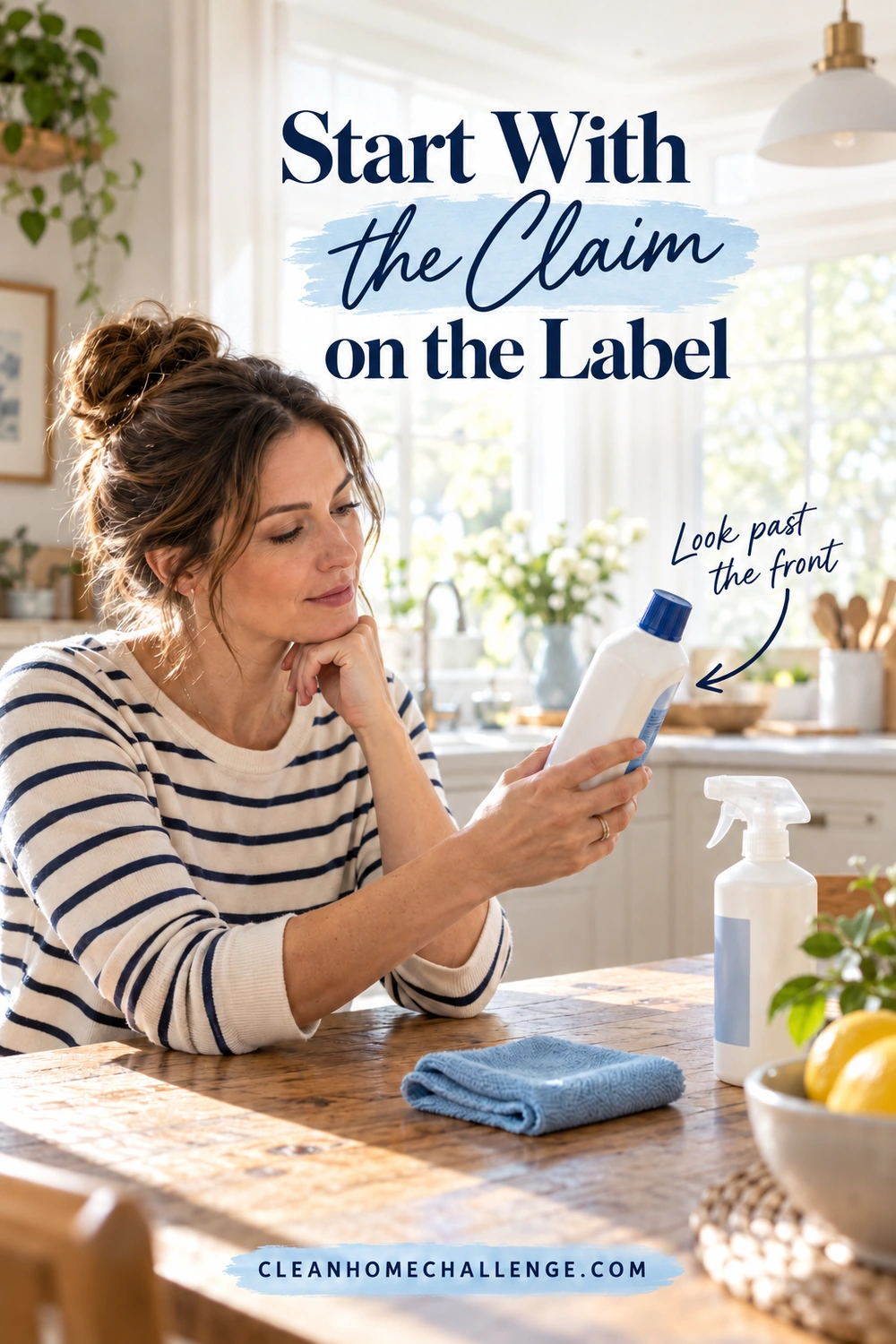
Turn the bottle around before deciding what a badge means. Look for the organization behind it and a clear explanation of what was evaluated. A brand’s own leaf design and a named certification program are different kinds of information.
The Federal Trade Commission’s guidance on environmental claims emphasizes that seals should make the basis of their claims clear. For a shopper, that translates into a useful question: “What, specifically, does this mark tell me?”
Separate three different questions
Start by sorting the information on the bottle into these groups:
- Formulation and certification: Has a named program reviewed the product against defined criteria?
- Purpose and performance: Is this a cleaner, sanitizer, disinfectant, polish, or another product, and what is it intended to do?
- Use in your home: Is it appropriate for your surface, equipment, and the way you plan to use it?
You need all three. An environmental certification does not make an oven cleaner suitable for a marble counter. A disinfectant claim does not make a product appropriate for spraying around people. A pleasant scent does not tell you whether the surface has been disinfected.
Think of labels as different tools
Here is the short version of the programs covered below:
- EPA Safer Choice: A voluntary EPA program reviewing ingredients and additional product requirements, including performance.
- EPA Design for the Environment, or DfE: Additional criteria for qualifying EPA-registered antimicrobial products.
- Green Seal and UL ECOLOGO: Certification against relevant standards with multiple health, environmental, and other product criteria.
- EWG VERIFIED: EWG’s own ingredient, disclosure, and other requirements for eligible products.
- USDA Certified Biobased Product: Verification of biobased content, rather than a general product-safety rating.
The details matter more than how many marks fit on the front label. There is no useful universal score obtained by simply counting badges.
Avoid an all-or-nothing cupboard audit
An uncertified cleaner is not automatically unsuitable, and a certified cleaner is not suitable for every use. Certification programs have defined scopes, eligibility rules, and participation processes.
If a product you already own works for its labeled purpose, use its instructions as your starting point. When it is time to replace it, you can compare verified options without treating every older bottle as an emergency.
Understand EPA Safer Choice
The EPA Safer Choice label helps identify products that meet the program’s requirements for safer ingredients and other product attributes. It is particularly useful when comparing everyday cleaning products for a similar job.
According to EPA’s explanation of the label, every ingredient is reviewed, including ingredients present in small amounts. The program also considers factors such as product performance, pH, and packaging. Participation is voluntary, and EPA conducts annual audits after products qualify.
This is more specific than a manufacturer’s unsupported “green” slogan. It also is not a declaration that a product is harmless under any circumstances.
Look for the actual product listing
Use EPA’s Safer Choice product search and enter the product or company name. Then narrow your check to the bottle you intend to buy.
Match the full name, product type, and any identifying variation. A company may sell several formulas. Finding one laundry detergent does not establish certification for that company’s stain spray or a differently named detergent.
The directory includes home and business products and a fragrance-free filter. It also explains its status notation for an overdue annual partnership review. Read the notes attached to a result rather than treating a search match as the end of the check.
Fragrance-free is an additional distinction
The standard Safer Choice label does not automatically mean fragrance-free. EPA has separate fragrance-free criteria for products qualifying for that designation. The review excludes fragrance materials, including masking components, under the program’s requirements.
An “unscented” claim alone is not the same as EPA’s verified fragrance-free designation; check the actual listing. If avoiding fragrance is your goal, use the fragrance-free filter and check the exact product. Do not infer it from a pale bottle, a mild smell, or a phrase about sensitive households. Fragrance-free certification also does not promise that nobody will react to any ingredient.
What Safer Choice does not tell you
The label is not a disinfectant claim, a guarantee of compatibility with every finish, or permission to ignore precautions. It does not mean that you can mix the product with another cleaner.
Keep your buying question narrow: “Does this particular product meet Safer Choice requirements, and is it suitable for the cleaning task I have?” That is a much more useful question than trying to find one bottle that is perfect for every room.
Know What Disinfectant Labels Mean
Cleaning and disinfecting are different tasks. A certification that helps you choose a general-purpose cleaner does not establish that the product kills a particular virus or bacterium.
CDC’s home-cleaning guidance distinguishes removal of dirt and germs through cleaning from sanitizing and disinfecting. Routine cleaning is the foundation; additional disinfection is relevant in circumstances such as someone being sick or at increased risk. Follow appropriate guidance for your household and the specific situation.
Where EPA Design for the Environment fits
EPA’s Design for the Environment certification, usually shortened to DfE, applies to qualifying antimicrobial products. They must meet pesticide registration requirements as well as the additional DfE criteria.
EPA reviews ingredients and considers human-health and environmental attributes. Antimicrobial efficacy claims still need the applicable supporting data and EPA approval. A DfE mark therefore serves a different role from the Safer Choice label on an everyday cleaner.
You can check EPA’s DfE-certified disinfectants list. Match the listed product and identifying information to the actual label; do not assume every disinfectant from that brand qualifies.
Check the claim you actually need
For a US surface disinfectant, look for the EPA registration number and read the approved label. Check:
- The organisms covered by the specific claim
- The surfaces and locations where the product may be used
- Any precleaning requirement
- The dilution, application method, and wet contact time
- Any rinsing requirement, including for food-contact surfaces
- Protective equipment, ventilation, storage, and disposal instructions
EPA’s disinfectant-use guidance explains why following the label matters. Wiping a surface dry immediately can fail to meet a required contact time. Using more than directed does not repair an unsuitable method.
Keep the claim separate from the certification
Do not treat “antibacterial,” a sustainability badge, and a registered disinfectant label as interchangeable. If a product also carries Green Seal or another environmental certification, that does not remove the need to verify its antimicrobial claim and directions.
There is no need to turn this into a daily research project. Keep the exact label for the disinfectant you use, know when it is needed, and avoid substituting an ordinary cleaner just because its packaging looks equally reassuring.
Compare Green Seal and UL ECOLOGO
Green Seal and UL ECOLOGO are useful names to recognize when you want more than a single vague environmental claim. Both have defined standards, but their criteria and categories are not identical.
Green Seal: match the relevant standard
Green Seal’s standards list separates product categories. Examples include GS-8 for household cleaning products, GS-37 for industrial and institutional cleaning products, and separate standards for laundry or specialty products.
For a cleaner, the relevant requirements can address performance, formulation, and environmental considerations. Green Seal’s household-cleaner standard overview includes cleaning-performance requirements rather than relying solely on a claim about ingredients.
Use the Green Seal Certified Directory to find the product. Check the listed standard and product details instead of assuming the company name certifies its entire range.
Green Seal’s FAQ explicitly distinguishes certification of individual products, services, and spaces from certification of whole companies. It also describes ongoing compliance monitoring and updates to listings as products meet revised standard editions.
UL ECOLOGO: check the certification scope
UL Solutions describes ECOLOGO as a certification for reduced environmental impact against relevant third-party standards. Its scope can include multiple product-life-cycle considerations, depending on the category.
For cleaning products, UL’s current program information identifies UL 2700 as a standard addressing human-health and environmental criteria for consumer, institutional, and industrial cleaning and related products.
Look up the exact product through UL’s Sustainable Products of Trust directory, linked from the ECOLOGO program page. Read which certification is listed. Do not treat every UL-related mark as the same assessment; ECOLOGO and other UL programs have different purposes.
Use the comparison to make one decision
Imagine two general-purpose cleaners that both fit your counter manufacturer’s care instructions. One is Green Seal-certified and one is ECOLOGO-certified. Rather than trying to declare a universal winner, compare practical details:
- Can you verify the exact product in the relevant directory?
- Is it sold for household use or does it require commercial dispensing equipment?
- Is the fragrance acceptable to your household?
- Is the dilution easy to measure reliably?
- Can you obtain the product at a price and quantity you will actually use?
You are choosing a suitable product with verifiable claims, not awarding a prize to the bottle with the most impressive front label.
Read EWG VERIFIED and Biobased Labels
These two marks are worth checking separately because they answer notably different questions. EWG VERIFIED focuses on EWG’s requirements for eligible formulations and transparency. USDA Certified Biobased Product focuses on the source of organic carbon.
EWG VERIFIED is a particular program
EWG’s cleaning-product explanation describes requirements involving its ingredients of concern, ingredient transparency, and manufacturing practices. These are EWG’s criteria, not EPA approval or a universal medical guarantee.
A favorable letter grade in an EWG database is not the same as EWG VERIFIED certification. Look for the actual mark and matching product information in EWG’s Guide to Healthy Cleaning.
The EWG VERIFIED application information for cleaners explains that the review includes formulation and label information. Certification is specific to the approved formulation, and a formulation change requires resubmission.
For your shopping list, record the exact product name and variant. “EWG verified cleaner” is a helpful search phrase, but the search result alone is not proof that every scent, refill, or related product qualifies. Check rather than guessing from the brand logo.
USDA biobased content is a different attribute
The USDA BioPreferred FAQ explains that biobased content is measured as renewable organic carbon relative to total organic carbon. Water and inorganic carbon are excluded from that calculation.
A percentage on the mark therefore is not a simple percentage of everything inside the bottle. Biobased materials may come from plant, animal, or other biological sources; the mark alone does not establish that a product is exclusively plant-based or vegan.
USDA also states that a higher biobased percentage does not necessarily mean better performance, safety, or environmental impact. Its label-use guidance makes clear that the certification is not a guarantee of safety.
Keep each claim in its lane
A cleaner might carry both a biobased-content certification and another certification assessing formulation requirements. Those marks can provide complementary information, but one does not stand in for the other.
Use this simple translation when shopping: “This tells me about verified biobased content. I still need to check what the cleaner is for, its other claims, and how to use it.” Likewise, EWG VERIFIED does not automatically mean USDA-certified biobased, and neither mark by itself establishes disinfectant efficacy.
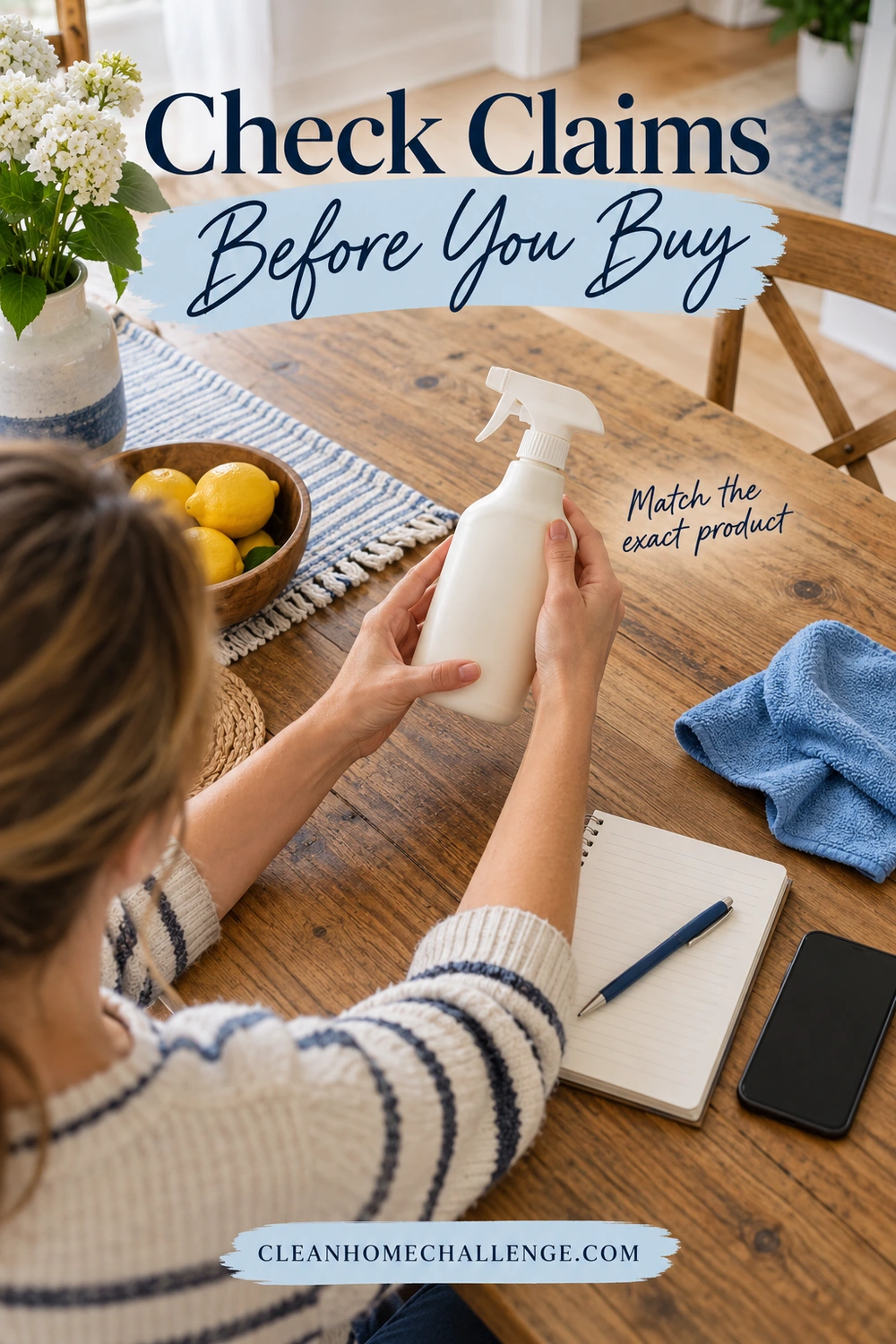
Check Claims Before You Buy
Set aside five minutes for one product category rather than trying to research the whole cleaning aisle. The goal is a short list you can reuse.
Step 1: Name the job and surface
Write a plain-language need such as “everyday cleaner for the kitchen counter” or “laundry detergent compatible with my washer.” Then check the surface or appliance manufacturer’s restrictions.
This prevents a common shopping detour: finding a promising certification first and only later discovering that the product is unsuitable for the job. Natural stone, wood finishes, screens, and specialty surfaces deserve particular care.
Step 2: Identify the exact claim
Read the full certification name. If the packaging only says “eco,” “clean,” or “natural,” look for a more specific explanation. A retailer’s broad sustainability badge may summarize several different qualifying attributes, so open the details rather than assuming what was reviewed.
Ask whether the claim concerns the cleaner, its packaging, a particular ingredient, or the company’s activities. Those are not interchangeable.
Step 3: Use the certifier’s directory
Use these official starting points:
- EPA Safer Choice product search
- EPA DfE-certified disinfectants
- Green Seal Certified Directory
- UL ECOLOGO information and its linked SPOT directory
- EWG’s Guide to Healthy Cleaning
- USDA BioPreferred information and its linked catalog
Compare the full product name, manufacturer, scent or variant where specified, and intended use. Check any scope or status notes. Save the matching listing, not merely the certifier’s homepage.
If the entry is unclear or missing, ask the manufacturer or certifier for the current listing before relying on the claim. A missing search result is a reason to investigate, not automatic proof of fraud.
Step 4: Read the actual directions
Open a readable label image before ordering online. Check dilution, surface exclusions, precautions, and whether the product needs rinsing. If the seller’s image is too blurry, use the manufacturer’s current label information or choose an option you can verify.
A concentrate is only convenient if you can measure and store it appropriately. A large commercial container is not automatically a better household purchase.
Step 5: Compare usable cost
Compare the cost of the usable product, following its labeled dilution, rather than comparing bottle sizes alone. A $12 concentrate that makes four usable bottles costs $3 per prepared bottle before any container costs. That is an illustration, not a price claim for a specific product.
Also consider whether you already have a suitable cleaner. Buying another bottle is not the only way to improve your routine.
Step 6: Save a tiny product note
Record the exact name, the verified certification, the listing link, and the job it serves. Add the dilution only if relevant, keeping the original label as the authority.
Recheck when the product name, scent, formulation, or packaging changes. This small note helps another adult in the household buy the same product without starting the comparison from scratch.

Build a Simple Safer-Cleaning Routine
A useful certification check should reduce decision fatigue. Once you have found a suitable product, put most of your attention back into manageable cleaning habits.
Start with one replacement
Choose the bottle that is nearly empty. Verify one alternative, read its instructions, and see whether it fits your normal routine. You do not need a new product for every room or an immediate cupboard clear-out.
Keep a short set of products with clear jobs. For example, a routine surface cleaner, the right bathroom product for your materials, laundry detergent, and a disinfectant for situations that call for one may cover many needs. Your surfaces and household circumstances determine the final list.
Make the instructions easy to follow
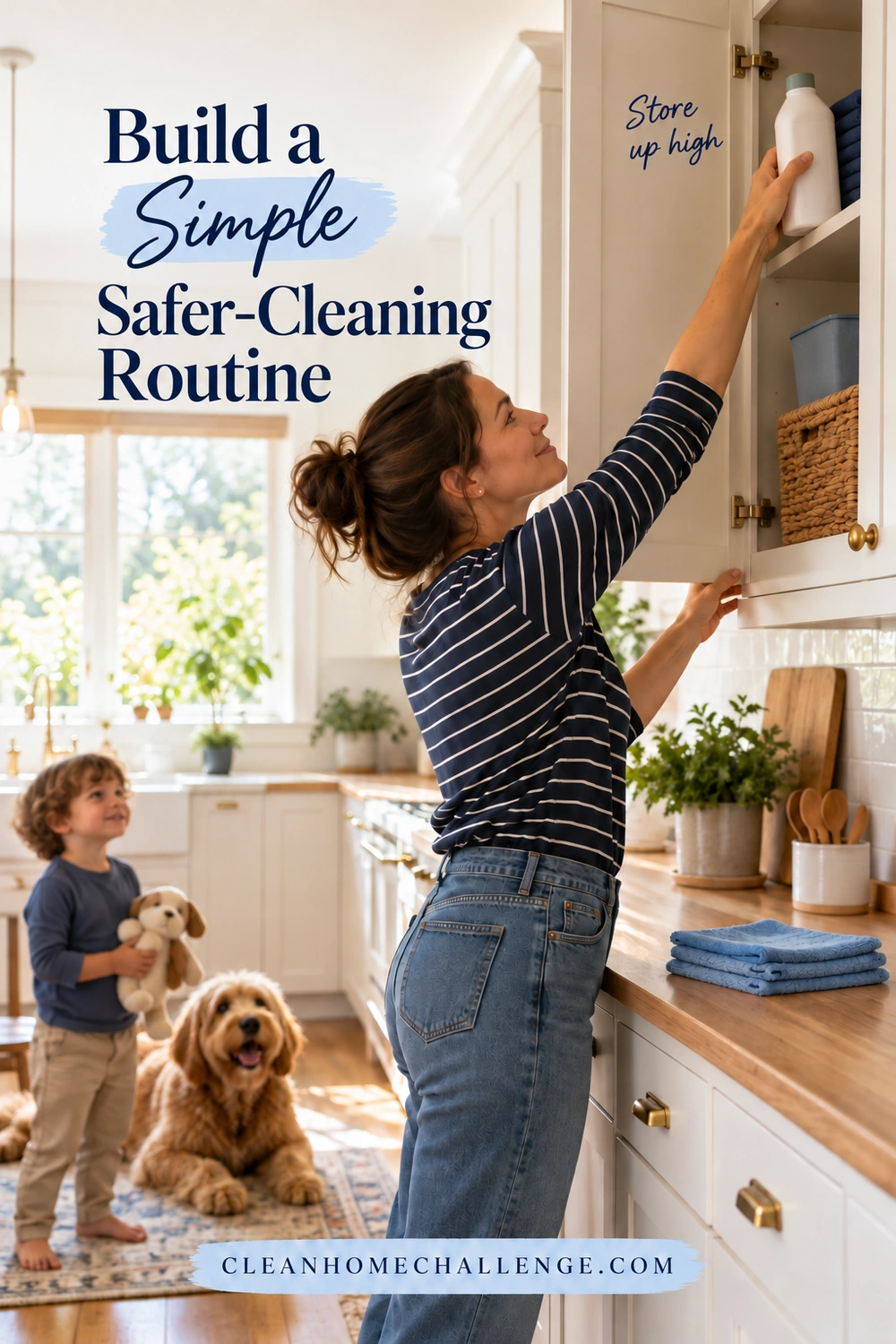
Keep products in their original labeled containers. For manufacturer-directed dilution or refill systems, use the specified container and labeling method; never use food or drink containers. Store cleaning supplies securely away from children and pets.
Follow label requirements for gloves, eye protection, and ventilation. Do not mix cleaners or add fragrance oils, vinegar, or another product to a certified formula. The certification does not apply to a homemade mixture you create afterward.
If a new product requires a compatibility test, choose the inconspicuous area specified by the product or surface manufacturer and evaluate it before wider use. A test does not override an explicit warning against using the cleaner on that material.
Fit the check into your week
On your next shopping-list day, spend a few minutes checking the one product you plan to replace. On cleaning day, follow the established directions rather than revisiting every certification.
A simple household note can say which product belongs with which task. Keep the full label available for the details, especially disinfectant contact times and food-contact rinsing requirements. Anyone helping should know where to find those instructions.
Keep the goal realistic
You do not need to memorize every standard or prove that one product is the safest on the market. You need enough reliable information to make a reasonable choice for the job in front of you.
Recognize the mark, verify the exact product, understand what was assessed, and follow the directions. That small habit makes safer cleaning product certifications useful in a real family home, without turning a simple restock into another overwhelming chore.
CLEANERS CLUBHOUSE
Build a Safer, Simpler Cleaning Routine
Clean confidently with practical guidance that helps you choose sensible products and use them correctly. The Cleaners Clubhouse combines safer cleaning support with realistic routines, worksheets and challenges.