

THIS POST MAY CONTAIN AFFILIATE LINKS. PLEASE READ MY DISCLOSURE FOR MORE INFO.
Vomit on the carpet is one of those jobs you want finished before you have even started. You may be looking after a sick child, checking on a pet, or discovering a dried patch behind the sofa. The goal is straightforward: remove the mess, treat what remains, and let the carpet dry properly without turning a small accident into a larger wet area.
If you need to know how to clean vomit from carpet, start by wearing gloves, lifting the solids, and blotting up liquid. Then use a cleaner approved for that carpet, remove residue as directed, and dry the area thoroughly. A lingering smell needs investigation rather than another layer of fragrance.
There is an important extra step when a stomach bug may be involved. Removing a stain or odor does not prove that infectious contamination has been dealt with. Read the stomach-bug section before choosing equipment or chemicals, and keep children and pets away while you work.
Disclosure: This post may contain affiliate links. As an Amazon Associate, Clean Home Challenge earns from qualifying purchases. If you make a purchase through these links, we may earn a small commission at no extra cost to you. This helps us keep creating practical cleaning tips, routines and resources for busy families! 🧽
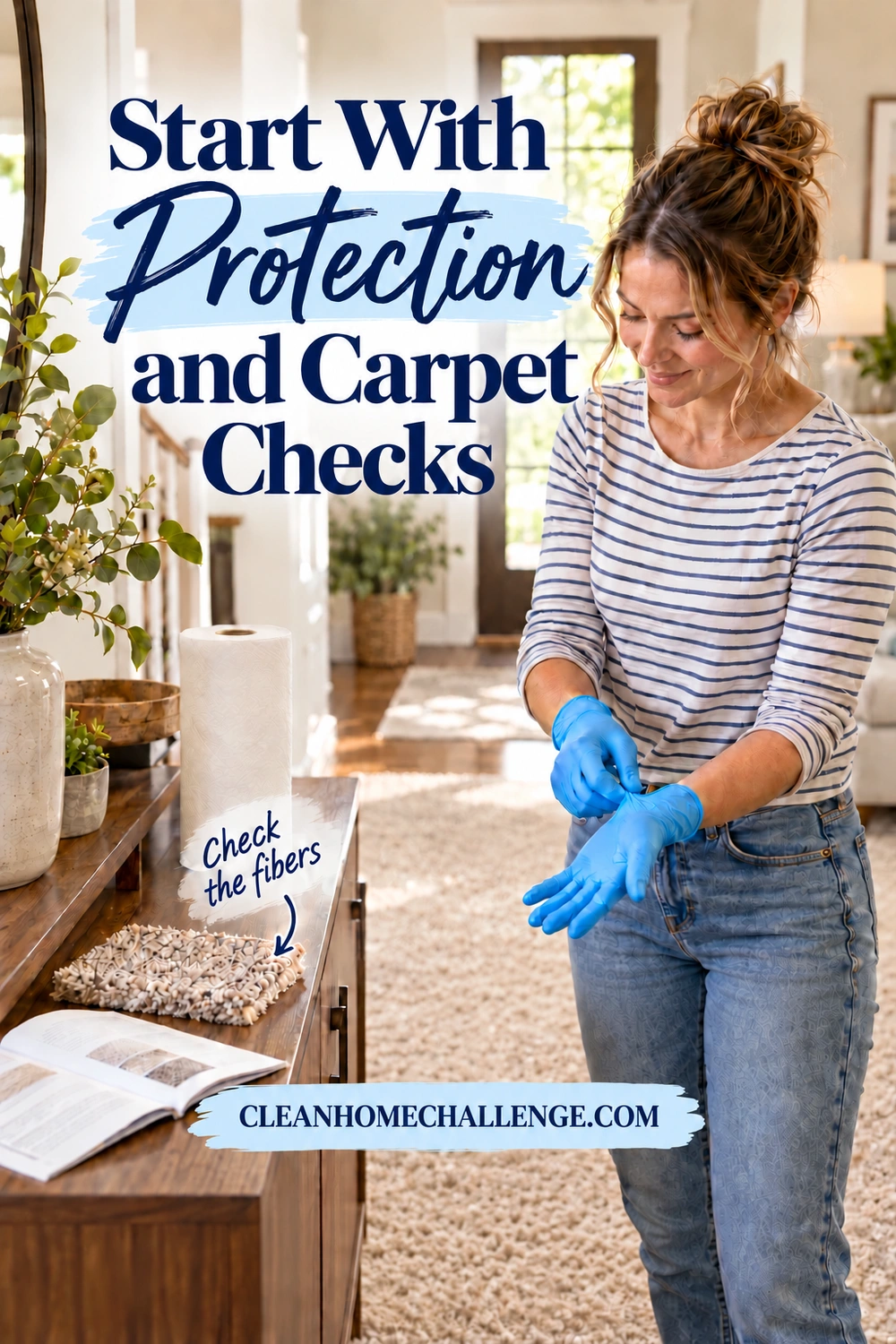
Start With Protection and Carpet Checks
First, make a little working space. Move people and pets away, stop a robot vacuum from entering, and put a trash bag within reach so you are not carrying dirty towels across the room. Open a window if conditions allow. Avoid pointing a fan at an untreated spill.
Wear disposable or washable protective gloves. If there is a substantial spill or a risk of splashing, use additional protection appropriate to the job, including eye protection and a mask. OSHA’s norovirus guidance describes protective clothing and splash protection for heavily contaminated cleanup. Do not touch your phone, face, or clean supplies with dirty gloves.
Gather a small kit:
- White paper towels or clean white absorbent cloths
- A rounded spoon or a disposable stiff card for lifting material
- A sealable trash bag
- A carpet-compatible spot cleaner in its original labeled container
- A small bowl of clean water, if water cleaning is permitted
- Extra dry towels and the carpet’s care information
Check the fiber and backing before choosing the cleaner. Look at the rug label, installation paperwork, retailer information, or manufacturer’s website. Synthetic carpet, wool, and plant-fiber rugs can need different treatment; appearance alone is not a reliable identifier.
For wool or wool blends, choose a specifically wool-approved method. For silk, sisal, jute, delicate handmade rugs, or an unknown valuable rug, contact a specialist before wet treatment. The Carpet and Rug Institute’s care guide emphasizes material-specific care, particularly for natural fibers.
Think about the cause without trying to diagnose it. A known isolated spill and vomiting during a household stomach illness are different cleanup situations. If infection is possible or the cause is unclear, use the extra precautions below.
This preparation need not become a cupboard-clearing project. A bag, gloves, absorbent towels, and the correct product are more useful than six cleaners gathered in a hurry. If another adult is available, ask them to handle the child or pet while you keep the cleanup area contained.
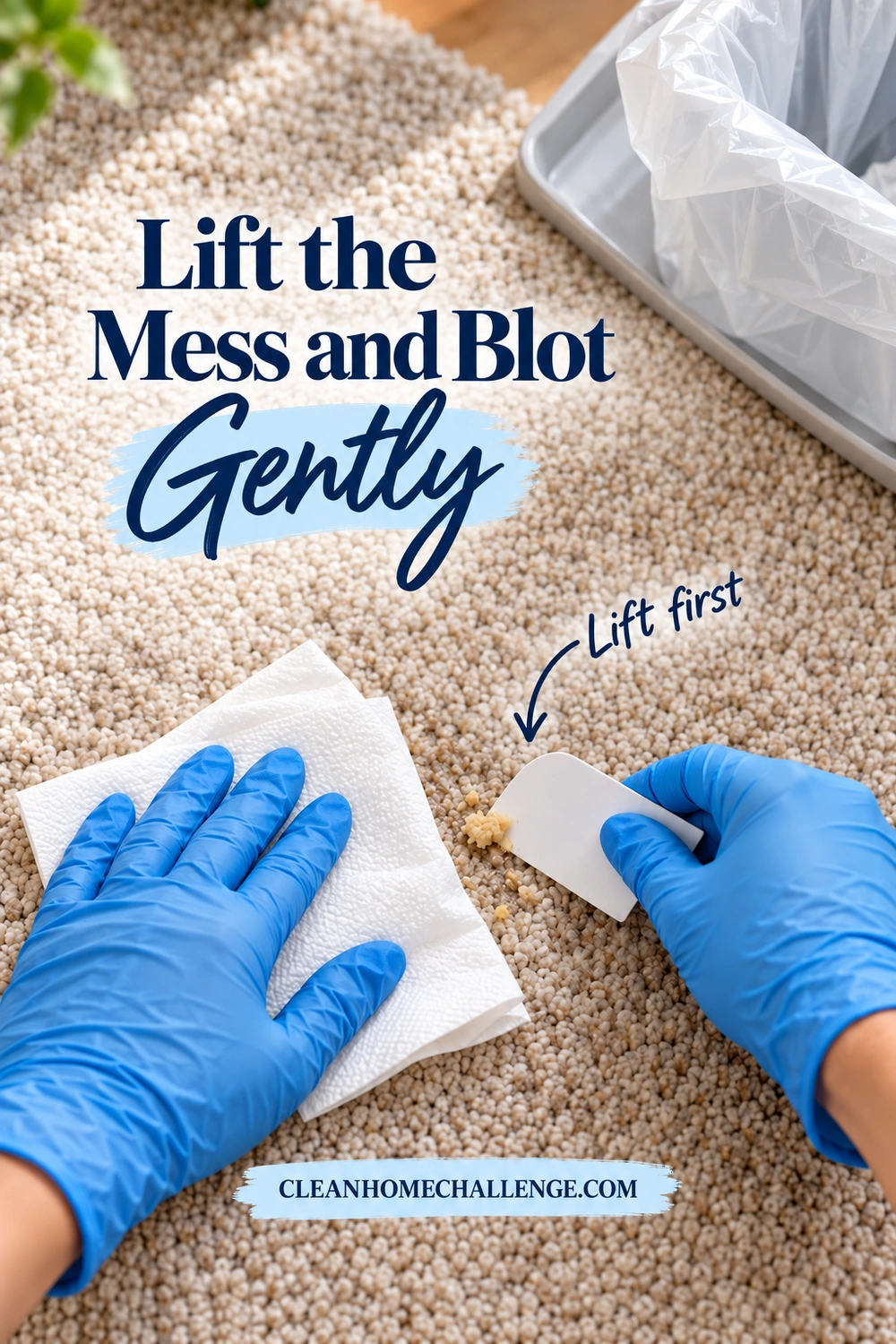
Lift the Mess and Blot Gently
Work promptly, but keep the movement slow. The first task is to remove material, not spread cleaner through it.
- Lift any solids. Use the edge of a rounded spoon or stiff card to lift material onto paper towels. Keep the tool close to the carpet and avoid flicking or dragging the mess across clean fibers.
- Bag the waste immediately. Place used towels and disposable lifting tools directly into the bag. Keep its outside as clean as possible.
- Blot the liquid. Lay a folded white towel over the remaining wet area and press gently. Lift it straight up, refold to a clean part, and repeat with fresh towels as needed.
- Work toward the center. Start around the visible edge and move inward so you are not pushing liquid into a wider ring.
- Check nearby surfaces. Look for small splashes on furniture legs, baseboards, or the side of a bed. Treat each surface according to its material and the contamination involved.
Keep scrubbing brushes out of this first stage. Shaw’s carpet-care guidance recommends blotting rather than abrasive rubbing, which can damage the pile. A fuzzy-looking patch after cleaning may be physical fiber damage rather than a stain that needs more product.
If the vomit has already dried
Do not brush it into dust or use a household dry vacuum to collect it. Carefully lift loose material by hand with your protected cleanup tools. If the carpet allows water cleaning, use a lightly dampened cloth to soften material still attached to the pile, then lift and blot. Work a little at a time rather than flooding the patch. If it does not release gently, stop and get material-specific advice.
Health guidance for contaminated carpet specifically warns against dry vacuuming because it can disperse contamination. The Montana public-health guide distinguishes this from ordinary routine vacuuming. The advice to vacuum dry household debris should not be borrowed for dried vomit.
You do not have to make the carpet look perfect at this stage. Removing the bulk of the mess and keeping it contained gives the next treatment a much better starting point.
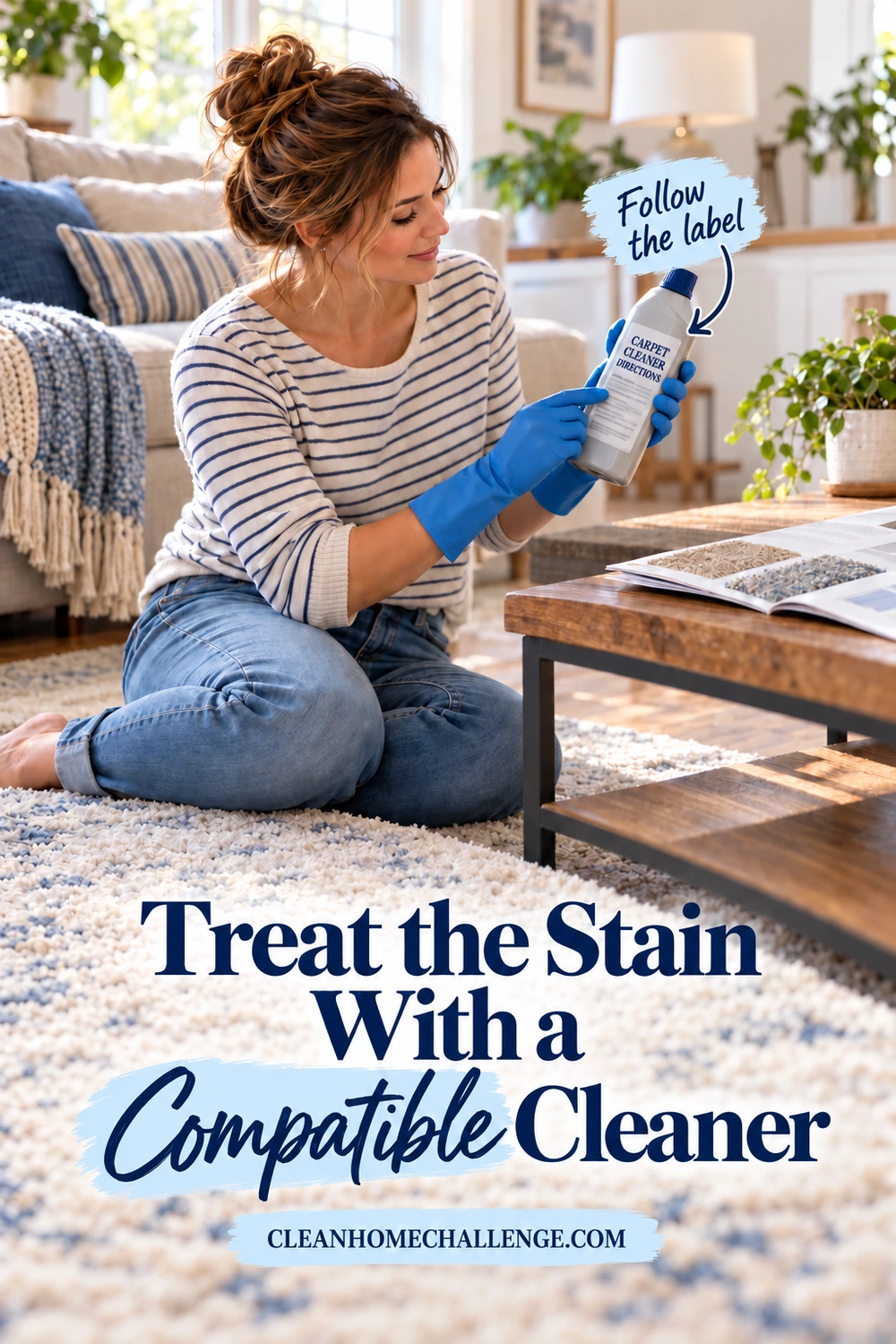
Treat the Stain With a Compatible Cleaner
Choose one approach that matches the carpet and the remaining soil. A carpet spot remover labeled for organic or vomit stains is a practical starting point, provided the carpet manufacturer permits it. Read the complete directions, including dilution, application method, dwell time, rinsing, and restrictions.
Patch-test first. Apply the product as directed in an inconspicuous location. Check for color transfer to a white cloth, altered texture, or a lighter patch, and allow the test area to dry before judging the result. A successful test reduces uncertainty; it does not override a care-label prohibition.
For a conventional blot-on spot cleaner, apply the specified amount, wait for the labeled time, and blot with a fresh white cloth. Some products belong on the cloth; others require direct application. Follow the actual bottle rather than assuming every cleaner uses the same method. Keep dirty cloth surfaces away from clean carpet.
Can you use diluted dish soap?
Only if the carpet’s care instructions permit it. Shaw gives a spot-cleaning dilution of 1/4 teaspoon of clear hand-dishwashing detergent in 1 cup of warm, not hot, water. Apply a little with a cloth and remove detergent afterward with small amounts of clean water and repeated blotting. This is a conditional fallback, not a recipe for every rug. Use a suitable clear detergent without bleach; avoid automatic dishwasher detergent and laundry detergent. Shaw’s detergent instructions explain the measured solution and rinse step.
Do not interpret “a little soap” as a generous squirt. More foam means more residue to remove, which can mean more water in the carpet.
What about wool and enzyme cleaners?
Wool requires product-specific checking. It is inaccurate to say that every enzyme cleaner destroys wool, but equally inaccurate to say that all are suitable. WoolSafe’s research explanation says enzyme-containing products can qualify for approval, while unsuitable concentration or prolonged exposure can damage the fiber. Choose a WoolSafe-approved product compatible with the carpet and follow its directions precisely, including rinsing where required.
If the first treatment is still transferring stain to the cloth, continue only within the label’s instructions. If improvement stops, do not automatically switch to something stronger.
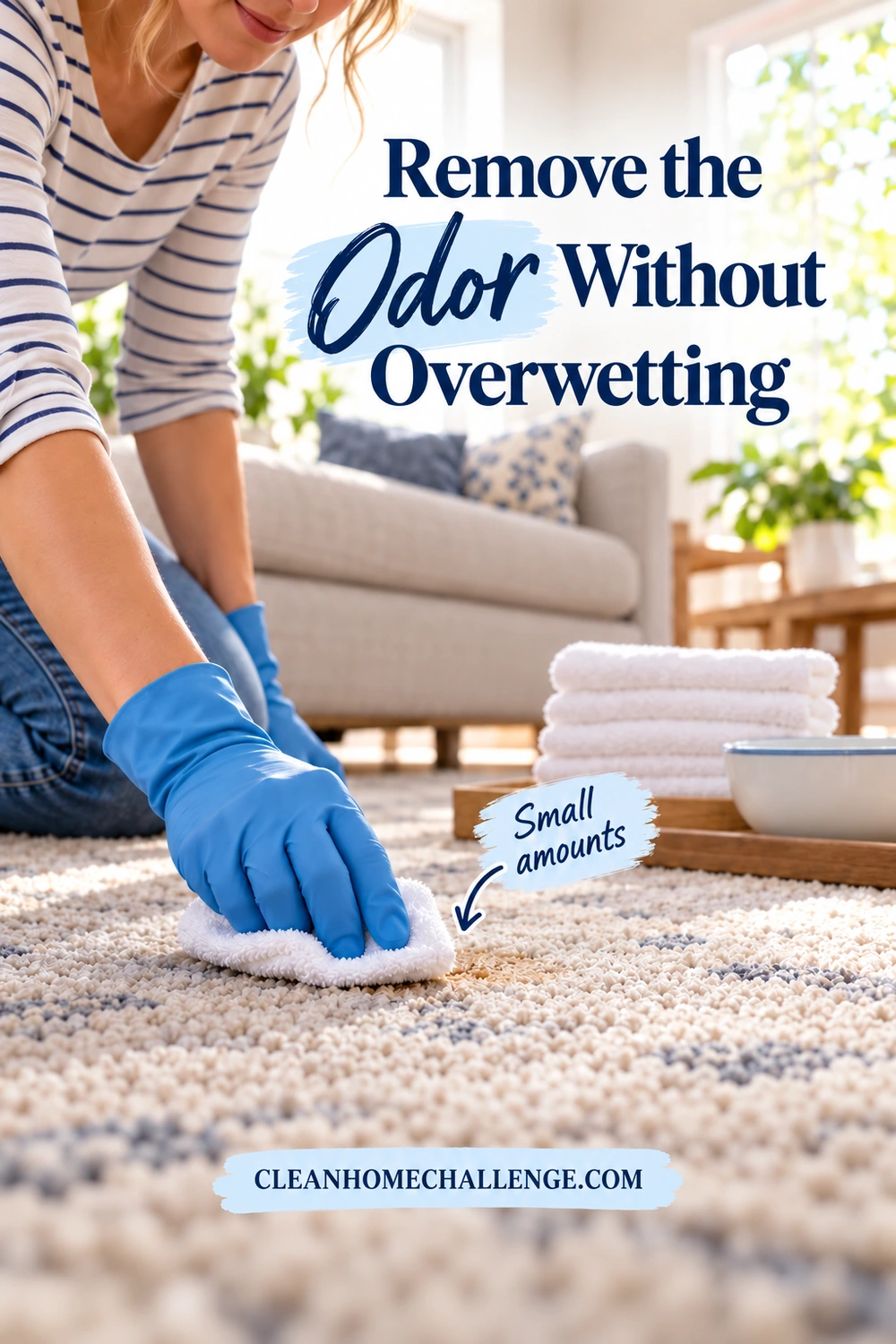
Remove the Odor Without Overwetting
A carpet can look cleaner while still holding some of the material that caused the smell. Adding fragrance does not tell you whether that residue has been removed. Aim to clean the source and recover the dirty moisture, rather than making the room smell strongly of a second thing.
An enzyme-based carpet treatment can be useful for compatible organic stains. Choose a product whose label covers the surface and type of mess, then allow the stated working time. Some require a longer treatment period than ordinary spot cleaners. There is no universal “leave it for ten minutes” rule, and more time is not automatically better.
Do not layer an enzyme cleaner over bleach, disinfectant, vinegar, or another treatment. Follow the product’s instructions about previous cleaners and rinsing. If you have already used several products, tell the manufacturer or professional cleaner exactly what they were before continuing.
Using a portable carpet extractor
For an ordinary stain on compatible carpet, a portable extractor can help remove dirty liquid after visible material has been lifted. BISSELL’s vomit-cleaning guidance explains the role of a suitable machine and formula. Its product recommendations concern stain and odor removal; they do not establish norovirus disinfection.
- Confirm that both the machine and its formula suit the carpet.
- Use only the formula and water temperature permitted by the machine instructions.
- Apply controlled amounts of solution instead of repeatedly spraying the same patch.
- Make the recommended extraction passes to recover moisture.
- Stop if the carpet is becoming wetter without useful recovery.
A household dry vacuum, a wet/dry shop vacuum, and a carpet extractor are different tools. A machine’s ability to pick up water does not establish that it is suitable for infectious body-fluid cleanup. If a stomach bug is suspected, discuss that specifically with a professional before putting contamination through a consumer machine.
Once ordinary spot cleaning is finished, follow the equipment’s tank, hose, and tool-cleaning instructions. BISSELL’s Little Green Mini care instructions, for example, include rinsing components and drying tanks before storage. Do not leave dirty recovery water sitting in the machine or improvise by sucking bleach through it.
For future everyday spills, our carpet spot-cleaner guide can help you compare practical features. Buying a machine is not a requirement for managing one small surface accident.
Handle Suspected Stomach-Bug Contamination
If someone has vomited during a suspected stomach illness, separate the appearance of the carpet from the infection-control question. Clean-looking, dry, and odor-free are not proof of disinfection. You cannot identify norovirus or confirm its removal by sniffing the carpet.
Cleaning removes soil and some germs. Sanitizing and disinfecting make different, specific germ-reduction claims. An odor remover or a product labeled to sanitize carpet is not automatically a norovirus disinfectant.
CDC’s norovirus prevention guidance calls for prompt cleanup, gloves, careful waste disposal, and appropriate disinfection after vomiting or diarrhea. Wash hands with soap and water for at least 20 seconds afterward. Hand sanitizer alone does not work well against norovirus.
Treat carpet and hard surfaces differently
Do not pour a hard-surface bleach recipe onto carpet. Bleach can damage fibers or remove color, and a hard, nonporous-surface disinfection instruction does not become suitable for absorbent carpet simply because both are in the same room.
For affected compatible hard surfaces, select an EPA-registered product with directions against norovirus and follow the surface, dilution, ventilation, protective-equipment, and wet-contact-time requirements. EPA’s List G helps identify products by registration number. Check the actual label: a listing for hard surfaces or laundry does not establish a claim for carpet.
For carpet, tell a qualified cleaner that the problem is suspected infectious vomit, not merely a stain. Ask how they will handle the carpet, backing, surrounding area, and contaminated equipment. Public-health authorities such as the Oregon Health Authority describe controlled steam treatment for contaminated carpet. Those instructions depend on treatment temperature and exposure time, not just a machine having “steam” in its name.
A quick pass with a household steam mop, warm-water extractor, or upholstery attachment cannot be assumed to meet those conditions. Heat and moisture may also be unsuitable for a particular rug. Where an appropriate method cannot be verified, keep the area out of use and ask the carpet manufacturer, a qualified cleaner, or your local health department for advice. Do not try to achieve a temperature target by pouring boiling water onto the floor.
Handle contaminated washable textiles without shaking them. Bag them where they are removed, keep them separate from clean items, and follow CDC’s laundering guidance alongside their care requirements. If a delicate item cannot tolerate the required treatment, ask for professional advice rather than assuming a cool wash disinfects it.
Dry the Carpet and Check the Result
Drying is part of the job. A small treated patch should not be left under a stack of permanently damp towels or covered with a rug to hide it.
After the cleaning product has had its required working time and any required rinse is complete, blot out remaining moisture with fresh dry towels. Remove wet towels promptly. For compatible carpet cleaned with an extractor, finish with the manufacturer’s recommended moisture-recovery passes rather than another spray cycle.
Once contamination has been appropriately dealt with, encourage ventilation and drying. Use normal room airflow, a dehumidifier, or air conditioning when helpful. A fan can assist a cleaned area; avoid blowing across untreated infectious material. Keep cords and equipment away from wet surfaces and out of children’s reach.
The Carpet and Rug Institute’s care guide recommends drying carpet within 12 hours after cleaning. Treat that as a useful target, not a promise: thickness, humidity, water volume, backing, and airflow affect the actual time. If the area remains wet into the next day, seek help rather than continuing to add liquid.
Keep feet, paws, furniture, and play mats off the patch until it is completely dry and the product’s re-entry directions are satisfied. For a removable rug, check the underside and the floor beneath it when it is safe to do so; a dry-feeling top does not tell you everything about trapped moisture.
Recheck after it has dried
Stand in the room normally instead of putting your face close to the carpet. Note whether the odor is gone, whether the color looks even, and whether the patch feels sticky or stiff once safe to touch.
- A sticky patch can mean cleaning residue needs attention.
- A returning ring may mean material is moving upward as moisture dries.
- A persistent sour smell may come from remaining contamination or excess moisture.
- A lighter patch may be color loss, which further cleaning will not restore.
These are clues, not a remote diagnosis. CRI’s explanation of carpet-cleaning science links inadequate rinsing and overwetting with avoidable cleaning problems. If you cannot tell which issue you have, stop and get advice before repeating the whole process.

Avoid Fixes That Make Things Worse
When an unpleasant smell lingers, a stronger treatment can feel tempting. These shortcuts usually make the next decision harder.
Covering the spill with baking soda
Baking soda is not a substitute for removing vomit, and it does not establish norovirus disinfection. This guide does not require a powder layer. It adds material you then need to remove, and dry vacuuming the contaminated area is the wrong cleanup route.
Do not assume every household vacuum can collect unlimited fine powder. For example, Dyson’s DC26 instructions limit fine-dust pickup to very small amounts. Check your own machine’s manual; avoid claims that baking soda is either harmless to every vacuum or guaranteed to destroy one.
Mixing cleaners or adding another product immediately
Never combine bleach with vinegar, ammonia, alcohol, or other cleaners. Do not layer them on the carpet either. Poison Control’s cleaning-safety guidance warns that mixed cleaners can release dangerous gases. Keep products in their original containers and put them away securely when finished.
Vinegar and baking soda are not a necessary “deep-cleaning” combination. Their fizz does not prove that the stain, odor source, or germs are gone. Choose the approved carpet-cleaning method instead of building a sequence of household experiments.
Pouring on water, heat, or concentrated cleaner
Boiling water, heavy saturation, vigorous brushing, and stronger-than-directed solution are not useful ways to make up for uncertainty. You may create a damaged patch or spread moisture into backing that was previously dry. Avoid a hot hair dryer aimed closely at the stain; removing moisture and allowing controlled drying is a better plan.
Treating every discoloration as removable dirt
A remaining yellow or pale mark might be a stain, a changed dye, or damaged fibers. Stop when a compatible treatment no longer improves the result. An “oxy” label does not mean a product is color-safe on all carpets, and plain household hydrogen peroxide is not a universal substitute for a formulated carpet cleaner.
The simplest way to avoid a chemical guessing game is to record what you used. Keep the bottle available if you need to call for advice, including how much you applied and whether you rinsed it.

Know When to Call a Professional
A small, fresh surface accident on a known, water-cleanable carpet may respond to careful spot cleaning. Professional help becomes more useful when the uncertainty is underneath the pile or in the material itself.
Call sooner if:
- The carpet is wool, silk, sisal, jute, handmade, delicate, or difficult to identify and you cannot verify a suitable treatment
- The spill was large, reached a seam, or may have soaked into the backing or padding
- Odor returns after the carpet has dried fully
- A patch keeps reappearing, stays wet, changes color, or becomes distorted
- Several cleaners have already been applied
- Infectious contamination is possible and you cannot verify appropriate treatment
Persistent odor does not automatically mean the whole carpet must be replaced. It does mean another surface spray may miss the problem. A professional can assess whether the affected layers are cleanable, whether local padding replacement is needed, or whether damage to the carpet itself changes the options.
Be specific when booking: “There was vomit on this carpet, this is when it happened, these are the products used, and a stomach illness may be involved.” Ask whether the service addresses that type of contamination. Ordinary carpet cleaning and specialist contamination work may differ in equipment, procedures, and scope.
Get the proposed treatment, likely limitations, drying expectations, and price before the visit. For a valuable rug, ask about experience with that material. A responsible cleaner should not promise every mark will disappear before assessing it.
Make the next cleanup easier
Restock a small spill kit with gloves, white towels, bags, and one verified carpet cleaner. Keep the care instructions somewhere easy to find. During a household illness, keep a washable bowl or appropriate container nearby and prioritize looking after the person who is unwell.
Use your Friday floor routine for checking supplies and ordinary maintenance, while handling accidents when they occur. Once this incident is resolved, our high-traffic carpet guide covers everyday care without turning every spill into a whole-room project.
The manageable goal is a contained cleanup, a material-safe treatment, proper drying, and an honest recheck. If the smell remains, changing the plan is more useful than repeating the same spray-and-scrub cycle.
CLEANERS CLUBHOUSE
Stay on Top of Floors Without Cleaning All Day
Give your floors a focused Friday reset instead of chasing every mark all week. The Cleaners Clubhouse helps you build a realistic routine with practical guidance, printables and monthly challenges.