

THIS POST MAY CONTAIN AFFILIATE LINKS. PLEASE READ MY DISCLOSURE FOR MORE INFO.
An electric spin scrubber looks tempting when the shower needs attention and your energy is already spoken for. A brush that turns while you guide the handle could make a tiresome job more manageable. But the useful question is whether it solves the cleaning problem you actually have.
For busy households, the strongest reason to buy one is a recurring scrubbing job on a surface that permits powered brushing. The weakest reason is a dramatic before-and-after video that leaves out the cleaner, preparation, and cleanup.
This is a research-backed buying guide, not a hands-on product test. Here is how to decide whether a cordless cleaning brush deserves a place in your cupboard, and how to use one without creating extra work or damaging a finish.
Disclosure: This post may contain affiliate links. As an Amazon Associate, Clean Home Challenge earns from qualifying purchases. If you make a purchase through these links, we may earn a small commission at no extra cost to you. This helps us keep creating practical cleaning tips, routines and resources for busy families! 🧽
Are Electric Spin Scrubbers Worth It?
Electric spin scrubbers can be worth it when repeated hand scrubbing is the difficult part of your routine, your surfaces allow powered brushing, and the tool feels comfortable to control. They are less compelling when you mostly wipe small areas, need very precise cleaning, or would struggle with another tool to charge, rinse, and store.
The motor supplies movement. You still choose the cleaner, cover the area, remove the dirty liquid, rinse when required, and dry the surface. A basic spin scrubber does not collect wastewater like a wet-dry floor cleaner. Foam moving around the shower is not the same as soil being removed from it.
Try this three-question check before shopping:
- Which repeat job would I give it? Name one real task, such as scrubbing compatible shower tile each week.
- What makes that task hard? Repeated brush strokes, awkward reach, stubborn deposits, and lack of time are different problems. A motor may help with the first two; it does not automatically solve the others.
- Where would I clean and keep the tool? Include a drying place and a safe charging location, not just a cupboard slot.
A worthwhile purchase may make a job feel more manageable without making it dramatically faster. Count the complete session, including setup and tool care, when judging value. You do not need to replace a manual brush that already works well for you.

Where a Spin Scrubber Helps Most
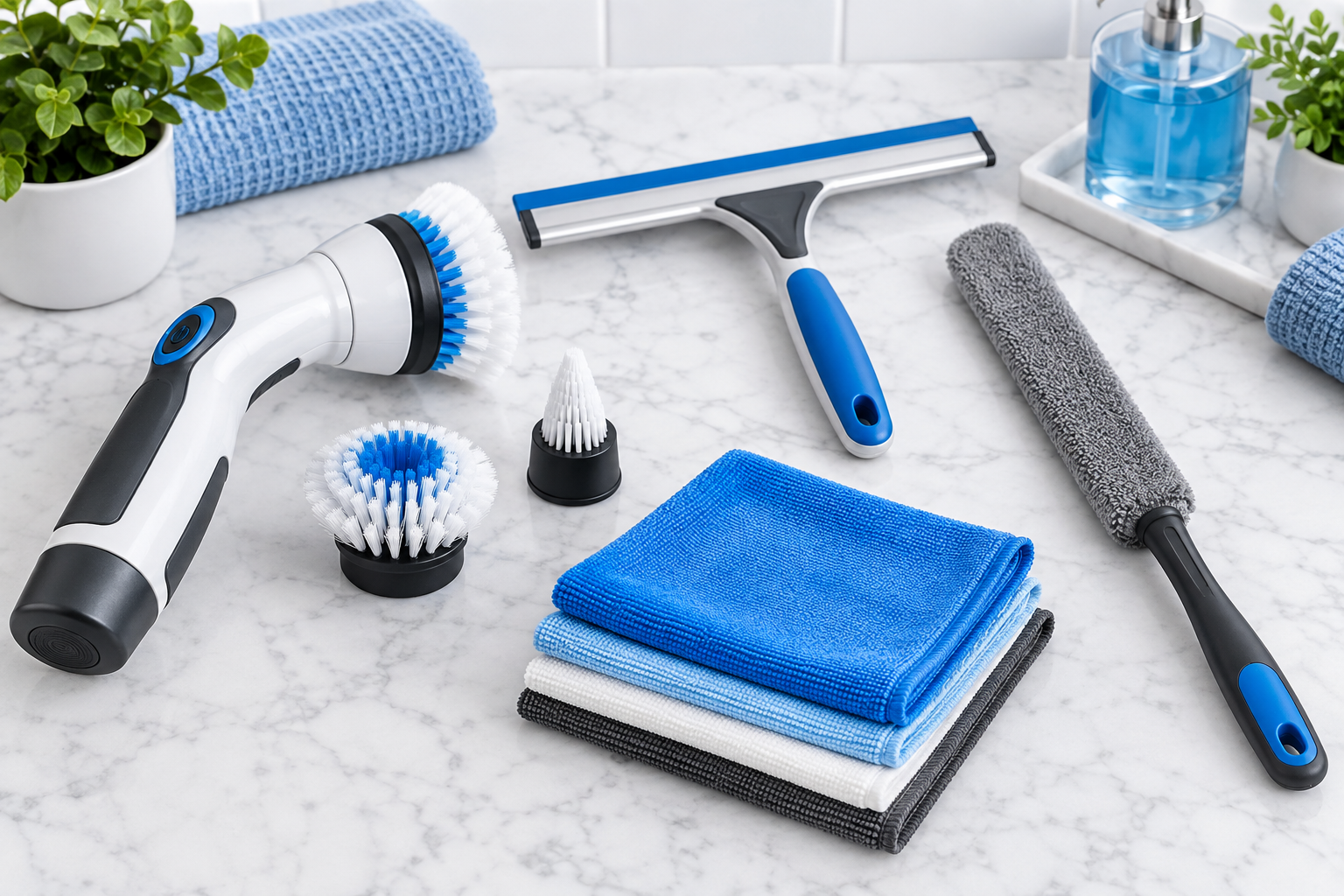
Long-handled spin scrubber: Consider this format for repeated work across accessible tile walls or other approved broad surfaces. Adjustable length and head angle can help you position the brush without reaching quite as far. Check whether you can guide it around the actual layout of your bathroom, including shower doors and tight corners.
Compact powered detail brush: Consider a smaller tool when your main task is a narrow groove or a short grout line. Some powered detail brushes oscillate rather than spin. For example, Rubbermaid describes its Reveal-style Power Scrubber as oscillating and AA-battery powered. It is a different format from a rechargeable pole scrubber, so compare the job each can reach rather than treating them as identical products.
Manual long-handled brush: Consider this first if reach is the main issue. It removes charging from the routine and gives direct control over pressure. It still needs a suitable head, a compatible cleaner, rinsing, and somewhere to dry.
Soft cloth or non-abrasive sponge: Keep these for finishes whose care instructions call for gentle wiping, as well as quick maintenance. A powered tool is unnecessary if the residue wipes away readily.
Be realistic about comfort. An extended tool still has weight, and you must resist its movement while steering it. A long handle can feel awkward above shoulder height or in a small shower. If possible, assess the assembled tool, with its battery and chosen head, before committing. Stop if using it causes discomfort; a scrubber is not a treatment for joint or back problems.

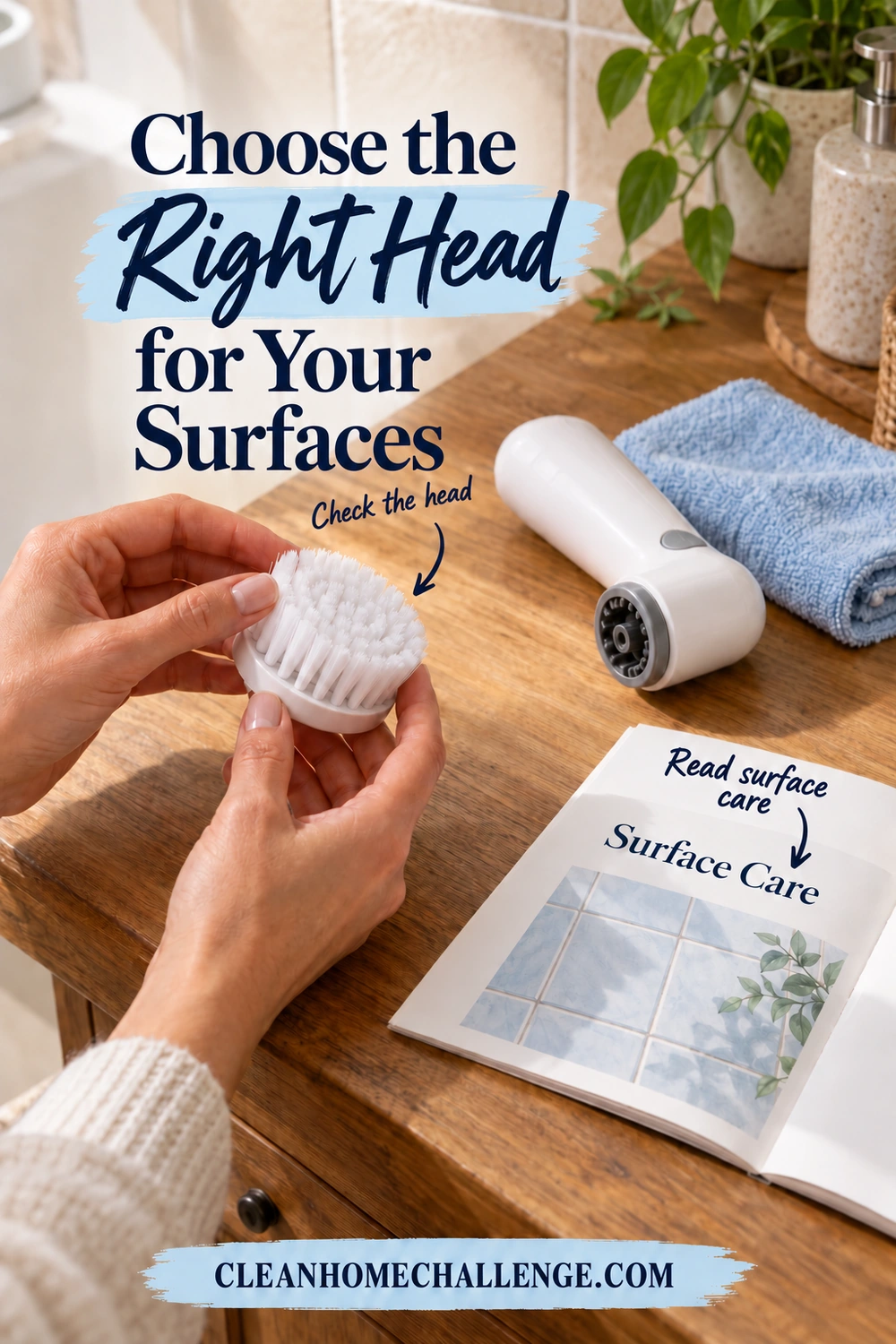
Choose the Right Head for Your Surfaces
Check three things together: the surface maker’s care instructions, the scrubber attachment instructions, and the cleaner label. A brush marketed for bathrooms is not automatically suitable for every material in your bathroom.
Tile and grout
For tile that allows powered brushing, a broad flat head can cover open areas; a narrower head can follow an approved grout-cleaning task. Choose the least aggressive compatible attachment. Do not judge stiffness by color alone, because brands use different color systems.
Check for loose, cracked, or deteriorating grout before starting. Avoid forceful brushing over damaged joints or silicone seams. Our bathroom grout-cleaning guide explains the material checks and gentle starting methods in more detail.
Acrylic, fiberglass, and refinished tubs
These need their own care instructions. Do not assume a soft-looking powered brush is acceptable. Sterling’s acrylic-bath guidance, for example, specifies a soft, damp cloth or sponge and says not to use brushes or scouring pads. A tub manufacturer’s restriction takes priority over a scrubber advertisement. Refinished surfaces may have a separate care sheet from the refinisher.
Shower glass and metal finishes
Use manual wiping unless the specific surface and attachment guidance permit a powered method. Delta’s shower-door care instructions call for non-abrasive cloths or sponges and warn that aggressive brushes can damage its protective coating. A pad labeled “non-scratch” is not a universal guarantee for coatings, polished metal, or nearby hardware. For gentle starting steps, see our guide to removing soap scum from shower glass without scratching.
Natural stone and unfamiliar surfaces
Pause until you identify the material. The Natural Stone Institute warns that acidic products, including vinegar and lemon, can dull or etch acid-sensitive stone. Scrubbing harder does not make an incompatible cleaner safe. Wood, laminate, painted surfaces, appliance finishes, and nonstick cookware also need explicit approval for the proposed method.
Where the method is allowed, test a small hidden area with the actual head and cleaner, then rinse, dry, and inspect it. Do not use a successful patch test to override an instruction that prohibits brushing.
What to Check Before You Buy
Choose the features that solve your named job. A large accessory count is less useful than two suitable heads you can replace later.
Fit and control
Look for a handle length that suits your height and task, a head angle that reaches the surface, and controls you can operate without stretching. Check how securely the pole locks and whether the head is straightforward to remove when the tool is off. Think about carrying it, too: a comfortable floor-cleaning position may tell you little about holding it against a wall.
Parts and support
Find the exact replacement-head listing before purchasing. Confirm the connector, model number, availability, and cost. Similar-looking heads may not fit; BLACK+DECKER notes that attachment compatibility varies between its models. Check whether the battery is replaceable, what the warranty covers, and who provides support. Read the seller’s current return conditions before using the tool.
Battery and kit contents
Check whether the box includes a battery, cable, and required power adapter or charger. A “tool only” listing may need separately purchased equipment. Ask which speed and conditions were used for a claimed runtime; do not plan your whole cleaning session around an unexplained maximum. A remaining-charge indicator can be convenient, but it does not tell you how the tool will handle your particular job.
RPM is the number of rotations per minute, not a complete cleaning-performance score. Head shape, contact with the surface, control, and the cleaning method all matter. A higher number on a listing is not enough evidence to call one scrubber better.
Water protection by component
Read the exact model’s manual rather than relying on “waterproof” in a headline. The HOTO Flexi QWQJA08 manual, for instance, gives its main unit an IPX7 rating and its extension rod an IPX4 rating; the removable brush head is submersible. Those parts do not have identical protection. Other models have different limits. No scrubber rating makes its charger safe to wet.
Total ownership cost
Write down the complete purchase cost, any missing charging equipment, replacement heads or pads, and replaceable batteries if needed. Add the practical costs: drying space, storage, and maintenance. Do not assume all heads need replacing on a fixed schedule; inspect wear and follow the manufacturer. If the parts are difficult to obtain or the tool has no clear instructions, keep looking.

How to Use a Spin Scrubber Safely
Start with one manageable section so you can learn how the tool behaves. Set aside a little extra time for your first attempt rather than promising yourself a whole bathroom in a few minutes.
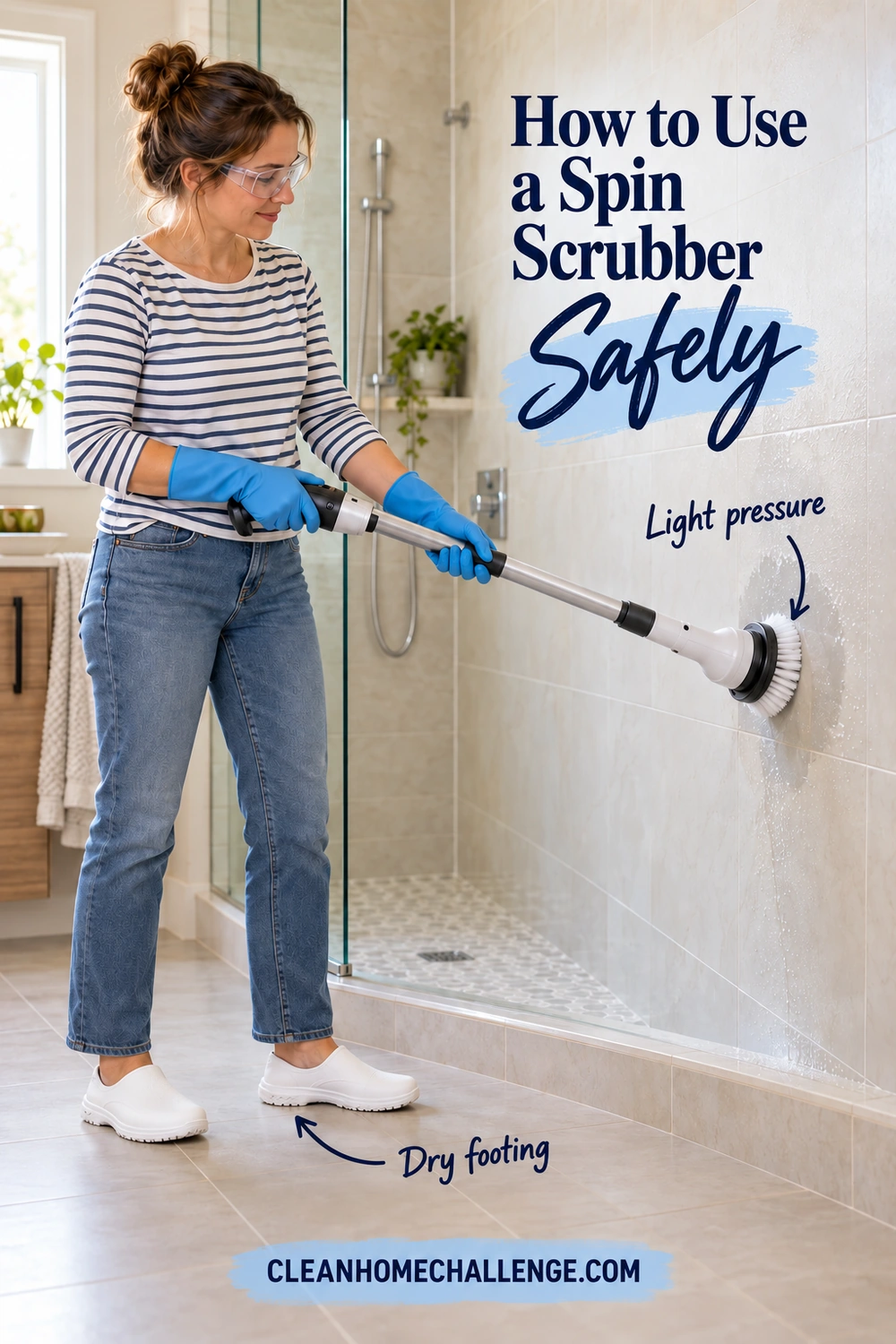
- Prepare the area and yourself. Move toiletries, pick up loose hair and grit, and protect nearby items from splashes. Ventilate the room and wear the gloves and eye protection required by the cleaner and tool instructions. Keep children and pets away from the work area. Stand on a stable, dry surface; do not balance on a tub rim or stretch beyond comfortable reach.
- Inspect and assemble with the power off. Check the housing, head, seals, and cable for damage. Fit the compatible attachment and secure the handle. Remove a detachable battery before adjustments when the manual requires it. Secure any charging-port cover or battery door before wet use, and keep loose hair and clothing away from the moving head.
- Apply one suitable cleaner as directed. Follow its dilution, application, and wait-time instructions. Do not invent a universal soaking time or let a product dry on the surface against its directions. Never mix products, including bleach with vinegar, ammonia, or another cleaner. Follow both product and scrubber restrictions; some tools prohibit strong acidic or alkaline detergents.
- Guide the head with light pressure. Follow the tool’s starting instructions. Keep the brush over the intended area, move steadily, and avoid staying in one spot. The RYOBI P4500 manual cautions against pressing down or holding the tool in one place because the surface can be damaged. If the brush slows, skitters, or catches, switch off and reassess rather than leaning harder.
- Remove the loosened dirt. Stop the head before lifting it away or changing attachments. Rinse the surface as its instructions require, or collect residue with clean damp cloths where appropriate. Refresh the cloth or rinse water so you are not spreading dirty solution back over the area. Wipe splashes and dry the floor before anyone walks through.
- Check the dry result. If a mark remains, identify it before repeating. Scale, staining, worn finish, and damaged grout do not all respond to the same treatment. A spinning brush cannot repair deterioration. Stop if you see dulling, scratches, loose material, or color transfer.
Powered scrubbing is cleaning, not proof of disinfection. If disinfection is needed, use a suitable product separately according to its label, including the required wet contact time. The CDC’s home-cleaning guidance explains the distinction.
Clean, Dry, Charge, and Store It
Tool care is part of the job, so leave yourself enough time to do it before putting everything away.
Clean the head. Switch off, wait for all movement to stop, and disconnect or remove power as directed. Detach the head if the manual permits it. Remove hair and trapped debris, wash using the approved method, and rinse away cleaner. Do not put attachments in a dishwasher, soak them in disinfectant, or use boiling water unless their instructions specifically allow it.
Clean the body correctly. A damp-cloth wipe is a sensible starting point when that is what the manual specifies. Do not rinse or immerse the motor housing, handle, battery compartment, or controls just because the head can get wet. BLACK+DECKER’s general maintenance guidance separates rinsing detached heads from wiping the body; always check your model’s more specific instructions.
Let the parts dry. Set approved detachable heads where air can circulate. Avoid sealing wet accessories in a bag or closing everything into a damp cupboard. Keep bathroom heads separate from tools used on food-contact surfaces. A dedicated toilet brush is a simpler way to avoid moving a toilet-used attachment between rooms.
Charge away from the wet work. Make sure the tool, charging connection, cable, and your hands are dry. Follow the specified charger or adapter requirements and temperature limits. Do not use the scrubber while charging. Health Canada’s lithium-ion battery advice recommends charging where you can see the device and away from soft surfaces that trap heat. Follow the manual’s charging duration rather than a general “leave it overnight” rule.
Store and inspect. Once dry, store the tool and chemicals securely out of children’s and pets’ reach. Protect bristles from being crushed. Replace damaged attachments and stop using a damaged or swollen battery. If performance changes, check the manual’s troubleshooting steps; do not open a sealed battery or improvise a repair. Use local battery-recycling guidance at the end of its life.

Build a Routine That Needs Less Scrubbing
The easiest tool to maintain is the one with a clear job. Give a spin scrubber a specific place in your routine instead of bringing it out for every spot.
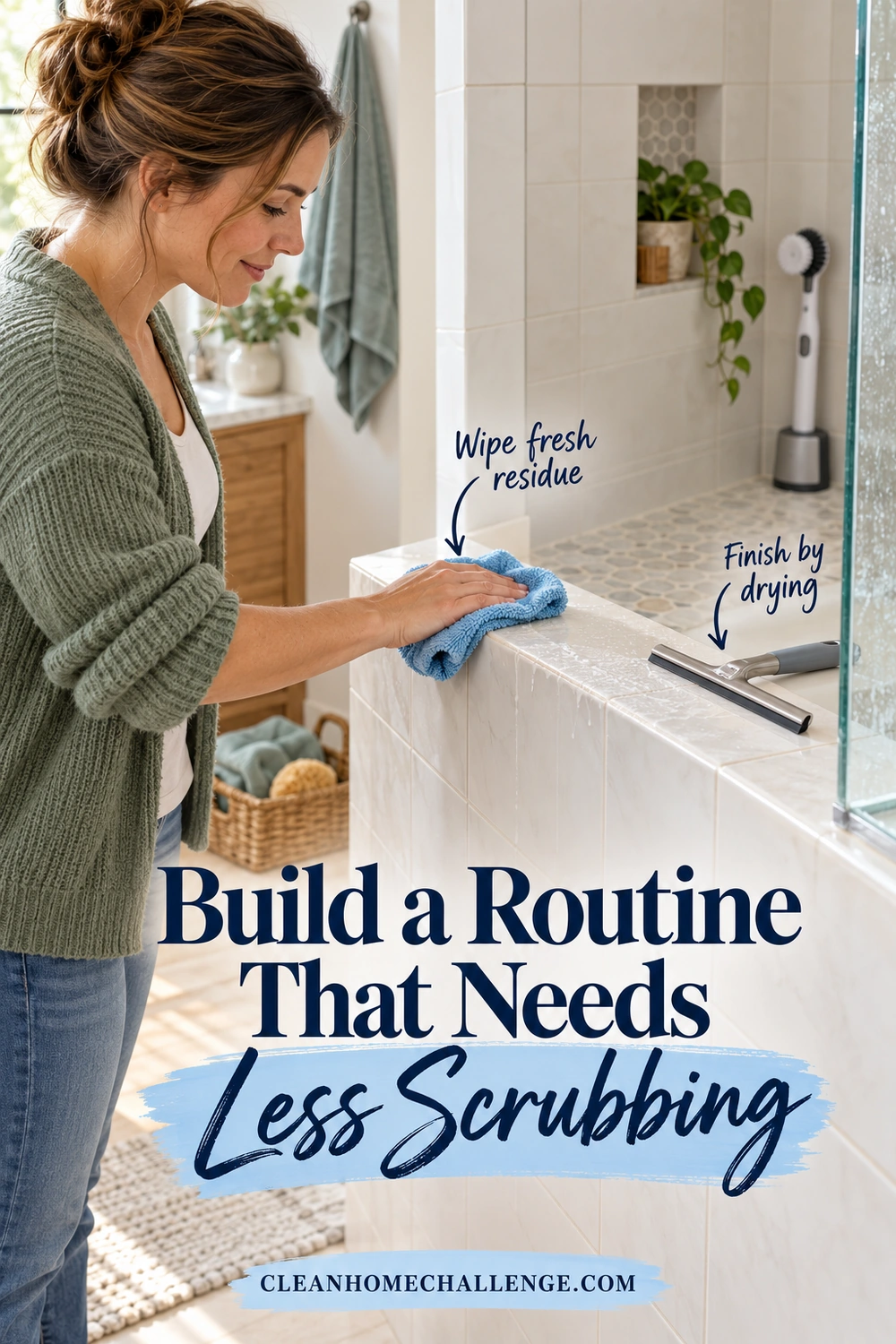
For Tuesday bathroom cleaning, choose one approved task: a section of tile, a compatible shower-wall area, or a few sound grout lines. Gather the cleaner, cloths, and rinse supplies before you start. Finish that section, rinse and dry it, then clean the attachment. A small completed area is useful even when the rest can wait.
Between deeper cleans, remove loose hair, wipe fresh residue using the surface’s recommended method, and dry water from suitable shower surfaces with a squeegee or cloth. Keep the manual detail brush for awkward edges. You may discover that regular gentle upkeep leaves little work for a powered tool, which is a good result too.
If you already own a scrubber, evaluate it over your next few ordinary cleaning sessions. Ask:
- Did I reach for it willingly?
- Did it make the specific task easier to manage?
- Could I control it comfortably without pressing hard?
- Were cleaning, drying, and storing it straightforward?
- Would a manual long-handled brush do this job just as well for me?
If you are still deciding whether electric spin scrubbers are worth it, choose based on those practical answers. Buy one for a repeat job on confirmed compatible surfaces, with usable replacement parts and a place to dry. Keep your current tools if they already make the routine manageable. A comfortably clean home does not require every cleaning gadget.

CLEANERS CLUBHOUSE
Use the Right Tools With a Routine That Works
Good cleaning tools work best when you know where and when to use them. Inside the Cleaners Clubhouse, recommended products sit alongside practical routines, printable worksheets and monthly challenges.