
THIS POST MAY CONTAIN AFFILIATE LINKS. PLEASE READ MY DISCLOSURE FOR MORE INFO.
Cleaning should leave your home feeling fresher, not stuffy. A little planning before you open a bottle can help move product vapors, spray droplets and disturbed dust out of the room while you work.
The right setup depends on the room, the weather, your ventilation system and the product label. Sometimes the answer is two open windows. Sometimes it is an outdoor-venting exhaust fan, a lower-spray method or waiting until outdoor air improves.
This practical guide explains how to create a clear airflow path without treating a fan or air cleaner as permission to overuse products. Follow the label, keep children and pets away from the work area, and never mix cleaning products.
Disclosure: This post may contain affiliate links. As an Amazon Associate, Clean Home Challenge earns from qualifying purchases. If you make a purchase through these links, we may earn a small commission at no extra cost to you. This helps us keep creating practical cleaning tips, routines and resources for busy families! 🧽
Why Ventilation Matters When You Clean
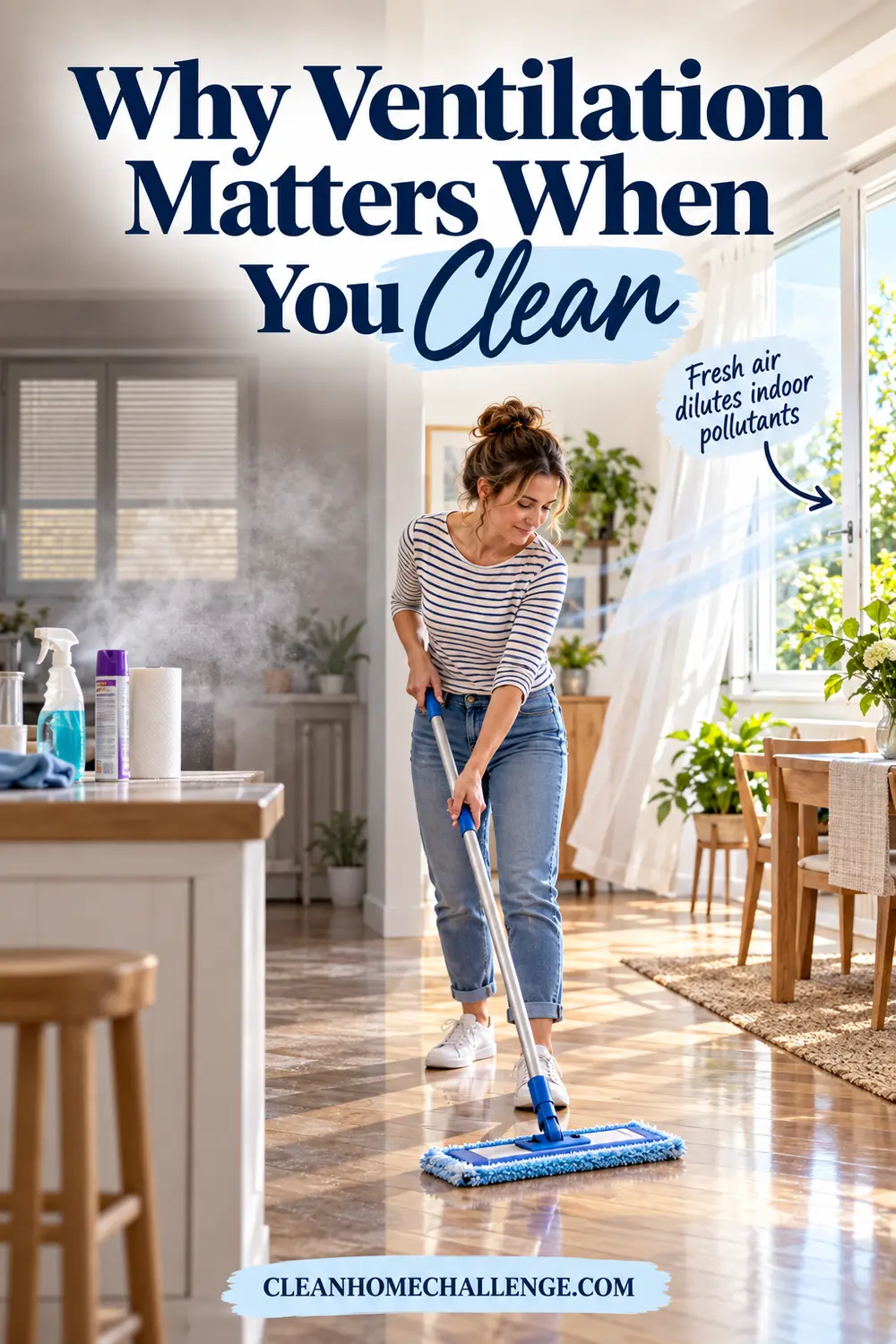
Ventilation is the exchange of indoor air for outdoor air. That is different from simply moving the same air around with a ceiling fan. During cleaning, fresh-air exchange can dilute vapors, fine droplets and other pollutants released from products or stirred up from surfaces, then carry some of that indoor air outside.
This matters because many cleaners, disinfectants, degreasers, polishes and fragranced products contain volatile ingredients. The U.S. Environmental Protection Agency notes that many organic pollutants are found at higher concentrations indoors than outdoors and that levels can remain elevated after a product is used. The safest response is not to panic or assume every cleaner is dangerous. It is to control the source: choose an appropriate product, use only the amount directed, close the container promptly and add ventilation when the label or room conditions call for it.
Ventilation is not permission to ignore the label, mix products or use an indoor product for an unapproved purpose. Never mix bleach with ammonia, vinegar, acids, alcohol or another cleaner. If a label says to use a product only outdoors or with specific protective equipment, an open window does not override that direction.
Do not use fragrance strength as an air-quality meter. A product can smell mild and still release vapors, while a strong scent may linger after the main cleaning job is finished. Follow the directions and use planned airflow instead of waiting until the room smells uncomfortable.
Set Up Fresh Air Before You Start
A useful ventilation plan begins before you open the bottle. First, read the label from start to finish. Look for directions about ventilation, dilution, protective gloves, dwell time, rinsing and surfaces to avoid. Put children and pets in another room, remove food and dishes from the immediate work area, and keep the route to a door or fresh-air space clear.
When outdoor conditions are safe, open more than one window or door. Two openings on different sides of a room can create cross-ventilation: outdoor air enters through one opening while indoor air leaves through another. Even a partly opened window can help, but secure openings around young children and pets and do not create a fall or security risk.
Switch on a bathroom exhaust fan or rangehood if it vents outdoors. Many recirculating rangehoods pass air through a filter and return it to the kitchen; they can improve circulation, but they do not replace outdoor exhaust. If you are unsure, check the appliance manual or look for an exterior vent. Set out your cloths, brush, gloves and trash bag now so you do not have to leave an open product unattended.
Cold weather does not require every window to be wide open for an hour. A short, strong cross-breeze before and after the task may be more practical than leaving one small window open all day. Keep the room comfortably safe for children, older adults and anyone with a health condition.

Make Airflow Move Out, Not Around
The most useful airflow has a clear entry and exit. If you use a portable fan, place it on a dry, stable surface near an open window and aim it outward. Crack another safe window or door farther away so replacement air can enter. This setup encourages indoor air to leave instead of pushing it deeper into the home.
Keep the fan away from sinks, buckets and wet floors. Route the cord where no one will trip, and do not leave a portable fan unattended around children or pets. Avoid pointing strong airflow directly at a person because it can carry spray droplets or dust toward their face. Also avoid aiming a fan from the cleaning area into a bedroom, nursery or occupied living space.
A ceiling fan can help mix air, which may make a room feel less stuffy, but it does not remove pollutants unless outdoor air is also entering or an exhaust route is operating. Think of circulation as a supporting step. The goal is to move contaminated air toward the exit, not spin it around the room.
Close doors to unused rooms if doing so keeps cleaning air from spreading through the home, but never block the replacement-air path your exhaust setup needs. Watch lightweight curtains or a strip of tissue near the opening to confirm the direction of movement without placing your face in the airflow.

Ventilate Small Rooms and Windowless Spaces
Small bathrooms, laundry rooms, pantries and closets can build up odors and vapors quickly because there is less air to dilute them. Use an outdoor-venting exhaust fan before, during and after the job. Open the interior door so replacement air can reach the room, provided that doing so does not send the air into an occupied or sensitive area.
In a windowless bathroom, apply cleaner directly to a cloth when the product directions allow instead of creating a cloud of spray. Work from the least soiled surfaces to the dirtiest, keep bottles closed between uses and clean one small zone at a time. If a product requires more ventilation than the room can provide, choose a different product approved for the surface or postpone the job.
Do not run an appliance exhaust fan unless it is intended for that space, and do not improvise ducting. A fan that vents into an attic, wall cavity or another room is not moving pollution safely outdoors. If you rent or cannot confirm the exhaust route, use lower-emission methods, open nearby safe windows and ask the property manager about the ventilation system.
For a tiny space, consider taking removable items such as a shower caddy or trash can to a better-ventilated area for cleaning when the material and product directions allow. That reduces the time spent using products inside the cramped room.

Use Fans, HVAC and Air Cleaners Wisely
Windows and exhaust fans exchange air. A central HVAC system mainly circulates air through the home and its filter. A portable air cleaner filters room air. These tools can work together, but they do not do the same job.
A correctly sized portable HEPA cleaner is designed to capture particles. It can be useful for dust and other airborne particles, but HEPA does not remove gases. Some units include activated carbon for certain odors and gases, yet performance depends on the amount and type of carbon, the pollutant and maintenance. Do not assume a small charcoal sheet makes chemical vapors disappear. Check the manufacturer’s coverage, Clean Air Delivery Rate for particles and filter-replacement instructions.
Avoid ozone-generating air cleaners in occupied homes. Ozone is a lung irritant and is not a safe shortcut for cleaning indoor air. If outdoor air is good, source control and ventilation usually come first: stop or reduce the pollutant, exhaust it outdoors, then use suitable filtration as a supplement. Replace HVAC and portable-cleaner filters according to the manufacturer rather than waiting until airflow drops.
For HVAC filters, use the efficiency level the manufacturer says the system can handle. A filter that is too restrictive can reduce airflow or strain some equipment. Seat it correctly, note the installation date and keep return grilles clear of furniture and storage.


Clean More Safely in Bad Outdoor Air
Opening windows is not always the safest choice. Wildfire smoke, high particle pollution, severe pollen, extreme heat, storms and nearby construction can make outdoor air unsuitable. Check a reliable local air-quality source such as AirNow in the United States before starting a long cleaning session. People with asthma, COPD or other respiratory conditions should follow their healthcare plan and local public-health advice.
On a poor-air day, keep windows and doors closed if local guidance recommends it. Run HVAC on recirculate with the most efficient compatible filter, use an appropriately sized portable air cleaner, and postpone optional jobs involving strong products, sprays or heavy dust. Damp-dust surfaces and apply cleaner to a cloth when the label allows so less material becomes airborne.
Kitchen and bathroom exhaust fans that vent outdoors create negative pressure, which can pull outdoor air through gaps. Use them for the shortest practical time during severe smoke and follow local guidance. If a job cannot be done safely without bringing polluted air inside, waiting for conditions to improve is a sensible cleaning decision, not a failure.
Air-quality indexes mainly report regulated outdoor pollutants and do not tell you everything about indoor vapors or personal fragrance sensitivity. Treat the index as one planning tool alongside the weather, pollen conditions, product label and the needs of the people in your home.

Know When to Stop and Get Fresh Air
Stop cleaning if you notice burning eyes, nose or throat irritation, coughing, wheezing, headache, dizziness, nausea, chest tightness or trouble breathing. Close the product only if you can do so without further exposure, leave the area and move to fresh air. Keep other people and pets away, and ventilate the room from a safe position if possible.
For a suspected inhalation exposure in the United States, Poison Control advises moving to fresh air and getting product-specific help through webPOISONCONTROL or by calling 1-800-222-1222. Call 911 for severe breathing difficulty, collapse, a seizure or rapidly worsening symptoms. Outside the United States, use your local poison center or emergency number.
If cleaners were accidentally mixed and you smell an intense bleach-like or unusual chemical odor, do not stay to troubleshoot it. Leave immediately, get fresh air and call for expert help. Do not add another chemical to neutralize the mixture. Save the product containers or take photos of the labels only if it is safe, because the exact ingredients help professionals give the right advice.

Keep a Simple Ventilation Routine
Make ventilation one of the normal setup steps, just like gathering cloths or putting on gloves. Use the same three-part rhythm each time: open or switch on the appropriate airflow, clean with the least product needed, then keep airing out the room as directed and as outdoor conditions allow.
After cleaning, close and store products in their original containers out of reach of children and pets. Wash reusable cloths according to their care instructions, remove the trash and let damp surfaces dry. Turn portable fans off before leaving the room. If an exhaust fan has a timer, use it; otherwise set a phone reminder so it does not run all day.
A comfortably clean home does not require filling every room with fragrance or doing every task at once. Short, well-planned sessions with sensible airflow are easier to manage and easier to repeat. Start with the room you are in, follow the label, and give the air a clear way out.
For a quick win, make ‘air first’ the cue that starts your weekly clean. Open the safe window or start the correct exhaust, set a short timer, complete one focused task and close the setup when the room has aired out. Consistency matters more than a complicated system.

CLEANERS CLUBHOUSE
Build a Safer, Simpler Cleaning Routine
Clean confidently with practical guidance that helps you choose sensible products and use them correctly. The Cleaners Clubhouse combines safer cleaning support with realistic routines, worksheets and challenges.