THIS POST MAY CONTAIN AFFILIATE LINKS. PLEASE READ MY DISCLOSURE FOR MORE INFO.
A chore can sound simple until two people picture different things. One person says “put the laundry away,” another gathers the basket, and neither realizes that the instructions left out where the folded clothes belong. Add different home languages, unfamiliar words, or different reading preferences, and a small job can need a much clearer explanation.
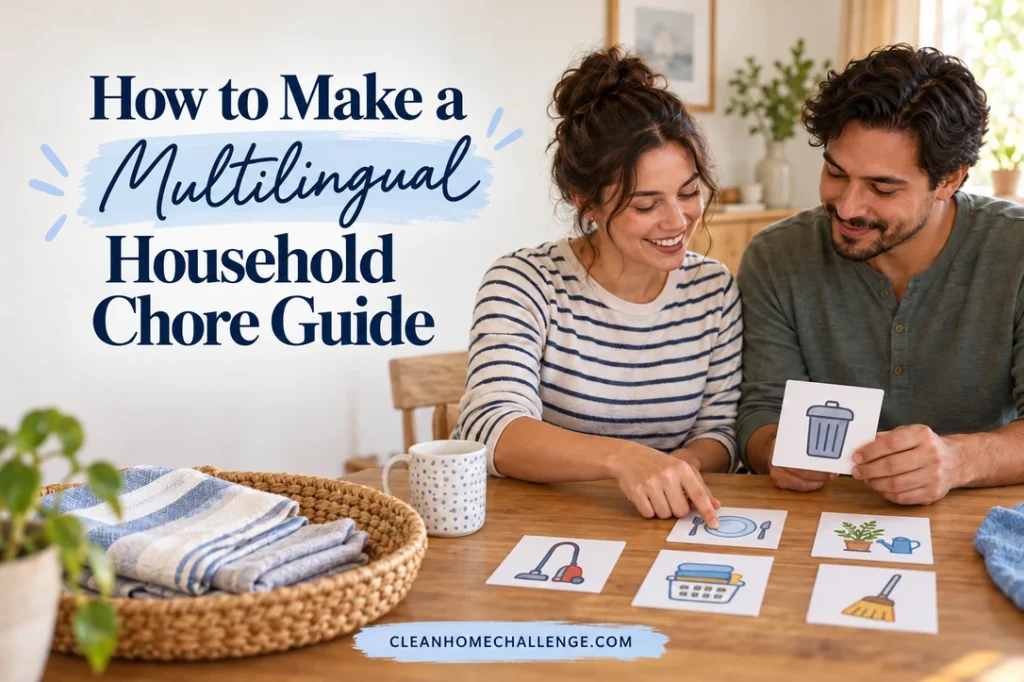
A multilingual chore guide gives household members the same practical information in the languages and formats they can use comfortably. It is not a language test, a list of rules imposed on guests, or a replacement for learning a task together. Start with one low-risk job, show its finish line, and ask the people using the guide to help shape it.
You can make a first version with paper, a pen, and a photo of your own storage spot. The free two-page task card below leaves the language fields blank so your household can add and check its own wording rather than depend on an unverified translation.
Disclosure: This post may contain affiliate links. As an Amazon Associate, Clean Home Challenge earns from qualifying purchases. If you make a purchase through these links, we may earn a small commission at no extra cost to you. This helps us keep creating practical cleaning tips, routines and resources for busy families! 🧽
Choose One Shared Task to Explain
Begin with a job that already causes an ordinary, repeatable misunderstanding. Returning shoes to a rack, folding clean hand towels, or putting books on a low shelf is more useful for a first card than “clean the whole kitchen.” Choose a task the person is willing and able to do, with materials they can reach safely.
Agree on the job before translating it
A clear guide cannot settle an unspoken disagreement about who should do the work. First agree on the responsibility, the level of help available, and a realistic finish. Ask, “Would a picture, written steps, or doing it together make this easier?” Adults should have a say in their own household responsibilities; children need tasks adapted to their abilities and appropriate supervision.
For a simple hand-towel task, the agreement might be: take the clean, dry hand towels from the basket, fold them once or twice so they fit, and place them on the bathroom shelf. It does not include running the washing machine, carrying a heavy load, or sorting somebody else’s clothing. Naming what is outside the task prevents the card from quietly expanding.
Before you write, decide:
- Who uses the guide? Ask which language, writing system, and everyday words they prefer. Speaking a language does not necessarily mean someone wants to read instructions in it.
- What is the finish line? Describe something observable, such as “the books are on the low shelf and the walkway is clear.”
- When does it happen? Use an agreed cue, such as after reading, rather than an unexplained abbreviation or a vague “later.”
- What happens when help is needed? Identify the person to ask and make stopping an acceptable option.
For help breaking a job into concrete instructions before translating it, use our guide to cleaning together when one person needs clear instructions. Keep this multilingual card focused on the language and format choices your household needs.
Keep the first version low risk
Leave chemical handling, ladders, sharp objects, heavy lifting, and electrical equipment out of an introductory household card. Adults retain responsibility for these tasks and for deciding what is suitable for a child. A picture of a spray bottle is not an instruction for using its contents.
Keep cleaning products in their original labeled containers, secured away from children, and follow their actual directions. New York State’s household cleaning guidance emphasizes labels, safe storage, and avoiding product mixtures. Your chore card must never cover, replace, or contradict those labels. If an adult cannot understand safety-critical directions, pause that job and obtain reliable language assistance or manufacturer guidance before using the product.
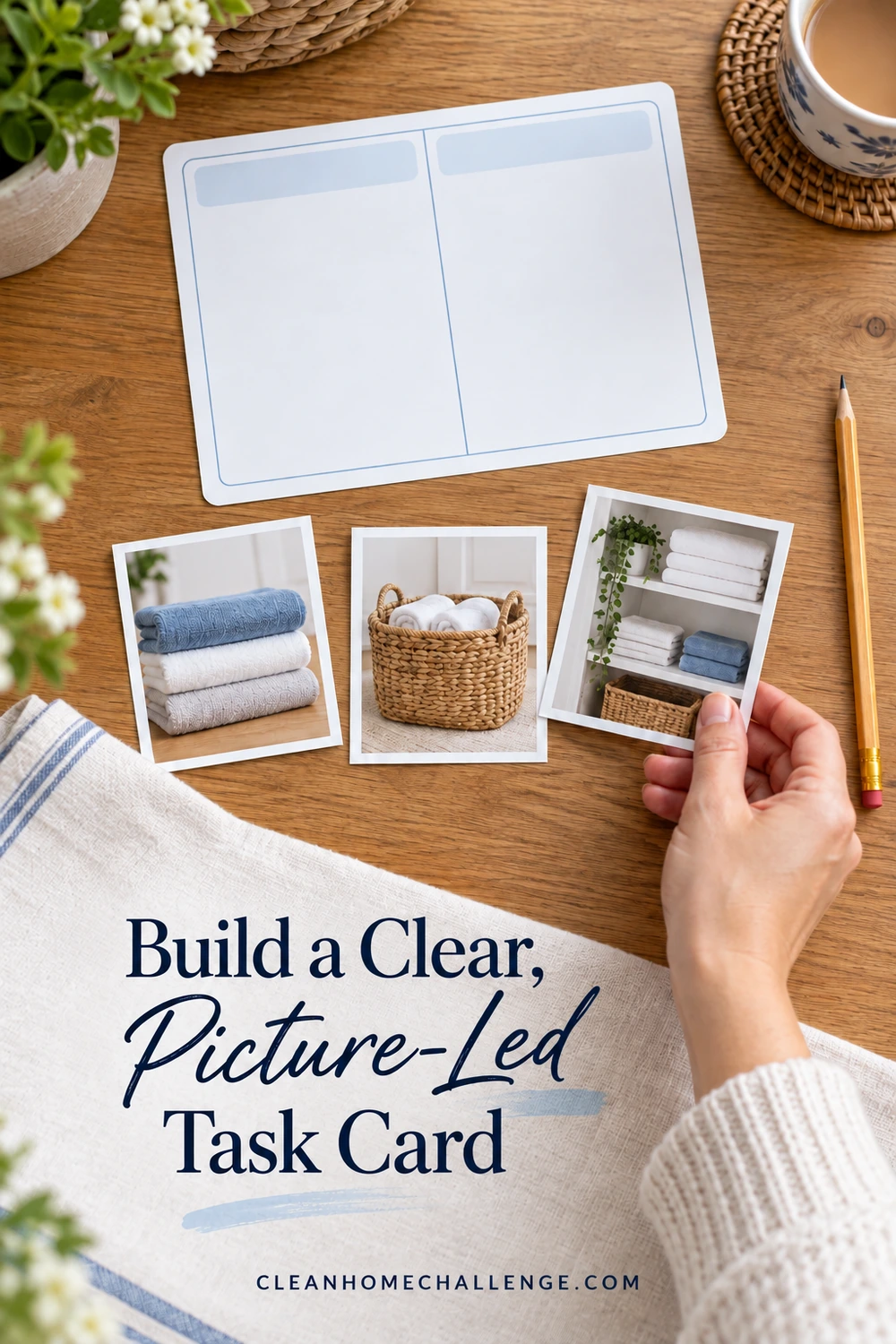
Build a Clear, Picture-Led Task Card
Write the simplest accurate version of the task in a language you can explain well. English does not have to be the starting language. Use the household’s preferred source language, then build matching versions from that shared meaning.
Put one action on each line. “Put the books on the low shelf” is easier to demonstrate than “restore the room to its usual condition.” Name the object and destination instead of relying on “it,” “there,” or “the normal place.” Replace expressions such as “give it a once-over” with the action you mean.
The UK Home Office’s guidance for readers with limited English recommends clear wording and avoiding expressions that do not translate readily. For a home guide, the practical aim is modest: fewer assumptions, not childish language. Keep the tone respectful for adults and children alike.
Match each picture to a real step
Take a simple photo of the actual shelf, basket, or finished arrangement, avoiding personal documents and other private details in the background. Ask permission before including people. A photo of the real destination can be more useful than a decorative image of a spotless room.
For returning books, a short sequence could be:
- Gather the books from the reading spot.
- Put them upright on the low shelf shown in the photo.
- Check that the walkway is clear.
Add a separate picture of the agreed result if it helps. Do not squeeze several actions into one busy collage. A simple sketch is fine when everyone recognizes what it means; do not assume a symbol is universal just because it is familiar to you.
Give every language enough room
Place corresponding steps beside one another, or use separate matching cards if the text becomes crowded. Keep the same step numbers and pictures across versions. Let each language use natural phrasing rather than forcing every line to have the same number of words.
Use dark text on a light background, generous spacing, and a size the reader can comfortably see. Do not shrink one language to fit beneath another or rely only on color to identify a step. With three or more languages, separate pages may be easier than tiny columns. For right-to-left scripts, ask the person using that language to check the reading order and final layout rather than reversing text manually.
Make room for people who prefer not to read
A demonstrated sequence, a few recognizable photos, or an optional spoken explanation may work better than a printed paragraph. If you record audio, get consent, avoid personal information, and make sure the intended person can play it without depending on someone else’s locked device. Keep an offline option when a phone is inconvenient.
You do not need a shopping trip to begin. Paper and an existing clipboard or folder can be enough. If you later choose reusable supplies, check that pens, fasteners, and small parts are appropriate for the people using them, and keep the finished card out of wet or hot work areas.
Check Each Translation Together
Translation is a meaning check, not a word-swapping exercise. A household member who understands both languages may be able to help with ordinary low-risk wording, provided they are comfortable doing so. Do not assume they must become the permanent translator or take over the chore because they helped write the card.
The W3C’s translation-review guidance checks whether a translation conveys the original meaning and whether it reads appropriately in the translated language. A household guide is a different setting, but the same distinction is useful: wording can sound fluent and still describe the wrong action.
Use a simple review conversation
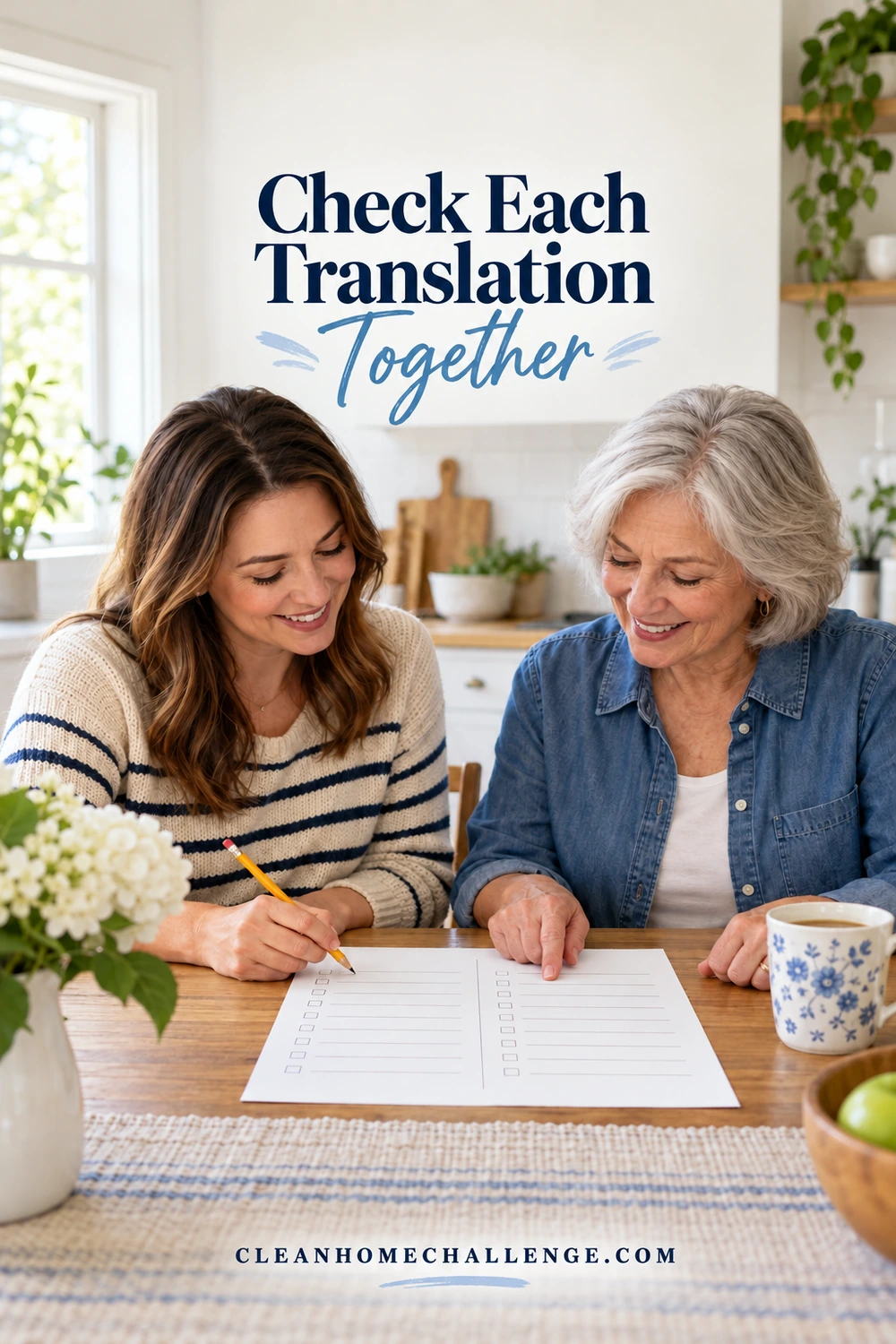
Sit with the card and the real objects. Invite corrections with a question such as, “Does this sound like something we would actually say at home?” Avoid asking only “Do you understand?” when someone may feel uncomfortable disagreeing.
Work through the card in this order:
- Compare the task. Check that each version names the same objects, place, and finish line.
- Check the sequence. Make sure no action has moved, disappeared, or been added.
- Notice important differences. Check quantities, times, “before” and “after,” and especially words such as “not.” Even a short instruction can change meaning if one of these is wrong.
- Show what the words mean. Ask the person to point to the destination or explain the next step in their preferred language. Treat uncertainty as a card problem to fix, not a failure by the reader.
- Read the finished layout. Check spelling, accents, character display, reading direction, and whether a line break separates words awkwardly.
If you cannot verify a version, mark it as a draft rather than presenting it as checked. Choose a simpler, directly demonstrated low-risk task while you arrange suitable help. Nobody needs to complete a job they do not understand.
Use automatic translation cautiously
An automatic translation can be a starting draft for an ordinary low-risk task, but a confident-looking answer is not proof of accuracy. Canada’s Translation Bureau advises considering risks and human review when using AI translation. Do not put private household information into a translation service unnecessarily, and do not treat translating the result back again as independent verification.
For this guide, never rely on unchecked machine translation for cleaning-product warnings, mixing or dilution directions, electrical instructions, or emergency information. Obtain reliable manufacturer-provided language information or qualified assistance. Do not make a child responsible for interpreting adults’ chemical-safety directions. Keep the original instructions available and do not invent a simplified substitute when a safety detail is unclear.
Download the blank task card
Download the Multilingual Household Task Card (PDF). Page one gives you space for a shared task, three steps in two household languages, picture notes, and a finish line. Page two helps you review meaning, try the guide, and record changes. Print another first page for additional languages or use separate cards with the same step numbers.
The language columns are intentionally blank. Complete them with the people who will use the guide; this is a planning tool, not a certified translation or a cleaning-safety label.
Try the Guide and Keep It Useful
Test the card during an ordinary, unhurried attempt. Stay available for help rather than turning it into a performance. Watch for practical snags: the picture shows an old basket, the shelf is too high, the instructions assume somebody knows which towels are clean, or the last step has no obvious stopping point.
Ask one useful question afterward: “What should we change so this is easier next time?” Fix the unclear instruction or awkward setup before adding reminders, rewards, or more text. If the person prefers a demonstration to a card, use that feedback. A printable is helpful only when it suits the people doing the task.
Troubleshoot the guide, not the person
- The step is skipped: Check whether it contains two actions or uses an unfamiliar word. Split it and show the action.
- The wrong object is chosen: Replace a generic illustration with a photo of the real item or destination, with permission.
- One version says something different: Stop using that line until the meaning is checked. Update every affected version together.
- The task is understood but not manageable: Change the task, tools, reach, support, or timing. Language access does not remove physical or other support needs.
- The card is ignored: Ask whether its location, format, or wording is inconvenient. Do not assume someone is refusing to help.
Agree who will update the guide when storage, routines, or household members change. Add a review date and remove outdated copies so two versions do not compete. A short check after the first few uses is more useful than printing a permanent chart before anyone has tried it.
For a low-energy start, make just one handwritten card with one photo and one action. You can add another step once the first works. There is no need to translate the entire cleaning routine in one evening.
Keep the guide close to the task, somewhere dry, readable, and safely reachable. Its job is to make participation clearer, not to demand a perfectly arranged home. One shared instruction that people can use confidently is a worthwhile result.
CLEANERS CLUBHOUSE
Turn Small Daily Habits Into a Cleaner Home
Make cleaning feel more achievable by sharing simple routines and building habits that stick. The Cleaners Clubhouse includes the 7-Day Daily Habits Bootcamp, printable support and motivating monthly challenges.