THIS POST MAY CONTAIN AFFILIATE LINKS. PLEASE READ MY DISCLOSURE FOR MORE INFO.
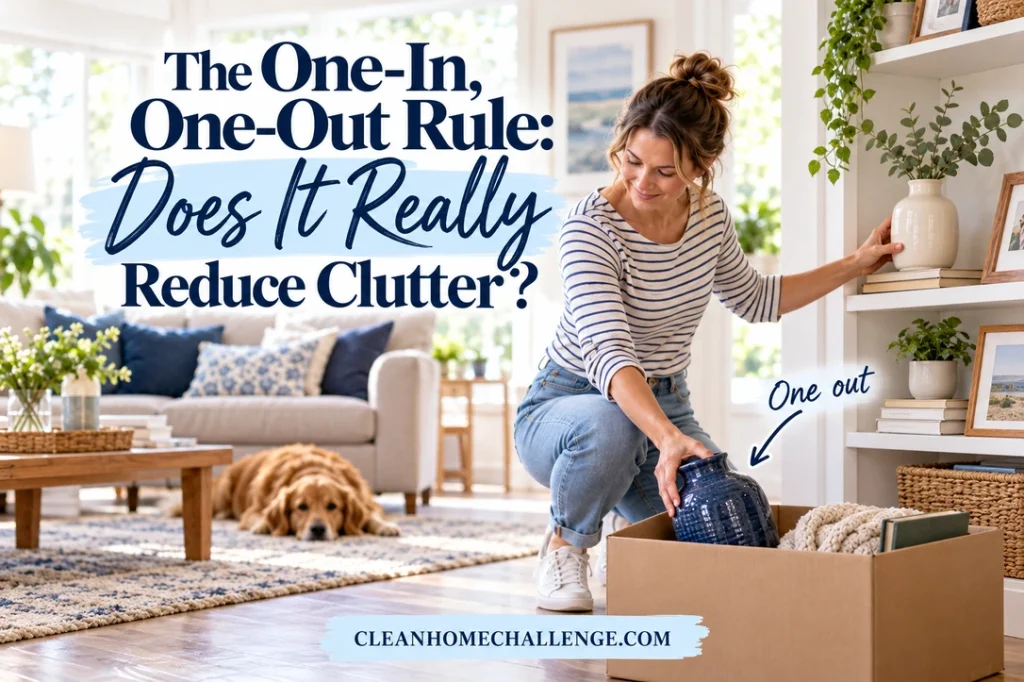
A new pair of shoes comes home, so an old pair leaves. A new mug goes into the cabinet, so another comes out. The one-in, one-out rule sounds wonderfully simple, especially when you are tired of moving everyone’s things before you can wipe a counter.
But does it actually reduce clutter? It can help stop a manageable category from growing. On its own, it usually maintains the number of things you have rather than reducing it. If a shelf already holds too much, exchanging one item for another will not create the breathing room you wanted.
That does not make the rule useless. It makes it a maintenance tool with a specific job. Used thoughtfully, it gives purchases a place to go, makes replacements more deliberate, and keeps an already-cleared space from filling straight back up.
This guide treats one-in, one-out as a practical household experiment, not a scientifically proven cure for clutter. You do not need to count every possession, throw away useful things, or make Mom responsible for everyone’s exits. Start with one category, agree on sensible exceptions, and judge the result by whether your home is easier to use.
Disclosure: This post may contain affiliate links. As an Amazon Associate, Clean Home Challenge earns from qualifying purchases. If you make a purchase through these links, we may earn a small commission at no extra cost to you. This helps us keep creating practical cleaning tips, routines and resources for busy families! 🧽
What One-In, One-Out Actually Means
The basic agreement is straightforward: when you bring a lasting item into a chosen category, you remove an item from that same category. The outgoing item might be sold, donated, passed along with permission, recycled through an appropriate program, or disposed of correctly if it cannot be used safely.
A new everyday sweater replaces an everyday sweater. A new water bottle replaces a water bottle. Buying a bulky kitchen appliance and discarding a dried-out pen technically changes two item counts, but it does nothing to protect the kitchen space you are trying to manage.
Count useful units, not every tiny piece
Decide what “one” means before you start. A board game is one complete game, not a box plus every card and token. A food-storage container with its matching lid can be one usable set. A pair of shoes is one pair. This keeps the agreement useful instead of turning it into an accounting exercise.
For collections with very different sizes, space may be a better measure than item count. One small paperback does not free enough room for a large coffee-table book. A single shelf of books or one comfortably closing craft drawer can give you a clearer limit.
Think of a replacement as a three-part action: choose the incoming item, decide what it replaces, and finish the outgoing item’s next step. Putting an unwanted sweater in a permanent bag behind the bedroom door is a decision, but it is not yet an exit.
Maintenance and reduction are different jobs
Imagine a cabinet containing 18 mugs. You buy one and donate one. You still have 18 mugs. If the cabinet comfortably holds 12, the exchange has preserved the original problem.
You could first choose the 12 that serve your household, find suitable destinations for the others, and then use one-in, one-out to maintain that limit. You could also make a separate small reduction without buying anything. There is no need to purchase a replacement to earn permission to declutter.
Avoid turning this into one-in, two-out unless that genuinely suits you. Removing more can reduce a category, but a stricter ratio is not automatically better. The best limit leaves room for what your household actually uses, including reasonable backups and seasonal needs.

When the Rule Helps and When It Does Not
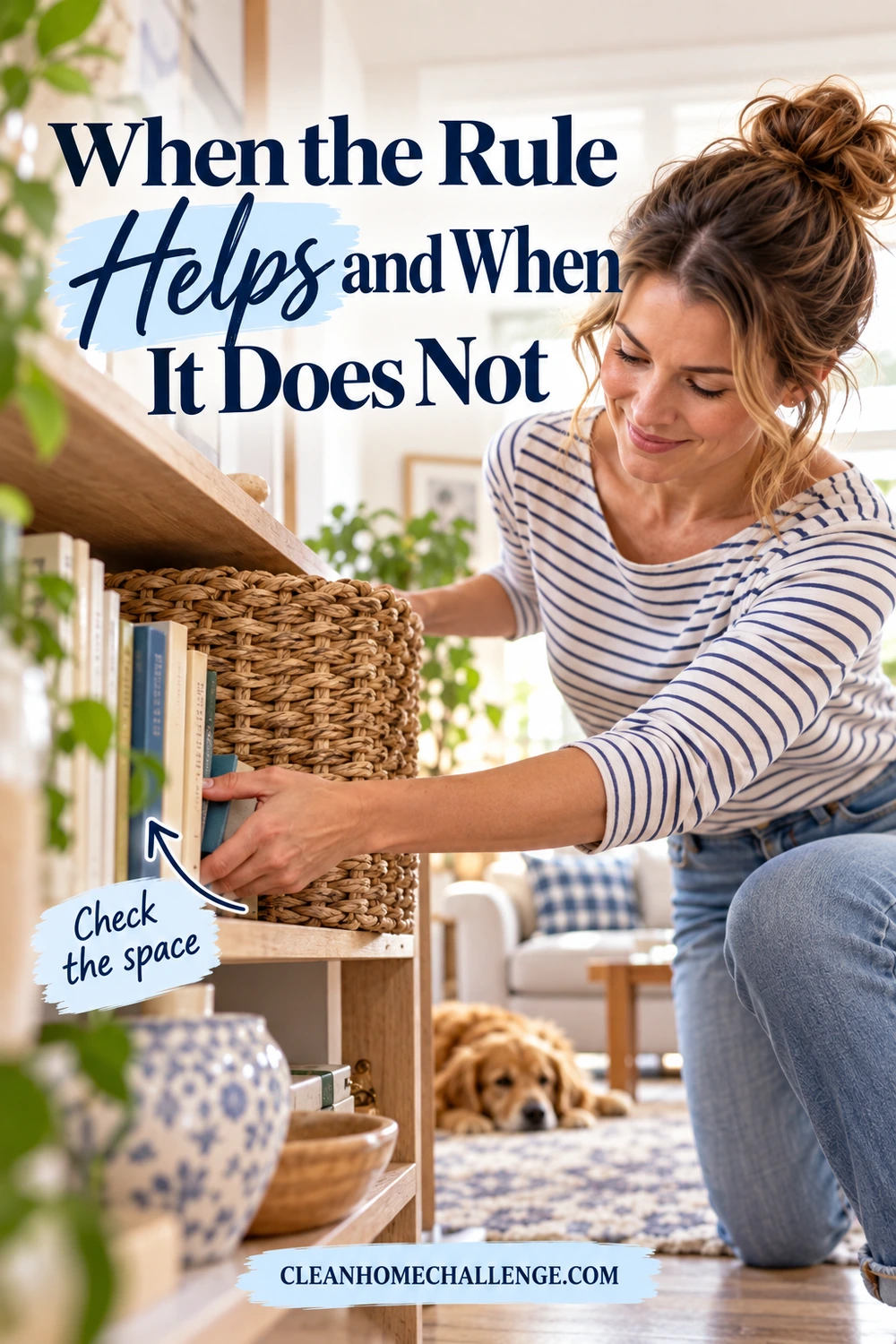
One-in, one-out is most useful when a category is already close to the right size, has clear boundaries, and attracts repeated additions. Mugs, casual clothing, reusable shopping bags, decorative pillows, and hobby supplies can all be manageable starting points.
It is less useful as a whole-house rule when belongings serve unrelated purposes. You might need a replacement winter coat and additional equipment for a new activity in the same week. Treating every arrival as a demand to surrender something can create needless decisions without improving storage.
Look for the problem behind the pile
Ask what is actually making the space difficult:
- Too many items: the drawer cannot close without pushing things down.
- No assigned home: belongings land wherever there is an empty surface.
- Awkward storage: frequently used items are behind heavy or rarely used things.
- An unfinished task: returns, repairs, donations, and paperwork are waiting for a next step.
- An unmet household need: family members keep buying duplicates because the original cannot be found or shared conveniently.
The first problem may benefit from reducing the category and maintaining a limit. The others may need an accessible home, a different shelf arrangement, or a scheduled task. Removing one book every time you buy another will not fix mail that has no place to go.
Watch for the permission-to-shop trap
The rule can become a reason to buy rather than a reason to pause: “I donated a shirt, so I can order another.” An outgoing item does not create an obligation to replace it. Empty space is allowed to stay empty.
Before buying, ask whether the incoming item solves a real problem, replaces something unsuitable, or supports an activity you genuinely do. If the answer is simply that you have cleared a slot, give the purchase more thought.
It also helps to distinguish visual neatness from usefulness. A row of identical boxes can look organized while hiding supplies nobody uses. A slightly varied shelf may work beautifully if everyone can find and return what they need.
Judge the rule by ordinary moments: can you put away clean clothes without a struggle? Can you take out a pan without unstacking six others? Can someone besides you find the tape? These observations are more useful than a perfect possession count.
Choose a Category and Set a Fair Limit
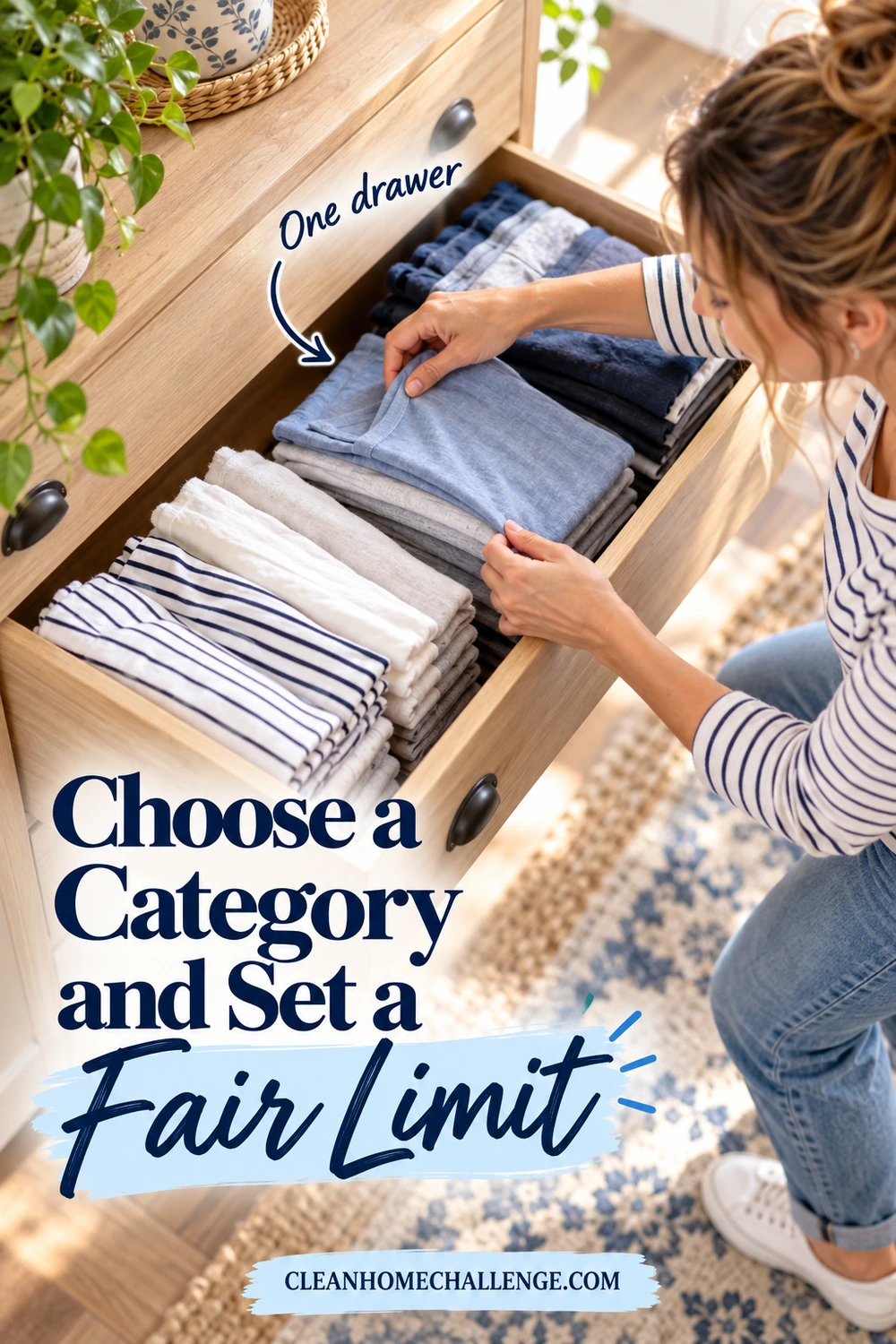
Start smaller than “the entire house.” Choose one shelf, drawer, basket, or closely related group of items that you can review without emptying a whole room. Leave shared sentimental belongings and another person’s private possessions alone unless they agree to participate.
Everyday mugs are a useful example. Gather them from the cabinet, dishwasher, desk, and other usual places. Otherwise, you may set a limit based on only half the collection and feel as though it failed when the rest reappears.
Work backward from real use
Consider the people using the category, how often it is washed or replenished, and what a normal busy week looks like. A family running a dishwasher every other day may need a different number of mugs from someone washing one immediately after use.
Keep the ones that fit the job. An easy-grip mug, a large work bottle, or a backup required for school can have a good reason to stay. There is no universal “correct” number that outweighs your household’s needs.
Then choose a boundary with usable space. A shelf should allow you to take something out without knocking other things over. A drawer should open and close normally. Do not count squeezing items into an overfilled container as proof they fit.
Write a short agreement, for example:
“Everyday mugs live on this shelf. Before a new everyday mug stays, we choose which one it replaces. Keepsake mugs are reviewed separately, within their own small space.”
That is much clearer than “We are not buying anything anymore.”
Give different categories different rules
You might use one-in, one-out for sweaters, a fixed shelf for books, and a use-up-first approach for cleaning supplies. Consumables do not need to follow the same rule as lasting possessions. Buying toilet paper is not a reason to throw away an unrelated household item.
For craft materials, decide whether you are tracking complete projects, particular supplies, or a storage boundary. A new paint set is not meaningfully balanced by discarding one tiny scrap of ribbon.
If the limit repeatedly causes problems, review the limit rather than assuming someone has failed. Perhaps the household needs more storage in an accessible place, fewer duplicate items, or a category split. Adjust deliberately instead of quietly adding overflow baskets until the original boundary means nothing.
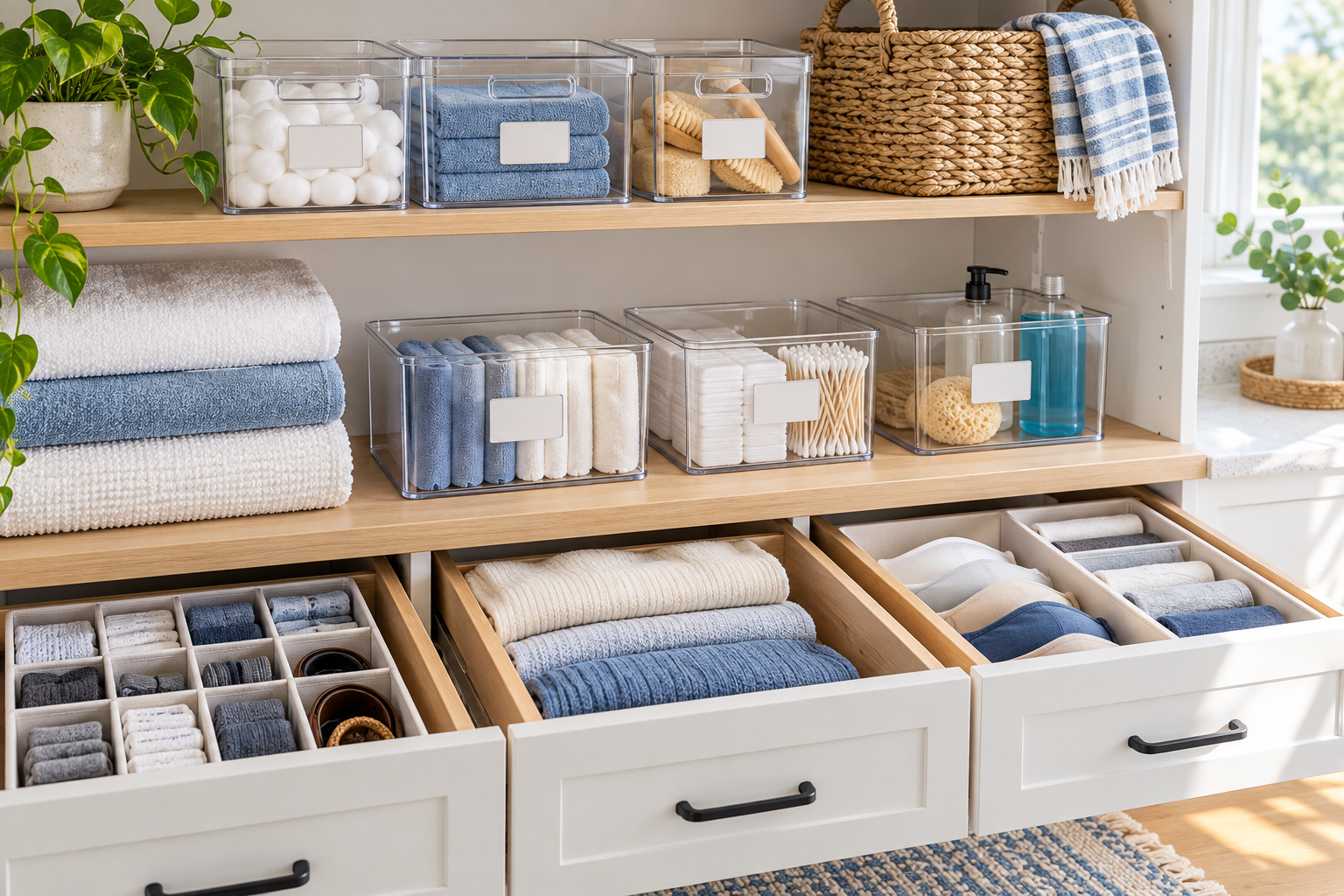
Build an Exit Plan Before You Buy
An exit plan is the difference between a manageable exchange and a new pile of things waiting for you. Before a nonessential purchase, identify the item it will replace and the next realistic step for that item.
Keep the process short enough to finish. You might use a small, clearly marked donation box in a dry, safe location and take accepted items on an existing errand. Do not block an exit or walkway, and do not leave hazardous items where children or pets can reach them.
Match the destination to the condition
For something usable, ask whether you will sell it, offer it to a person who wants it, or donate it to an organization that accepts it. Check the destination first. Goodwill’s donation guidance points donors toward their local organization; accepted items can depend on the location. An unanswered offer to a relative is not a confirmed handoff.
Before giving away or selling a used product, check its model against the CPSC recall database. Follow the recall’s instructions rather than passing a recalled item along. CPSC’s resale safety guidance is a useful starting point when you are unsure what can safely be reused.
For broken items, check your local waste authority’s instructions rather than assuming everything belongs in curbside recycling. Lithium-ion batteries and devices containing them need an appropriate collection route; the EPA says these batteries do not belong in household trash or municipal recycling bins.
Old cleaners, paint, and other potentially hazardous household products need their own plan. Keep them in labeled original containers, do not combine leftovers, and consult your local collection program. The EPA’s household hazardous waste guidance explains why disposal needs special care.
Put a boundary around selling
Selling can be worthwhile, but photographing, answering messages, and arranging pickup take time. Decide how much effort the item deserves before it becomes a long-term project. For an ordinary usable item, you could choose one listing period and then move to a suitable donation option if it does not sell.
Record the next action and its date, not just “sell someday.” Keep hazardous or recalled items out of this ordinary sell-or-donate process. Safety instructions take priority over your preferred decluttering deadline.

Make the Rule Work for the Whole Family
A family rule needs shared agreement and shared work. If everyone brings things in but one person sorts the outgoing items, checks donation rules, takes photos, and makes deliveries, the system has simply created another job for that person.
Start with your own category or one genuinely shared category. Explain the practical problem: the shoe area blocks the door, the game shelf is too full to use, or the lunch containers keep falling out. A concrete problem is easier to discuss than a general accusation that someone owns too much.
Assign the entire replacement task
For adults and capable older children, replacing an item can include choosing what leaves, checking its condition, and completing the agreed handoff. Smaller children can help choose from a manageable set of options while an adult handles safety checks and transportation.
Avoid making another person’s belongings the automatic source of outgoing items. One adult buying new kitchen equipment should not quietly donate a child’s toy to keep the household tally balanced. Keep the exchange within the relevant category and respect ownership.
A short family conversation might sound like this:
“The game shelf is full, and we cannot put games away easily. Let’s choose the games we still play and see what fits. When we want another game, we will talk about space before it comes home.”
That leaves room for discussion rather than imposing a surprise consequence after a birthday or shopping trip.
Make returning items easy
A clear home matters as much as a clear limit. Put everyday items where the people using them can reach and return them comfortably. Labels can help if similar baskets are confusing, but you do not need a new set of matching containers to begin.
Choose a brief shared check-in that fits an existing routine. For example, review the outgoing box before a regular weekend errand. Whoever has agreed to handle a handoff owns that next step; it should not silently transfer to Mom because the box is still there.
If someone does not want to use the rule, focus first on shared-space boundaries and your own belongings. You can agree that a hallway stays clear without demanding an identical approach to every private drawer. A workable household agreement is more valuable than winning an argument about the method’s name.

Handle Gifts, Growing Kids, and Everyday Exceptions
A useful rule has exceptions that match real life. Growth, changing work needs, disability-related equipment, a new baby, and a different living arrangement can all change what a household needs. Necessary items do not have to wait while you find an unrelated object to remove.
For children’s clothing, assess fit and season rather than making every new garment trigger an immediate exchange. A child may genuinely need several larger items at once. Sort outgrown clothing separately, check its condition, and decide whether to keep a realistic amount for a younger sibling or find an appropriate new home.
Plan for gifts without punishing the recipient
You can share preferences before celebrations: something on a wish list, a consumable treat, or an experience may suit your household. Other people may still choose differently. Do not turn the moment of receiving a gift into an unexpected decluttering test, especially for a child.
Afterward, find a suitable home and review the category calmly. If the gift does not suit, decide on an appropriate return, exchange, or handoff when possible. You can appreciate someone’s kindness without keeping every object indefinitely.
Sentimental belongings need a separate conversation. A keepsake box or display space can provide a gentle boundary, but there is no need to pair every meaningful new object with an immediate sentimental loss. Leave difficult decisions for a time when you have the attention to make them thoughtfully.
Keep intentional backups
A spare set of sheets, a school uniform needed between laundry loads, or equipment that prevents disruption may earn its space. The question is whether the backup has a clear job, not whether a minimalist checklist says it is allowed.
“Just in case” becomes easier to evaluate when you name the case. How often does it happen? Is the item suitable and easy to find? Would keeping this particular backup avoid a realistic inconvenience, or are there several duplicates doing the same job?
For essential replacement equipment, confirm the new item works before removing the old one when that is practical and safe. An overlap can be sensible. Give it a review date so a temporary backup does not become an unnoticed permanent duplicate.
The rule should help your family manage belongings through change. It should never pressure you to discard something necessary, useful, or personally important just to keep an arbitrary count correct.

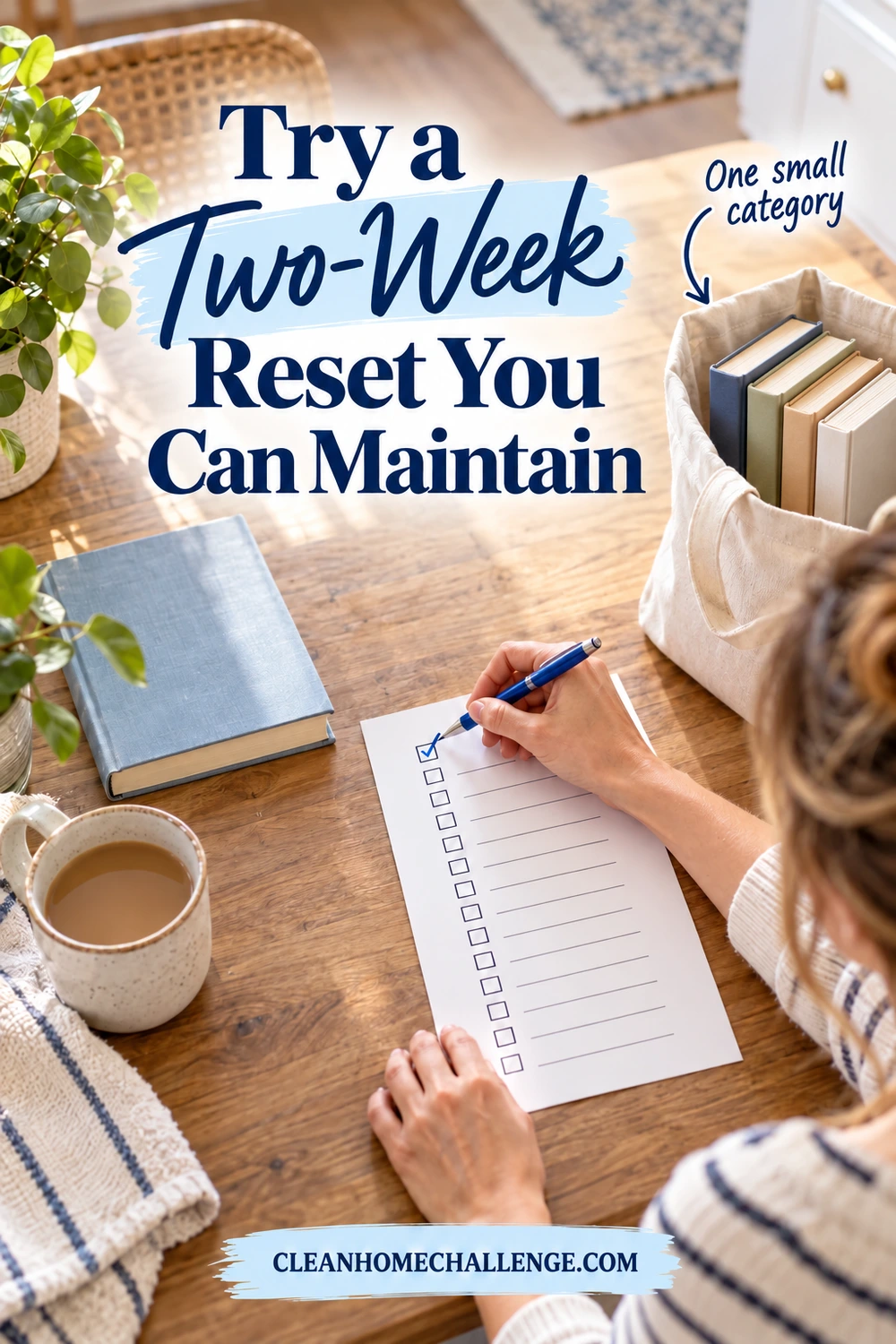
Try a Two-Week Reset You Can Maintain
Treat the next two weeks as a small experiment. You are checking whether this approach makes one part of your home easier to use, not proving that you can follow a perfect rule forever.
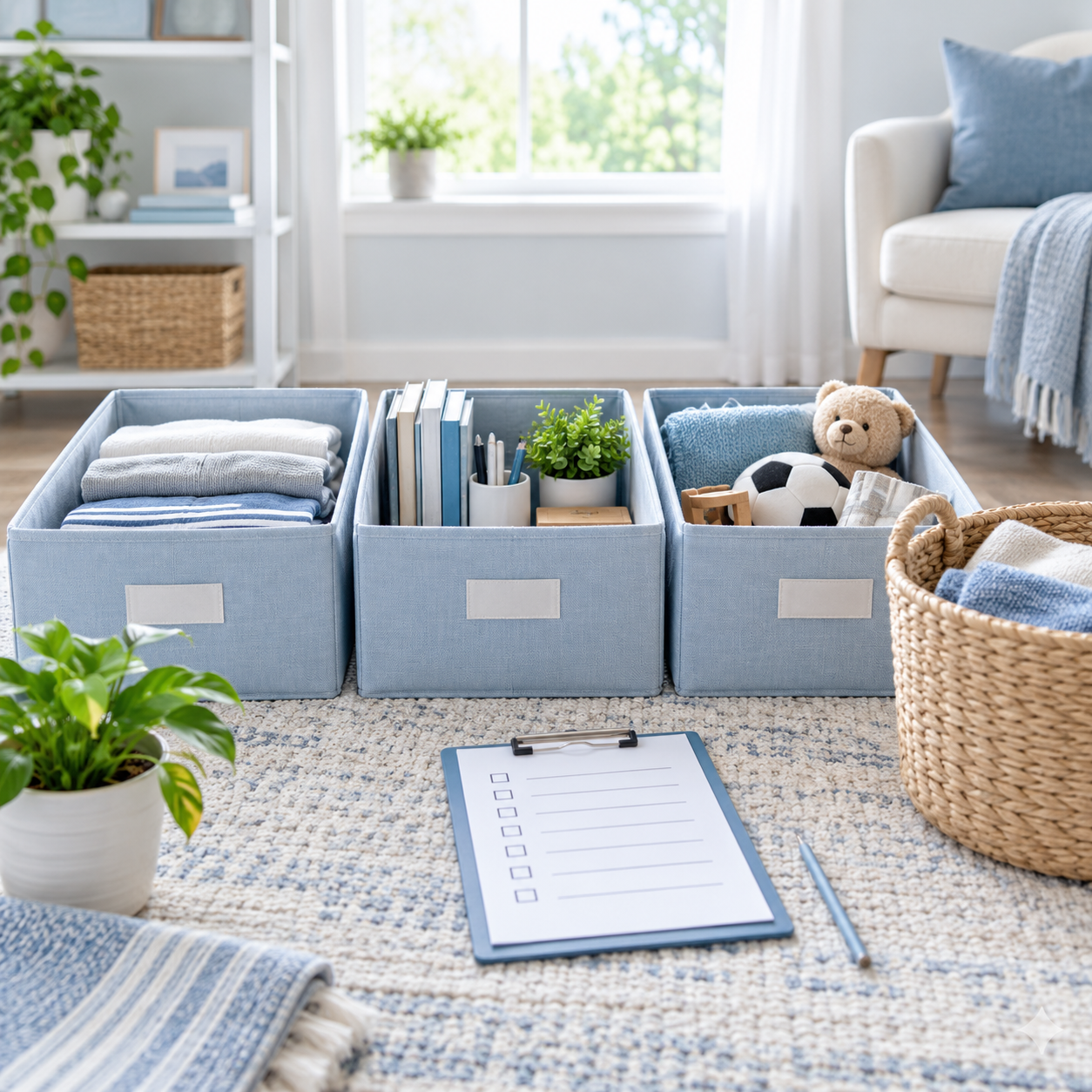
On the first day, choose one category and one boundary. Gather the category, identify what you actually use, and decide whether a small initial reduction is needed. Do not empty several rooms at once. Take a simple “before” photo if it will help you notice a practical change, but a photo is optional.
During the first week, pause before additions. Before buying something in the chosen category, name its home and, if it is a replacement, the item it replaces. You do not need to buy anything during the experiment. A week with no arrivals can still be a successful week.
Finish one ordinary exit. Take accepted donations to their destination, complete a confirmed handoff, or arrange the correct local disposal route. If special collection is not available within two weeks, record the appointment or next available option and store the item safely according to relevant guidance. Do not force an unsafe shortcut to meet the experiment’s timeline.
At the end of the second week, check three things:
- Can you take out and put away the items without rearranging everything?
- Are fewer outgoing items waiting around for someone to deal with them?
- Does the agreement fit your household without creating unfair extra work?
If the space works and the process is manageable, keep the rule for that category. If it is still overcrowded, make a separate reduction or revise the boundary. If you kept buying because there was room, change the emphasis to using what you already own. If the exit box became another chore for one person, reassign complete tasks before expanding the system.
You can write your final agreement on an ordinary note: “New water bottles need a home. Replacements leave through a safe, agreed route. No one has to fill an empty slot.” That is enough structure to start.
The one-in, one-out rule works best as a guardrail for a space you have already made usable. It can help prevent growth, but real clutter reduction comes from choosing what belongs, limiting unnecessary arrivals, and finishing responsible exits. Start with one category that annoys you every day, make the agreement fair, and keep only the parts that make home easier.
CLEANERS CLUBHOUSE
Ready to Clear the Clutter One Step at a Time?
Join the 30-Day Declutter Challenge and work through your home in small, achievable steps. The Cleaners Clubhouse includes the plan, printable support and encouragement to help you keep going.