THIS POST MAY CONTAIN AFFILIATE LINKS. PLEASE READ MY DISCLOSURE FOR MORE INFO.
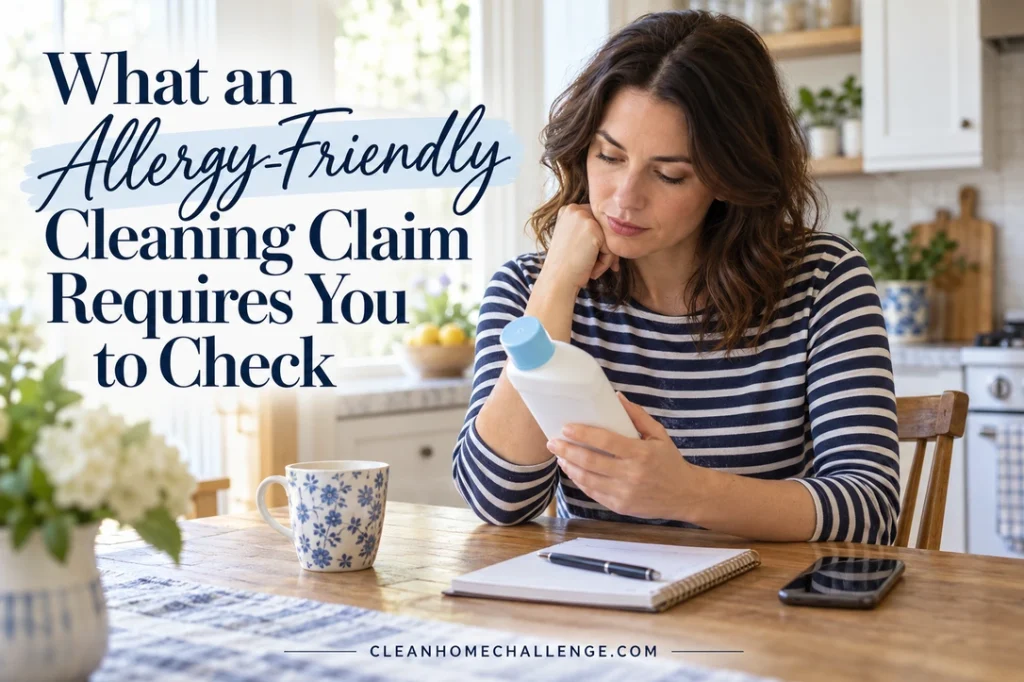
A bottle with a reassuring badge can look like an easy answer when you are buying cleaning supplies for a sensitive household. But an allergy-friendly claim becomes useful only when you can connect it to a real certifier, the exact product in your hand, and an explanation of what was assessed.
The quick check is who, which product, what testing, and how to use it. A verified certification can help you narrow your choices. It cannot promise that nobody in your family will react, replace your household’s medical advice, or make an unsuitable cleaner safe for every surface.
You do not need to investigate the whole cleaning cupboard tonight. Start with the cleaner you are about to replace. Keep its packaging closed, have your phone nearby, and use the checklist below to make one informed decision. The free printable near the end gives you somewhere to save the details for next time.
Disclosure: This post may contain affiliate links. As an Amazon Associate, Clean Home Challenge earns from qualifying purchases. If you make a purchase through these links, we may earn a small commission at no extra cost to you. This helps us keep creating practical cleaning tips, routines and resources for busy families! 🧽
Check Who Stands Behind the Claim
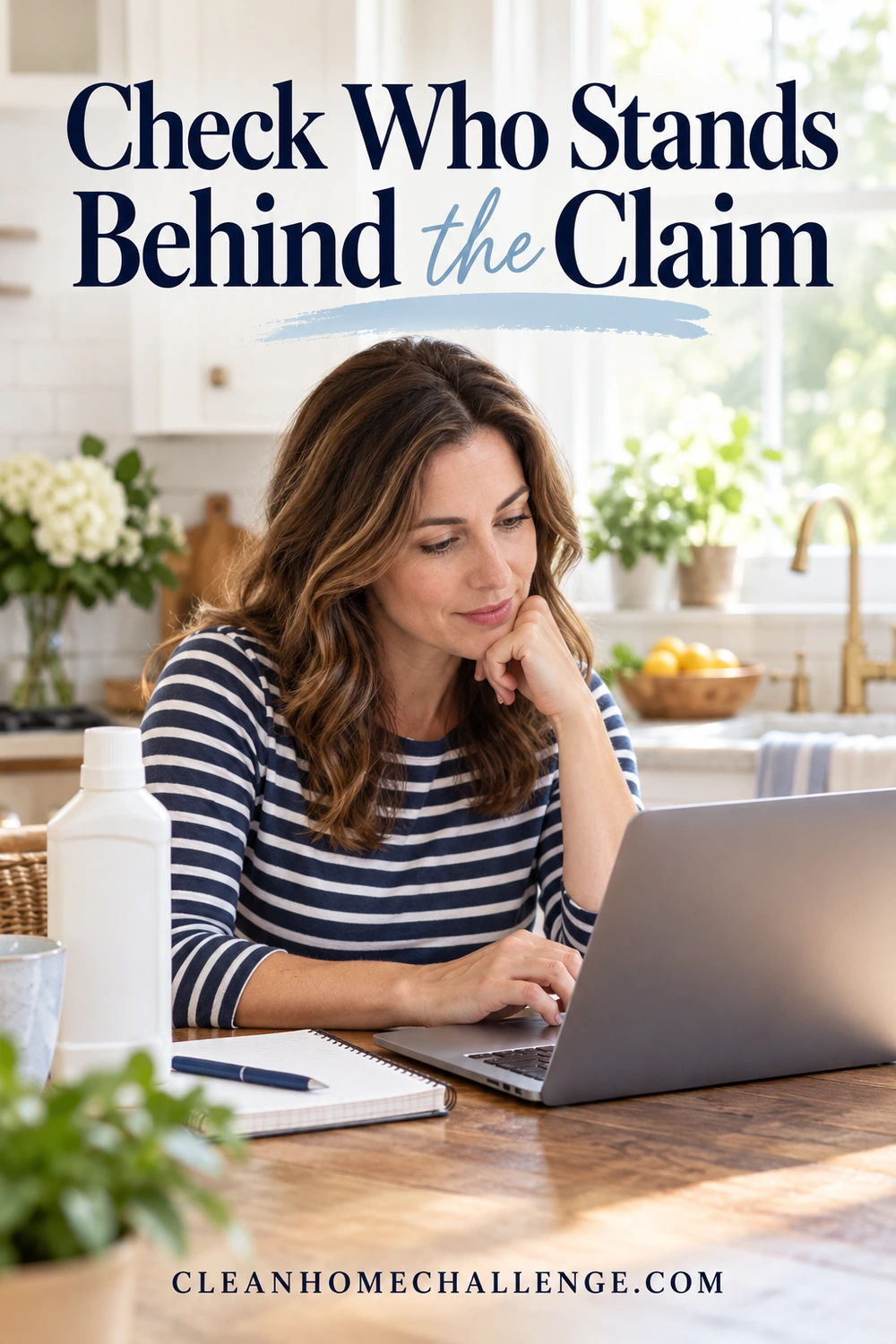
Before comparing scents or prices, find out whether the wording is a brand’s own description or a certification you can independently check. A leaf, a soft color, or the word gentle does not tell you who reviewed the product. Look for the full program name and follow its official website rather than relying only on a retailer’s product photo.
Find a named organization and an official listing
A useful verification trail has three parts: an identifiable organization, a description of its requirements, and a current listing or confirmation for the product. Start at the certifier’s website and search there for the manufacturer and product name. If a bottle has a certification code, keep that with your notes.
For example, the Asthma & Allergy Friendly Certification Program was developed by the Asthma and Allergy Foundation of America and Allergy Standards Limited. AAFA’s program explanation describes certificates and unique certification codes. That gives you specific information to check beyond a general allergy-friendly phrase.
A manufacturer’s own claim may still come with useful evidence. Ask what it means and where the supporting information is available. If the company cannot identify the assessment or explain its scope, treat the claim as unverified for your purchasing decision. That is a reason to ask questions, not proof that the product is dangerous.
Keep the programs separate
Different labels answer different questions. EPA Safer Choice considers ingredient and product criteria for human health and the environment. The Asthma & Allergy Friendly program has category-specific requirements connected to allergens and irritants. A label on one program is not evidence that a product passed another program’s tests.
Avoid treating several unrelated logos as a combined promise of zero risk. An environmental packaging claim, a cruelty-free statement, and an allergy-related certification may each refer to a different part of the product’s story. Read the explanation next to each one and record only what it actually supports.
If you have two minutes: find the official program name and save its product-directory page. Leave the rest of the comparison for later rather than guessing from the front label.
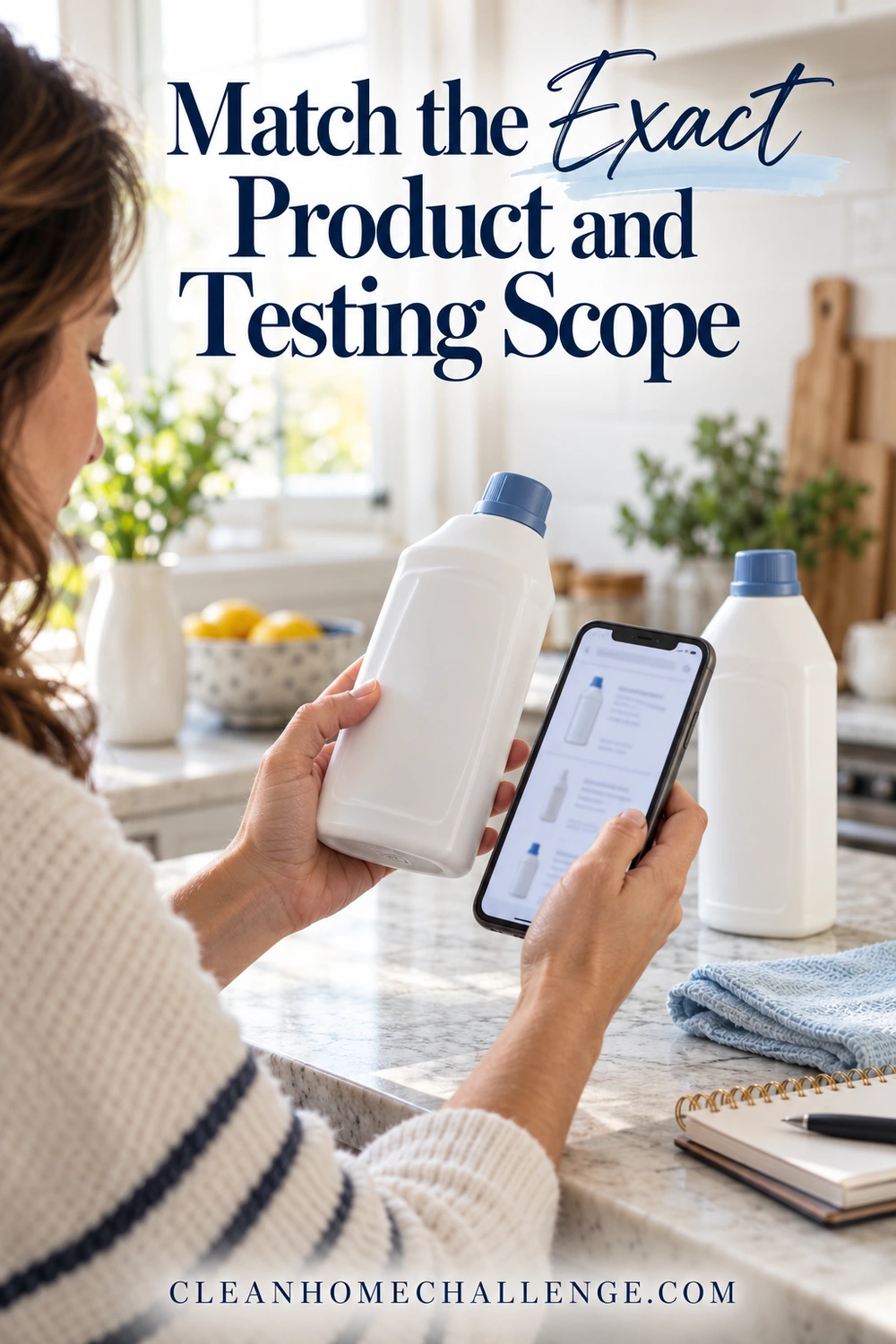
Match the Exact Product and Testing Scope
Once you have found a credible program, make sure its information describes the product you are considering. Certification belongs to the product or product range identified in the listing; it is not a blanket approval of everything a company sells.
Compare the bottle with the listing
Check the brand, full product name, fragrance or variant, intended task, and product format. A ready-to-use spray and a concentrated refill can have different instructions. A laundry product and a hard-surface cleaner may share a brand name while doing completely different jobs. Products sold in different countries may also differ, so confirm that the listing applies to your market when that is unclear.
Do not assume that a similar-looking replacement, a scented version, or a new refill automatically carries the same status. If the exact name is missing, ask the manufacturer or certifier whether that version is covered. Record the answer rather than borrowing certainty from a neighboring product.
Ask what was measured
The program’s cleaning-products guidance describes assessment of the formulation, emissions during controlled use, airborne particles, and allergen removal from hard surfaces. These are defined evaluations, with conditions and limits. They do not mean every user, every allergen, and every cleaning method was tested in an ordinary family home.
Useful questions include:
- Is this assessment about the ingredients, emissions during use, removal of allergens, or a combination?
- Does it cover the task I need, such as hard-surface cleaning, rather than a different product category?
- What instructions or conditions apply to the tested use?
- Does the explanation give measurable requirements, or only broad reassuring language?
- Does the listing identify the exact current formula or variant?
You do not need to interpret a technical laboratory report yourself. A clear public summary may be enough to decide whether the program addresses your concern. When an important detail is unavailable, ask for clarification and leave that part of the checklist unanswered.
Use a comparison that keeps the limits visible
| What you find | What to check next | What you still cannot assume |
|---|---|---|
| A named allergy-related certification | Exact listing and category requirements | Nobody in your household will react |
| EPA Safer Choice | Exact certified product and applicable standard | The product is fragrance-free or a disinfectant |
| An additional fragrance-free designation | Its criteria and the exact formula | Every other ingredient suits your household |
| A self-described allergy-friendly claim | The manufacturer’s definition and evidence | Independent certification took place |
| A disinfectant claim | The regulated label and task-specific directions | Allergy-related suitability follows from germ-killing claims |
The point is to choose evidence that matches your question. If you need to avoid a particular ingredient on professional advice, a general product badge does not replace checking for that ingredient.
Read the Label for Your Household
After checking the certification, turn back to the practical job. Is the cleaner appropriate for the surface? Can you follow the directions comfortably? Does its ingredient information address anything your household has specifically been advised to avoid?
Check fragrance as its own question
Under the EPA Safer Choice standard, a product can receive an additional fragrance-free designation after review for fragrance materials. The ordinary Safer Choice label alone is not a fragrance-free promise. The EPA product search includes a fragrance-free option to help you narrow results.
Words such as botanical or naturally scented do not answer the same question. Read the ingredient information instead of opening a bottle to sniff it in the shop. If avoiding fragrance is your main goal, our fragrance-free cleaning guide explains how to build a simpler routine around that preference.
Check the method before bringing it home
Read the directions for suitable surfaces, dilution, ventilation, protective equipment, rinsing, and storage. Use the product only as directed. Do not mix it with another cleaner, add scent, or change its concentration because the badge looks reassuring. A surface patch test, when the manufacturer recommends one, checks material compatibility; it does not establish that a person will tolerate the formula.
For a busy household, instructions matter as much as the front-label wording. A product that needs a careful measured dilution may be manageable in one home and inconvenient in another. A cleaner requiring a rinse adds a step that needs to fit your routine. Choose something you can use correctly, and keep it in its labeled container away from children and pets.
Cleaning and disinfecting are different tasks. An allergy-related claim does not establish disinfectant performance. If disinfection is needed, use a suitable product with the relevant directions for the surface and situation, including any required contact time and rinsing. Do not infer those instructions from another bottle or from a certification logo.
Keep individual needs in the decision
A certification offers information about defined requirements, not a personalized medical assessment. It cannot guarantee that a product contains none of a particular person’s triggers. Follow any existing clinician advice and do not deliberately test a cleaner on skin or provoke symptoms to find out whether it is suitable.
AAFA’s indoor-air guidance discusses reducing sources of allergens and irritants throughout the home. Product choice is only one part of that picture. A realistic cleaning routine also needs to address the household’s actual sources of dust, moisture, and buildup without turning every day into a deep clean.
If an ingredient listing is unclear, a useful message to the manufacturer is: “I am checking [exact product and variant] sold in [country]. Which certification covers this formula, where can I verify it, and where can I find the current ingredient list and use directions?” Add a specific ingredient question if you have been advised to avoid one. Keep the reply with the product details.

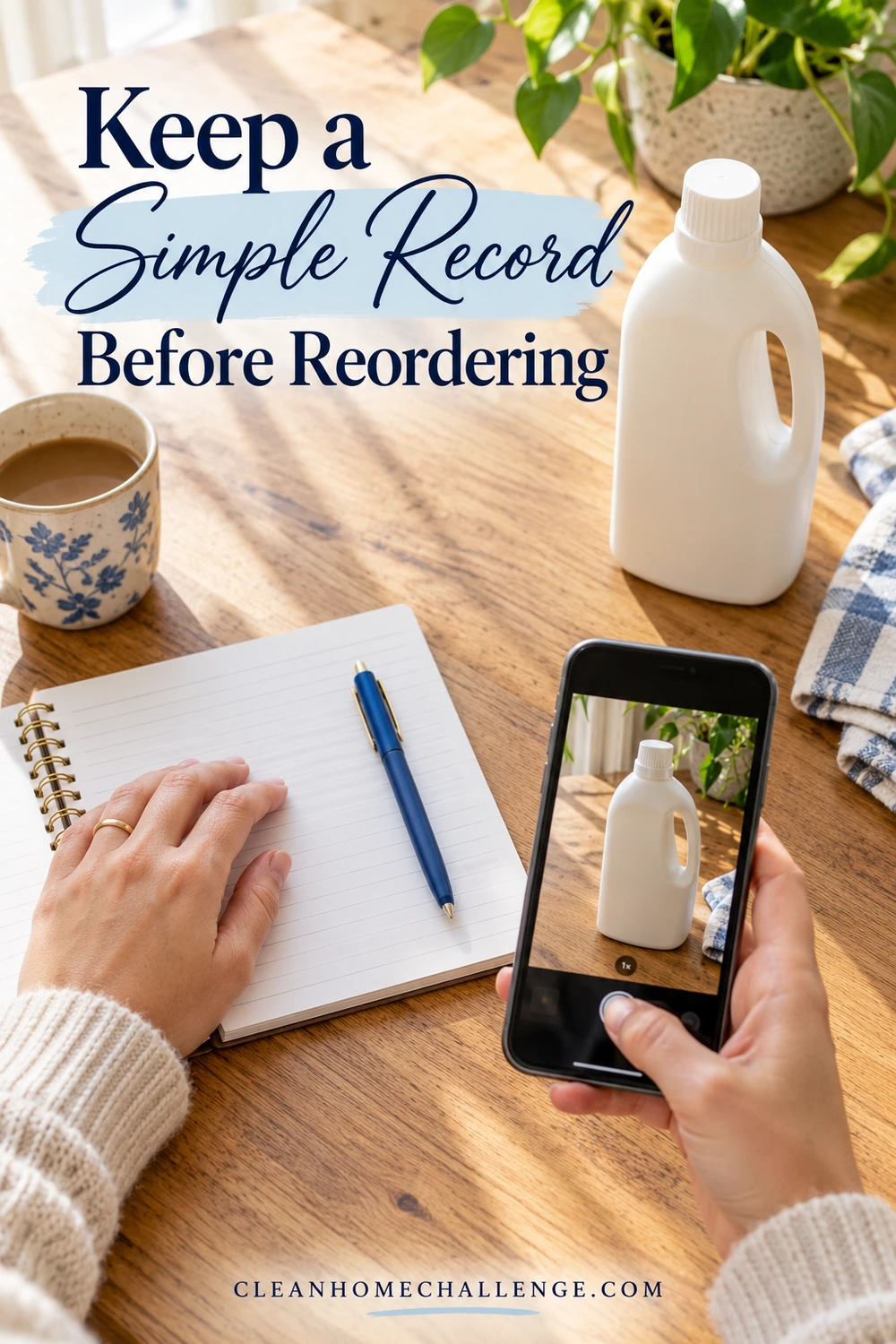
Keep a Simple Record Before Reordering
Once you have checked a product, save enough information that you do not have to start again at the next shopping trip. A photo of the front and back labels, the official listing, and the date you checked are usually more useful than a long list of products you might buy someday.
Use the free cleaning-claim checklist
Download the free Cleaning Claim Check worksheet (PDF).
Use one sheet per product. It has space for the exact variant, certifier, official listing, scope, instructions, and questions still unanswered. It is a purchasing record, not a medical symptom diary or a certificate of safety. You can keep a digital photo of the completed page if a paper binder is not your thing.
Work through it in this order:
- Write the full product name and the task you need it for.
- Find the certifier or write “manufacturer claim” if there is no named independent program.
- Match the listing to the variant and format you plan to buy.
- Note what the program actually assesses and any relevant limits.
- Read the current ingredients and directions against your household’s requirements.
- Mark unanswered questions and save the manufacturer’s response before deciding.
A hypothetical example: an online listing shows a certified unscented hard-surface cleaner, but the refill on the shelf has a different scent name. Do not copy the tick from the online listing onto the refill. Check that exact refill or choose the version you can verify. The same logic applies when the bottle says “new formula.”
Make rechecking part of the shopping reset
Before a repeat purchase, compare the name, variant, ingredients, certification information, and directions with your saved record. Recheck when something has changed, the official listing no longer matches, or you receive new household advice. Do not assume an old screenshot settles a current formula question.
There is no need to replace a whole cupboard simply to collect matching labels. Start with one frequently used product, buy only what you need, and keep your kit manageable. If you are browsing the supply list below, apply the same checks to each exact product; inclusion in a shopping list is not evidence of allergy-related certification.
For help making the routine itself easier to follow, you can explore Cleaners Clubhouse. Its practical cleaning guidance, routines, worksheets, and challenges can support the everyday work around the product decisions.
The next time a reassuring badge catches your eye, follow the short trail: named program, exact product, clear scope, usable directions. Save what you verified, ask about what is missing, and let one informed purchase be enough for today.
CLEANERS CLUBHOUSE
Build a Safer, Simpler Cleaning Routine
Clean confidently with practical guidance that helps you choose sensible products and use them correctly. The Cleaners Clubhouse combines safer cleaning support with realistic routines, worksheets and challenges.