

THIS POST MAY CONTAIN AFFILIATE LINKS. PLEASE READ MY DISCLOSURE FOR MORE INFO.
A balcony can become the place where dusty chairs, empty pots, and a forgotten watering can collect. Then the weather improves, you want to sit outside, and the whole space suddenly looks like a weekend project.
Learning how to clean a balcony is easier when you separate loose dirt, washable surfaces, and jobs that need building maintenance. For an apartment, the useful starting point is a controlled, low-water clean: collect debris, wipe accessible surfaces, and clean the floor in small sections without sending dirty water downstairs.
This checklist is for ordinary household dust and grime on a sound, accessible balcony. Allow roughly 45–90 minutes for a small balcony, plus drying time, as a planning estimate. Heavy clutter, fabric washing, or unfamiliar flooring can take longer. You can also split the work over two short sessions.
Disclosure: This post may contain affiliate links. As an Amazon Associate, Clean Home Challenge earns from qualifying purchases. If you make a purchase through these links, we may earn a small commission at no extra cost to you. This helps us keep creating practical cleaning tips, routines and resources for busy families! 🧽
Check Your Balcony Before You Clean
Confirm the building rules and floor finish
Check your lease, resident handbook, or building manager’s instructions before choosing a cleaner. Ask three useful questions: What is the floor surface? Which cleaning methods are permitted? Where should collected wash water go?
A gray balcony floor might be bare concrete, sealed concrete, painted concrete, or a waterproof coating. Those surfaces do not automatically share a care routine. Tiles and removable deck tiles may also sit over a waterproof system that you cannot see.
If the finish is unknown, stick to collecting ordinary loose debris while you get the care instructions. Do not experiment with an acid cleaner, bleach, a steam tool, or an aggressive scrub pad to see what happens.
Look for problems that cleaning cannot fix
From a safe position, look for loose railing components, cracked glass, lifting seams, peeling coatings, soft boards, significant cracks, or water remaining where it should drain. Photograph concerns and report them to the building manager. Do not test a loose railing by leaning on it, remove fixed drain covers, or try to reseal an unknown waterproof system.
The NSW Government’s balcony safety guidance emphasizes regular inspection and maintenance. A cleaning session is a useful opportunity to notice a problem, but it is not a structural inspection.
Set a safe working boundary
Choose a calm day when the surface is cool enough to clean comfortably. Postpone the job in high winds, heavy rain, icy conditions, or extreme heat. Wear shoes with a secure grip and keep children and pets away from the work area, wet floor, tools, and cleaning products.
Keep both feet on the balcony floor. No standing on chairs, leaning over the railing, or reaching around an exterior glass panel. Arrange inaccessible exterior cleaning through building management.
Do not move furniture against the railing while making space. The Sydney Children’s Hospitals Network balcony guidance emphasizes keeping climbable objects away from railings and supervising young children.
Pause for bird droppings or other contamination
Do not sweep, brush, or run a household vacuum through bird or bat droppings. CDC guidance warns against disturbing dry, dusty material during removal.
Keep the area separate from your routine cleaning. Ask the building manager about repeated fouling, nests, substantial buildup, dead birds, or contamination you cannot confidently identify. Seek an appropriate specialist for significant accumulations. For an isolated small spot, consult NYC Health’s cleaning precautions and local guidance before proceeding; this ordinary balcony checklist is not a contamination-removal procedure.

Gather a Simple Low-Water Cleaning Kit
You probably already own most of what you need:
- A soft broom and dustpan for ordinary dry debris
- Several clean microfiber cloths
- A flat mop with washable pads, if suitable for the floor
- A soft, non-scratching brush for approved surfaces
- Two small buckets or basins, one for the approved solution and one for clean rinse water
- A cleaner specifically compatible with the surface and its finish
- A few absorbent towels and a bag for collected debris
- Gloves and any other protection required by the cleaner’s label
An indoor household vacuum is optional only for ordinary dry dust and grit that its instructions allow. Keep it away from damp areas, rain, standing water, and contamination. A broom and dustpan may be more practical than managing a cord through the doorway.
Use manageable amounts of water rather than filling a heavy bucket. Keep buckets stable and away from the edge. Have enough clean mop pads or cloths to change them when they become dirty.
Read the cleaner’s dilution, contact-time, rinsing, and disposal instructions. More product can mean more residue and more work. Do not mix cleaning products. Patch-test the approved cleaner in an inconspicuous spot and let the test area dry before deciding it is suitable.
A small squeegee can be useful on compatible accessible glass, but only if you can catch the drips within the balcony. It is not a tool for pushing dirty floor water over the edge.

Clear Clutter and Capture Loose Dirt
Make a working space without creating another mess
Remove cushions and small decorative items first. Put dirty items on a washable tray or protected indoor surface rather than carrying balcony grime onto the sofa. Keep the doorway and your route back inside clear.
Lift lightweight furniture instead of dragging it. If a planter or table is too heavy to move comfortably, leave it in place and clean what you can safely reach. Ask for help rather than pulling a heavy pot across a membrane or piling everything into one corner.
For a narrow balcony, work in halves. Clean one area, allow it to dry, and then move a manageable item onto that clean section. You do not need to empty the entire balcony to make progress.
Collect debris instead of redistributing it
Pick up leaves, wrappers, and larger bits of potting mix. Use short, gentle broom strokes to bring ordinary grit toward a dustpan. Work inward from the edges without sending debris through railing gaps or into the drain.
Skip the leaf blower. On an apartment balcony, it can move the mess into someone else’s outdoor space and make a small, controlled job harder to contain.
Fold or roll a dirty outdoor rug inward to carry it to a suitable cleaning spot. Do not shake it over the railing. Check its label before vacuuming or washing, and confirm that both the rug and its backing are suitable for the balcony floor before returning it.
Give the doorway and pots some attention
Brush or vacuum ordinary dry grit from the accessible door track using a suitable attachment, then wipe it with a barely damp cloth. Leave drainage openings clear. Do not force tools under seals or pour water into the track to flush it out.
Collect spilled potting mix and wipe accessible saucers. Avoid pouring fertilizer-containing water or muddy water over the edge. If you cannot identify where a drain leads, ask the building manager rather than treating it as a convenient sink.
Once the loose dirt is gone, wiping and mopping become much easier. You also avoid turning a layer of grit into muddy streaks.

Clean Railings, Furniture, and Cushions
Work from higher accessible surfaces down toward the floor, using only the care method suited to each material. Clean the railing’s reachable inner side and top without stretching beyond the protected area.
Wipe railings and accessible glass
Start with a clean, soft cloth to lift ordinary surface dust. If washing is permitted, use the finish-approved cleaning solution on a well-wrung cloth. Wipe one small area, remove residue as directed, and dry with a fresh cloth where the finish allows.
For painted or powder-coated metal, avoid abrasive pads and improvised rust treatments. A rusty mark, loose fixing, or flaking finish may need maintenance rather than stronger cleaning. For wood, check the coating manufacturer’s instructions before wetting it.
Use a glass-safe method that also suits any coating, film, neighboring frame, and seals. Apply the cleaner to a cloth if its label permits, which helps limit overspray. If using a squeegee, keep a towel ready to collect drips inside the balcony and finish the lower edge with a cloth.
Leave hard-to-reach outer surfaces alone. A streak that is outside your safe reach can wait for an approved cleaning service.
Wash furniture one piece at a time
Remove loose dirt from chair seats, table edges, and accessible crevices. Wipe washable frames using their own care instructions. The same cleaner is not necessarily suitable for metal, resin wicker, wood, and fabric.
Pay attention to chair feet before moving the furniture onto a clean floor. Replace damaged protective feet with a type compatible with the balcony finish. Never improvise with adhesive pads or rubber-backed materials if the floor manufacturer warns against them.
Check folding mechanisms and storage compartments for debris without dismantling anything unfamiliar. Let pieces dry before stacking or covering them, and keep covers secured in the way their manufacturer recommends.
Treat cushions according to their construction
A zipper does not prove a cushion cover is machine washable. Read the furniture label before removing it. Some outdoor fabrics tolerate washing methods that the foam, backing, trim, or finished cushion does not.
For example, Sunbrella’s upholstery care guide directs users to confirm whether removable casings can be machine washed, rinse away cleaning residue, and allow the fabric to air-dry. That advice applies to the specified fabric and construction, not every outdoor cushion.
Choose an approved washing location where you can contain and dispose of rinse water. If a cushion needs a thorough rinse, do not compromise its care instructions just to wash it on the balcony. Clean it elsewhere or arrange suitable help.
Dry cushions fully before returning them to storage. If you only have a short window today, wipe the furniture frames and put cushion washing on a separate day.

Mop the Balcony Floor Without Runoff
The goal is to remove dirt while keeping wash water under control. It is not to soak the balcony and hope the drain handles it.
Pinellas County’s runoff-prevention guidance recommends collecting debris rather than hosing it away and keeping wash water out of storm drains. Building drainage arrangements and local disposal requirements vary, so confirm your own route before starting.
Match the method to the material
Ceramic or porcelain tile: Check the tile, grout, and any sealer instructions. Use a compatible cleaner and a non-scratching tool. Do not assume a strong grout cleaner is also suitable for the tile or surrounding metalwork.
Natural stone: Choose a product approved for the particular stone and finish. The Natural Stone Institute recommends appropriate neutral cleaning products and warns that acids such as vinegar can etch acid-sensitive stone. Skip vinegar, abrasive powders, and improvised acid treatments.
Painted, sealed, or coated concrete: Follow the coating’s care guide. A product sold for bare concrete may be unsuitable for its top layer. Stop if cleaning lifts color or exposes a damaged surface.
Vinyl or another waterproof membrane: Get the exact system’s instructions. Duradek’s care guidance stresses thorough residue removal and protecting the surface from dragging sharp or heavy objects. Do not scrape seams, pry up edges, or substitute a low-water method if the manufacturer requires a rinse you cannot safely provide.
Wood or composite decking: Identify the material and product line. Trex publishes different care directions for newer and early-generation decking, including different pressure-washing restrictions. A method shown for one deck is not permission to use it on yours.
For removable deck tiles, do not dismantle the floor unless the product and building instructions permit it. Cleaning the top surface does not confirm that the space below is clear or the waterproofing beneath is sound.
Use a controlled, section-by-section method
This approach is for a floor whose care instructions allow damp mopping and residue removal with controlled amounts of water.
- Test a small section. Start at the label’s recommended dilution, not an extra-strong mixture. Confirm that your cloth or mop can lift the dirt without flooding the surface.
- Begin at the far end. Work toward the door so you can leave without stepping across the wet floor. Keep a clear, dry place to stand.
- Apply a small amount. Wring the mop thoroughly. The pad should clean the surface without leaving puddles, flowing water, or a wet trail toward the edge.
- Lift the soil. With a flat mop, use controlled pull-back strokes, lifting and repositioning the head rather than repeatedly pushing dirty water around. Use a compatible soft brush for a small textured area only when needed.
- Change dirty water and pads. A visibly grubby pad will spread the dirt. Switch to a clean one and refresh the water as necessary.
- Remove cleaner residue. Follow the product and surface instructions. Where a damp rinse pass is suitable, use clean water and a clean pad, collecting it as you go. Some systems require more extensive rinsing; arrange an approved method instead of leaving cleaner behind.
- Pick up remaining moisture. Use a suitable clean pad or cloth, then allow the floor to dry before putting furniture or rugs back.
Keep towels available for incidental drips, but do not plug drains or create a dam at the threshold. If water starts flowing toward an edge, door, or neighbor’s space, stop adding water and collect it.
Handle stubborn marks without escalating blindly
For an ordinary food spill, blot the excess first and follow the surface’s stain guidance. For rust, white deposits, greasy buildup, unknown stains, or recurring green growth, identify the cause and finish before choosing treatment. A persistent mark may be a maintenance problem rather than remaining dirt.
Do not bring out a pressure washer simply because the balcony looks dirty. Material approval, building permission, safe access, and wash-water collection all matter. This checklist does not require one.
Strain collected solid debris into the trash and dispose of the remaining cleaning water through the route approved for that product and building. Never empty the bucket over the railing, into a street drain, or onto another balcony.

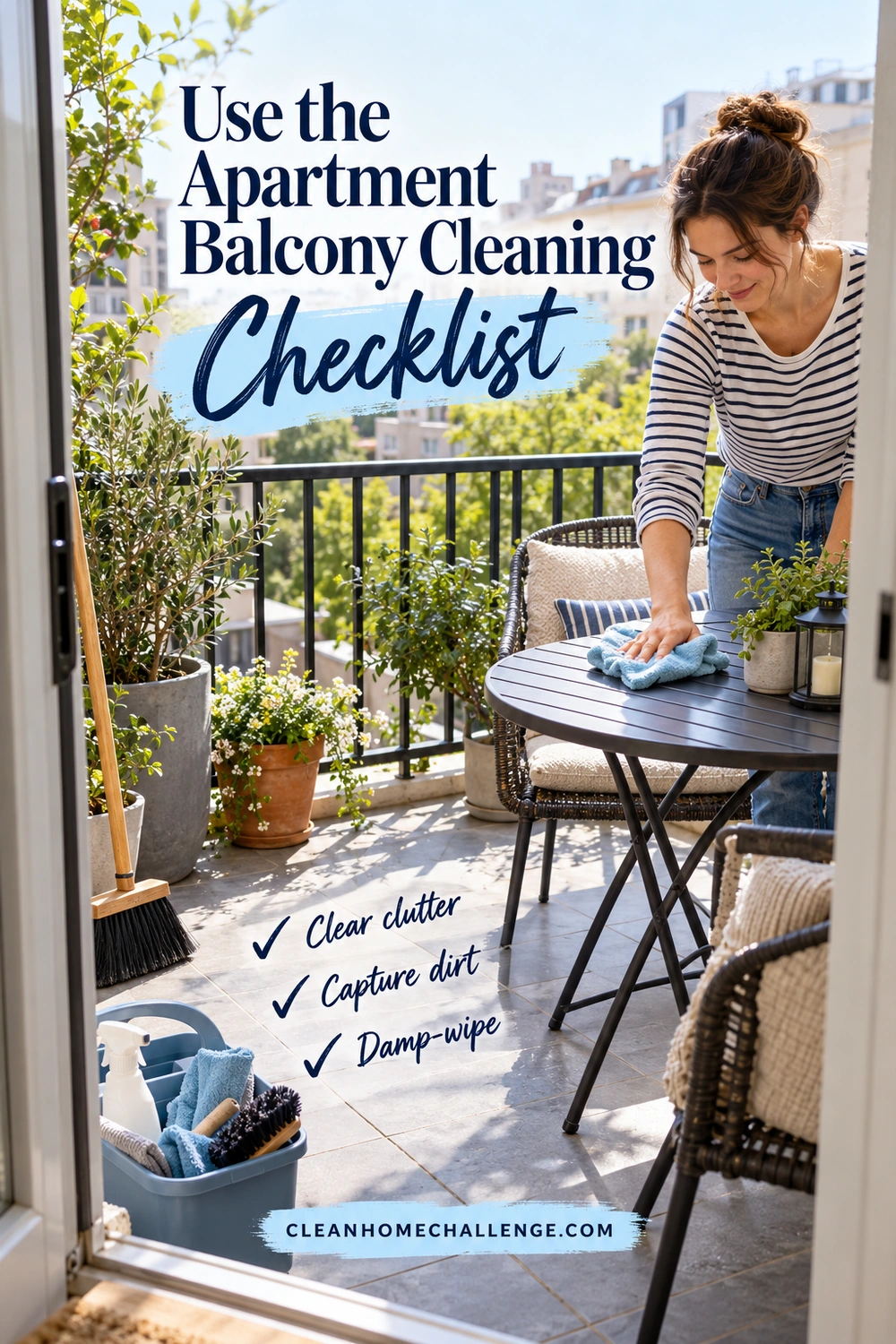
Use the Apartment Balcony Cleaning Checklist
Save this list for your next cleaning session. Check off the parts that apply to your balcony rather than adding jobs your space does not need.
Before cleaning
- Confirm the building’s cleaning and wash-water rules.
- Identify the floor, coating, and furniture care instructions.
- Check for damage, loose railings, drainage concerns, and contamination.
- Choose suitable weather and keep children and pets clear.
- Gather the compatible cleaner, tools, clean pads, and towels.
- Patch-test the cleaner and inspect the dried test area.
During cleaning
- Remove or safely reposition lightweight items.
- Bag leaves, litter, and ordinary loose debris.
- Collect grit from accessible corners and the door track.
- Wipe reachable railings, glass, and furniture.
- Clean cushions separately according to their labels.
- Mop the compatible floor in small sections.
- Change dirty pads and water, then remove cleaner residue.
- Collect moisture without sending runoff downstairs.
Before finishing
- Confirm the floor and furniture are dry enough for use.
- Return only fully dry cushions and rugs.
- Leave drains and the doorway clear.
- Keep climbable furniture away from the railing.
- Dispose of debris and wash water appropriately.
- Wash and dry the cleaning tools; store products securely.
- Send any maintenance photos to the building manager.
For a smaller first step, do the safety check, collect ordinary loose dirt, and wipe one chair and the table. That creates a usable spot without starting a wet-cleaning job you do not have time to finish.
Download the one-page apartment balcony cleaning checklist and keep it with your cleaning supplies. Use it alongside the surface-care and safety guidance in this article.
Keep Your Balcony Comfortable With Small Habits
Use this as a flexible starting routine, then adjust for wind, trees, nearby construction, pets, and how often you sit outside.
After using the balcony: Bring in food and dishes, wipe a fresh spill using the appropriate method, and return lightweight items to secure storage. Check under a plant after watering so a small overflow does not become a muddy ring.
Once a week, if needed: Spend about five minutes collecting leaves and ordinary grit, wiping the table, and looking for new maintenance concerns. Skip the full mop when the floor does not need it.
Seasonally or when visibly dirty: Repeat the fuller checklist, inspect under movable items, and plan fabric washing for a day with enough drying time. Follow any more specific maintenance schedule for your flooring or furniture.
Tie the balcony check to an existing routine, such as your Friday floor reset, rather than creating another daily obligation. Our Cleaning Schedule for a Small Home or Apartment can help you fit it around the rooms you use most.
Finish by rinsing suitable mop pads and cloths, laundering them according to their labels, and drying them before storage. For a manageable tool-care routine, see How to Store and Maintain Cleaning Tools So They Last Longer.
A comfortable balcony can have a few weathered surfaces and still be a lovely place to take a break. Keep the floor usable, the furniture ready, and the next small clean easy to start.


CLEANERS CLUBHOUSE
Follow a Simple Room-by-Room Cleaning Plan
Break the house into manageable spaces and know exactly where to focus next. The Cleaners Clubhouse gives you a follow-along 12-month calendar, printable worksheets and motivating monthly challenges.