
THIS POST MAY CONTAIN AFFILIATE LINKS. PLEASE READ MY DISCLOSURE FOR MORE INFO.
“Ask your sister—she’s better at that.” “Let Dad handle the tools.” Familiar phrases can slip into a busy day without anyone meaning to close a door. Over time, though, they can make laundry, cooking, cleaning, and basic home care feel like jobs a person inherits because of their gender.
Gender neutral chores start with a different question: What can this person safely do, what support do they need, and what would be useful for them to learn? You can keep a comfortable family routine while making room for everyone to develop a broader set of skills.
You do not need a new chart or a serious speech every night. Start with one ten-minute conversation, one language change, and one manageable teaching opportunity this week. This guide includes conversation examples and a skill-exposure worksheet you can copy or print. The timings are practical suggestions, not a tested program or a promise that family habits will change on a schedule.
Disclosure: This post may contain affiliate links. As an Amazon Associate, Clean Home Challenge earns from qualifying purchases. If you make a purchase through these links, we may earn a small commission at no extra cost to you. This helps us keep creating practical cleaning tips, routines and resources for busy families! 🧽
Notice the Assumptions Behind Your Chore List
Begin with curiosity rather than an announcement that everyone has been doing things wrong. Write down who usually handles six ordinary jobs: preparing a simple meal, clearing the table, doing laundry, cleaning a shared space, taking out household trash, and checking whether supplies need replacing. Add safe maintenance tasks if they are part of your home life.
For each job, ask why that person usually does it. A work schedule, mobility need, genuine preference, or existing skill can be a sensible reason. “That’s what women do” or “boys aren’t good at details” makes gender the deciding factor. Familiarity can also hide an old assumption: someone may look naturally capable because they have had years of practice that others never received.
UNICEF’s parenting guidance encourages families to question unequal expectations in household tasks. Raising Children Network similarly recommends offering children a range of home responsibilities and reflecting on the examples adults set. These ideas support a practical starting point: give people access to learning before deciding a skill does not suit them.
Look beyond the visible action. Who remembers the clean towels, notices the empty soap, or teaches a younger child where things go? If a girl is routinely asked to organize everyone while a boy receives one clearly defined job, the difference may be in responsibility rather than the number of boxes checked.
Try these private questions before the family conversation:
- Have I offered the same kind of instruction to each learner?
- Do I praise one child for basic participation but expect another to do it without recognition?
- Who gets time to learn cooking or practical maintenance, and who is expected to tidy afterward?
- Have I mistaken a disability, sensory need, or lack of practice for unwillingness?
- Does one person’s preference quietly remove another person’s choice?
You are looking for patterns, not proof of bad intentions. There is no need to count every minute or make siblings perform identical jobs. The useful change is to stop treating gender as the reason a skill belongs to someone.
For a broader discussion about workload and ownership, read How to Split Household Cleaning Fairly Without Constant Reminders. Here, the focus is on opening up learning opportunities and changing the language around them.

Use Words That Name the Task and the Skill
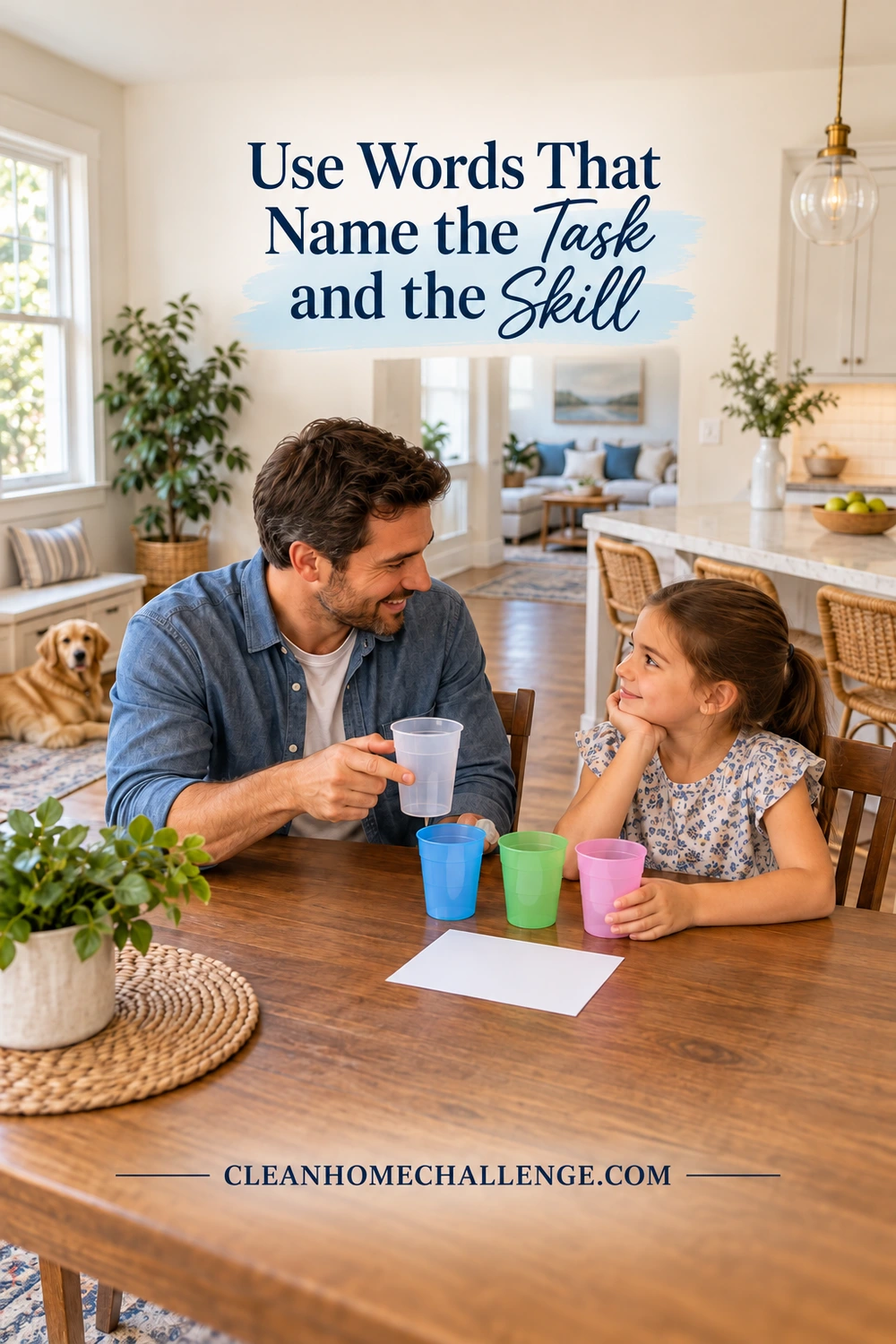
Choose a calm moment, away from a missed chore or a rushed school morning. A simple opening is: “I’d like everyone to have a chance to learn the skills that keep our home running. Let’s look at what we’ve each practiced and choose one thing to learn next.”
Keep requests concrete. Name the task, the expected result, and any help available. “Please put the clean towels on the bathroom shelf before dinner; I’ll show you where the larger ones fit” gives more useful information than a comment about who is supposed to be tidy.
| Familiar phrase | A more useful alternative |
|---|---|
| “Girls are better at keeping things neat.” | “Putting things away is a skill we can all practice.” |
| “Go help Mom with her kitchen.” | “The kitchen needs a reset. Which part are you taking?” |
| “That’s a man’s job.” | “That job needs the right training and safe equipment.” |
| “Your brother doesn’t notice those things.” | “Let’s show everyone what to check before the job is finished.” |
| “Be a good little helper.” | “Thank you for completing your part of our shared work.” |
| “Ask your sister to remind you.” | “Let’s choose a cue you can check yourself.” |
“Help” is not a forbidden word. People help one another all the time. The aim is to avoid making one adult the permanent owner of the home and everyone else an occasional assistant. You can say “Can you help me carry this?” without implying that all housework belongs to you.
When an old phrase slips out, repair it briefly: “I said that badly. Anyone can learn this. What matters here is doing it safely.” A short correction models learning without turning dinner into a lecture.
If a child repeats “That’s for girls” or “Boys don’t do that,” ask where the idea came from, then give a clear family expectation: “People of any gender need clean clothes and food. In our home, everyone gets to learn.” Avoid mocking the child or another household’s choices. Return to a small practical action, such as learning to match socks or clear an unbreakable place setting.
Use names and task descriptions on charts rather than gender categories. Let children choose colors and symbols they can easily recognize. Pink, blue, or any other color can remain a personal preference; it does not need to determine which job somebody receives.
Teach Household Skills With Safe, Supported Practice
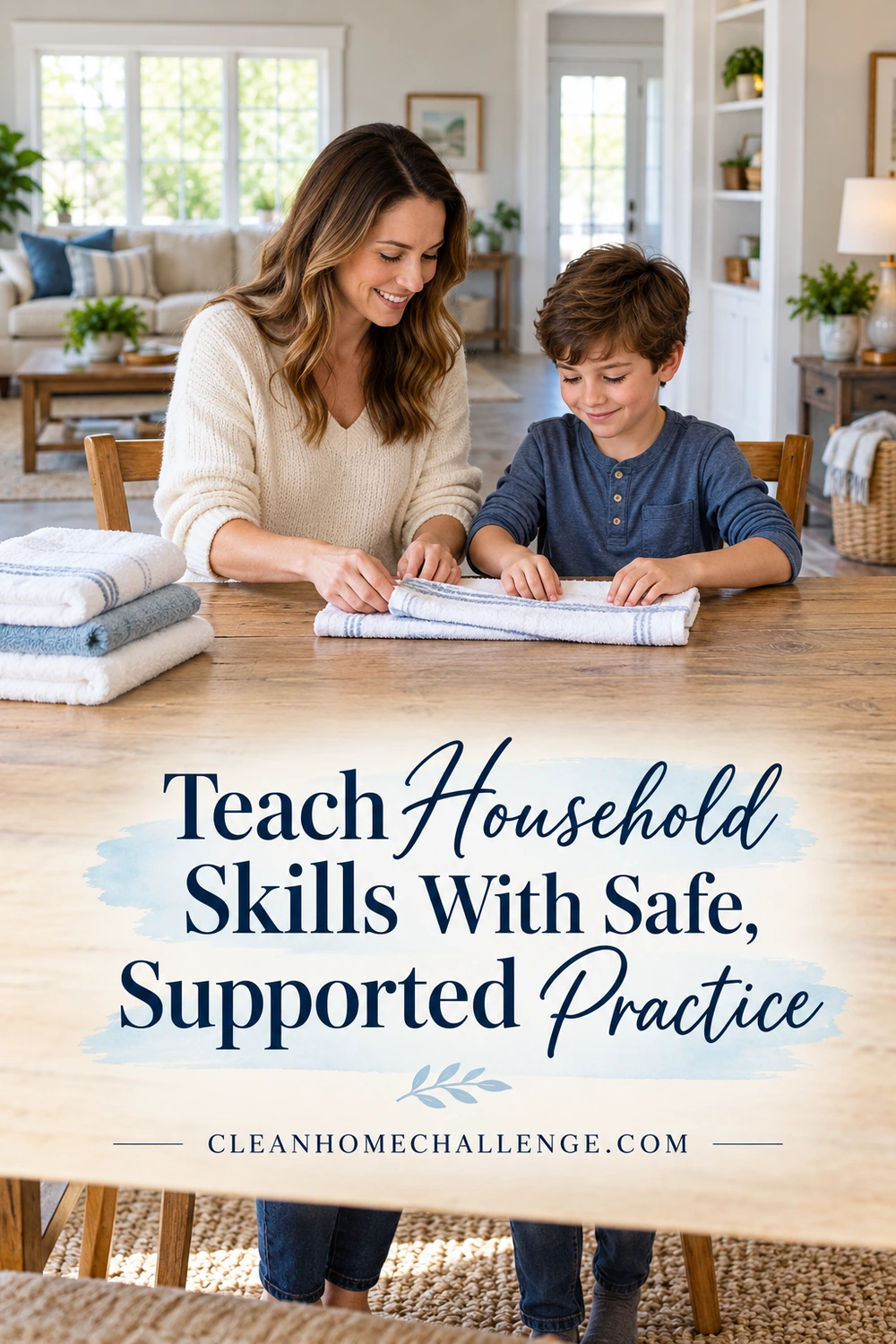
An invitation to learn needs actual teaching time. Start with a task small enough to demonstrate in a few minutes: folding a hand towel, setting out unbreakable cups, returning books to a shelf, or sorting clean socks. Match the task to the individual child’s development, understanding, coordination, and support needs.
The American Academy of Pediatrics recommends realistic expectations, clear routines, encouragement, and support when children learn chores. Age lists can suggest possibilities, but they do not replace knowing your own child or checking the hazards of a particular task.
Use this teaching sequence as a flexible household method:
- Explain the finish line. “The towels go on this shelf, with the edge facing forward so they stay together.”
- Demonstrate once at a comfortable pace. Describe the useful steps instead of expecting the learner to infer them.
- Practice together. Let the learner handle the safe parts. Ask whether a shorter instruction, picture, seated position, or different tool would help.
- Offer another supported attempt. Give one correction at a time and allow ordinary beginner mistakes.
- Agree on the next step. Record “practice together again” when independence is not yet appropriate.
Keep instruction balanced across skill areas. A child who often folds laundry could also learn safe food preparation. A child who usually carries recycling could learn where towels belong. Adults can broaden their skills, too: one adult might learn garment-care symbols while another learns a safe household supply check. These are examples, not required trades.
Learning does not mean handing children hazardous work. Adults retain responsibility for cleaning chemicals, sharp objects, hot appliances, electrical work, ladders, heavy lifting, and unsafe waste. Do not use a live repair or a difficult cleaning product as a demonstration activity simply to challenge a stereotype. A maintenance lesson might instead involve an adult explaining when to report a loose handle and why a child should not try to fix it alone.
Keep chemicals secured in their original containers and follow product labels. Children do not need a spray bottle to participate: returning books, folding clean towels, or arranging safe table items builds useful habits without exposure to cleaning products. Any cleaning method must also suit the surface and its manufacturer instructions.
Avoid redoing a learner’s safe work in front of them purely for appearance. If the result needs improvement, teach the missing step. If an adult must intervene for safety, explain that reason directly. “The walkway needs to be clear so nobody trips” is more helpful than “You’re just not a tidy person.”
Fill In a Skill-Exposure Worksheet Together
This worksheet is a conversation aid, not a scorecard or a developmental test. It helps you notice who has had a chance to learn, who would like practice, and what support makes participation possible. Complete it for willing participants and keep individual notes private if a shared display would feel embarrassing.
Use one sheet per person. Do not label someone permanently as “bad at” a task. Choose a current stage: new to me, watching, practicing together, or ready for an agreed responsibility. Revisit it as needs and confidence change.
Person: __________ Date: __________ Chosen check-in date: __________
| Skill area | A safe example to consider | My current stage | Support or adaptation | One next practice |
|---|---|---|---|---|
| Food and kitchen routines | Set out unbreakable cups | __________ | __________ | __________ |
| Laundry and clothing | Match clean socks or fold a towel | __________ | __________ | __________ |
| Shared spaces | Return books to an accessible shelf | __________ | __________ | __________ |
| Household supplies | Tell an adult when hand soap is low | __________ | __________ | __________ |
| Basic maintenance awareness | Notice and report a loose handle | __________ | __________ | __________ |
| Planning and follow-through | Check a simple personal task cue | __________ | __________ | __________ |
One skill I want to learn: __________
Someone who can teach me: __________
A suitable time and place: __________
What finished will look like: __________
What stays an adult responsibility: __________
For example, a child might choose towel folding, practice alongside an adult while seated at a table, and put two folded towels on a reachable shelf. A sibling might learn the same skill another week. The point is access to instruction, not making everyone produce the same result on the same day.
Adapt freely. Use spoken notes, large print, tactile markers, photos of your own storage spaces, or a short audio reminder if those work better. A person who cannot safely carry a basket may still sort items at a table. Do not assume a limitation makes every part of an activity inaccessible, and do not pressure someone to prove their capability through an unsuitable task.
Keep practice brief enough to fit around ordinary life. Five minutes beside an existing routine is often a workable starting offer. If the household is overwhelmed, fill in just one row and leave the rest for later. You can print the worksheet section of this guide or copy these fields onto paper you already have.

Keep the Conversation Fair as Family Needs Change
Gender neutral chores do not require an exact rotation of every job. People can have preferences, specialized skills, and different capacity. A family member who enjoys cooking may keep doing much of it, provided the arrangement is discussed and others have a fair opportunity to learn and contribute.
Ask what a preference actually means. “I like cooking” does not necessarily mean “I want to plan every meal, shop, cook, and wash every pan.” Likewise, someone who prefers outdoor work still needs the chance to develop indoor household skills. Make the arrangement explicit rather than relying on assumptions.
When someone says “I’m no good at it,” separate unfamiliarity from a real barrier: “Would a demonstration help, or is there something about this task that makes it unsuitable?” Offer a small supported attempt where appropriate. If pain, fatigue, sensory distress, accessibility, or another limitation is involved, adapt or choose another meaningful contribution. Fairness includes rest and support.
If a relative makes a gendered comment, a brief boundary can be enough: “We’re teaching everyone the household skills they can safely learn.” You do not need to win a debate in front of the children. Keep the tone respectful and follow through with your own routine.
Try a short check-in after your chosen practice period:
- Did each learner receive instruction rather than just a new demand?
- Did anyone get an opportunity they would usually miss?
- Did the teaching or reminding fall back onto one person?
- Is the task still safe, manageable, and appropriate?
- What is one useful change for next time?
Praise the specific contribution: “You checked the shelf and put the towels away without being asked.” Keep standards comparable for people with comparable experience and support needs. Ordinary participation should not earn exceptional praise for one gender while going unnoticed for another.
On a hectic week, keep the essential household routine and postpone new teaching. You have not undone the progress because a parent handled dinner or somebody used their familiar skill. Return to the next learning opportunity when there is room.
Choose one sentence to change and one skill to open up this week. A home becomes easier to share when people understand what needs doing, know they can learn, and receive the support to contribute. That is a useful outcome even when the laundry still waits until tomorrow.
Sources and Further Reading
Guidance checked October 22, 2026. The scripts, worksheet, and suggested practice sequence are original editorial tools informed by the sources below; they are not a validated intervention.
- UNICEF: Four key ways to promote equity in household tasks
- UNICEF Parenting: Equal treatment from day one
- American Academy of Pediatrics: Age-Appropriate Chores for Children
- Raising Children Network: Healthy attitudes to gender for children and teenagers

CLEANERS CLUBHOUSE
Turn Small Daily Habits Into a Cleaner Home
Make cleaning feel more achievable by sharing simple routines and building habits that stick. The Cleaners Clubhouse includes the 7-Day Daily Habits Bootcamp, printable support and motivating monthly challenges.