
THIS POST MAY CONTAIN AFFILIATE LINKS. PLEASE READ MY DISCLOSURE FOR MORE INFO.
The first few weeks with a new roommate can be full of little discoveries. One person washes dishes straight after dinner; another expects to do them before breakfast. You might both think you are taking care of the trash, yet the bin still overflows because neither of you knows whose turn it is.
A first-month roommate chore review gives you a chance to compare the original plan with everyday life, then agree on one practical change. Choose a calm time, bring a couple of specific examples, listen to each person’s experience, and write down what you will try next. The goal is a shared home that works for everyone.
You do not need a long meeting or a new chore app. A notebook, your current agreement, and about 15 to 20 minutes are enough for the suggested agenda below. That time is a planning option, not a deadline you have to meet. The free worksheet gives you somewhere to capture the decision without turning the conversation into a list of complaints.
Disclosure: This post may contain affiliate links. As an Amazon Associate, Clean Home Challenge earns from qualifying purchases. If you make a purchase through these links, we may earn a small commission at no extra cost to you. This helps us keep creating practical cleaning tips, routines and resources for busy families! 🧽
Prepare a Calm First-Month Cleaning Check-In

Invite everyone before a small irritation becomes the whole conversation
Ask for a time rather than launching into the discussion while someone is trying to leave for work. Try: “We’ve been here about a month now. Could we spend 15 minutes on Saturday looking at which cleaning arrangements are working and which need changing? I’d like us both to have a say.”
If three or more adults share the home, include everyone affected by the change. A conversation between two people should not assign a third person’s chores. Choose a setting where people can hear one another and take a break if needed. Sitting at the table may feel easier than standing beside the sink you are upset about.
The month mark is a useful editorial starting point because you have some real experience to discuss; it is not a scientifically established best time. If the current arrangement is causing a problem sooner, bring it up sooner. If things are comfortable, a short check-in still lets you confirm that the plan feels workable.
Bring a small amount of useful information
Read whatever you originally agreed, including a shared note or message. Each person can bring one thing that is working and one recurring difficulty. Keep the examples ordinary and recent. “The bathroom floor stayed wet after the last two evening showers” is more useful than “You never care about the bathroom.”
You do not need photographs of someone’s belongings, a tally of every cup, or a case to prove. Avoid entering private rooms or opening cupboards to gather evidence. This is a review of shared arrangements, with personal spaces and possessions respected.
Before the meeting, consider three questions:
- Which shared space has been hardest to use comfortably?
- Is the difficulty the task itself, its timing, the supplies, or uncertainty over responsibility?
- What small adjustment could you reasonably do yourself as part of a new plan?
Use a short agenda
Here is a suggested 20-minute shape. Shorten it or split it into two conversations if that suits your household.
| Part | Suggested time | Useful question |
|---|---|---|
| Notice what works | 3 minutes | What should we keep doing? |
| Hear each person’s example | 7 minutes | What happened, and what made it difficult? |
| Choose one trial change | 7 minutes | Who will do what, and when? |
| Confirm the follow-up | 3 minutes | Where will we record this and when will we review it? |
If you only have five minutes, choose one shared-space problem and one next step. Save the rest for a time you both accept. A rushed conversation does not need to settle the whole household routine.
Discuss Real Examples Without Assigning Blame

Describe the task, its effect, and a possible change
For a sink problem, you could say: “When the pans are left in the sink overnight, I can’t fill the kettle easily before my early shift. Could we agree on somewhere for pans that need soaking and a time for finishing them?” Then pause and listen. Your roommate may have understood the original agreement differently, or the proposed time may be impossible for them.
UCLA’s roommate guidance recommends discussing a specific observation, its effect, and a possible solution while giving the other person space to respond. Use that approach to start a two-way conversation, rather than rehearsing a speech that leaves only one acceptable answer.
Ask a practical question: “Which part is getting stuck?” You might find that the dish rack is always full, the vacuum is inaccessible, or both people assumed the other was buying trash bags. Fixing that obstacle can be more useful than adding another reminder.
Separate shared needs from personal preferences
Work through what the space needs to let everyone use it. A clear place to prepare food is a different concern from wanting every appliance hidden. One roommate may prefer perfectly aligned cushions; the other may be comfortable with a lived-in sofa. Name the result you need and ask which details can stay flexible.
For example, an agreed kitchen finish might be: food put away, each person’s dishes dealt with by the agreed time, and spills cleaned using a surface-compatible method. It does not have to include reorganizing another person’s shelf. These are sample discussion points, not universal rules for every home.
Avoid diagnosing a roommate as lazy, careless, or controlling. Ask what is manageable without demanding private health, financial, or personal information. If someone cannot do a particular physical task, discuss a workable alternative rather than assuming the limitation removes their voice from the plan.
Make room for different schedules
Two people can contribute without cleaning at the same hour. A person coming home after midnight may be able to handle quiet tasks but not run a noisy vacuum. Someone with an early start may need the bathroom ready at a different time from a person who works from home.
Describe the actual conflict: “The vacuum wakes me after my night shift” is clearer than “You clean at the wrong time.” Consider an agreed quiet window, a different day, or a task swap. Ask before treating someone’s work-from-home hours as free cleaning time.
If the discussion gets tense, stop and name a return time you both accept. “I want to sort this out, but I need a break. Can we come back to the kitchen plan tomorrow at six?” is more constructive than continuing until someone gives in. A cleaning conversation is not a substitute for support if you feel threatened or unsafe.
Agree on One Clear Change to Try

Put the decision into a complete sentence
“We should both help more” is hard to act on. A useful trial names the task, the person responsible, the agreed finish, the time, and the review date. Try this structure:
For the next two weeks, we will try ______. ______ owns the next step. Finished means ______. It happens by ______. If that becomes difficult, we will ______. We will review it on ______.
Two weeks is simply a manageable example. Choose a trial long enough to encounter the problem again without making the change feel permanent before you have tested it.
Here is an invented household example: Alex and Sam initially agreed to “share the trash.” After the first month, neither knows who should act when the kitchen bin is full. They decide that Alex checks it after dinner on Monday, Wednesday, and Friday; Sam checks it on the other days. Their finish includes taking the bag to the correct collection point and fitting a new liner. They agree to handle a full bin sooner when needed and review the arrangement after two weeks. The useful part is the clarity, not that particular division of days.
Include the small steps that are easy to overlook
Ask whether a chore includes buying supplies, putting equipment away, and telling someone when a problem needs attention. Do not assume the person who cleans most often will also maintain the entire system.
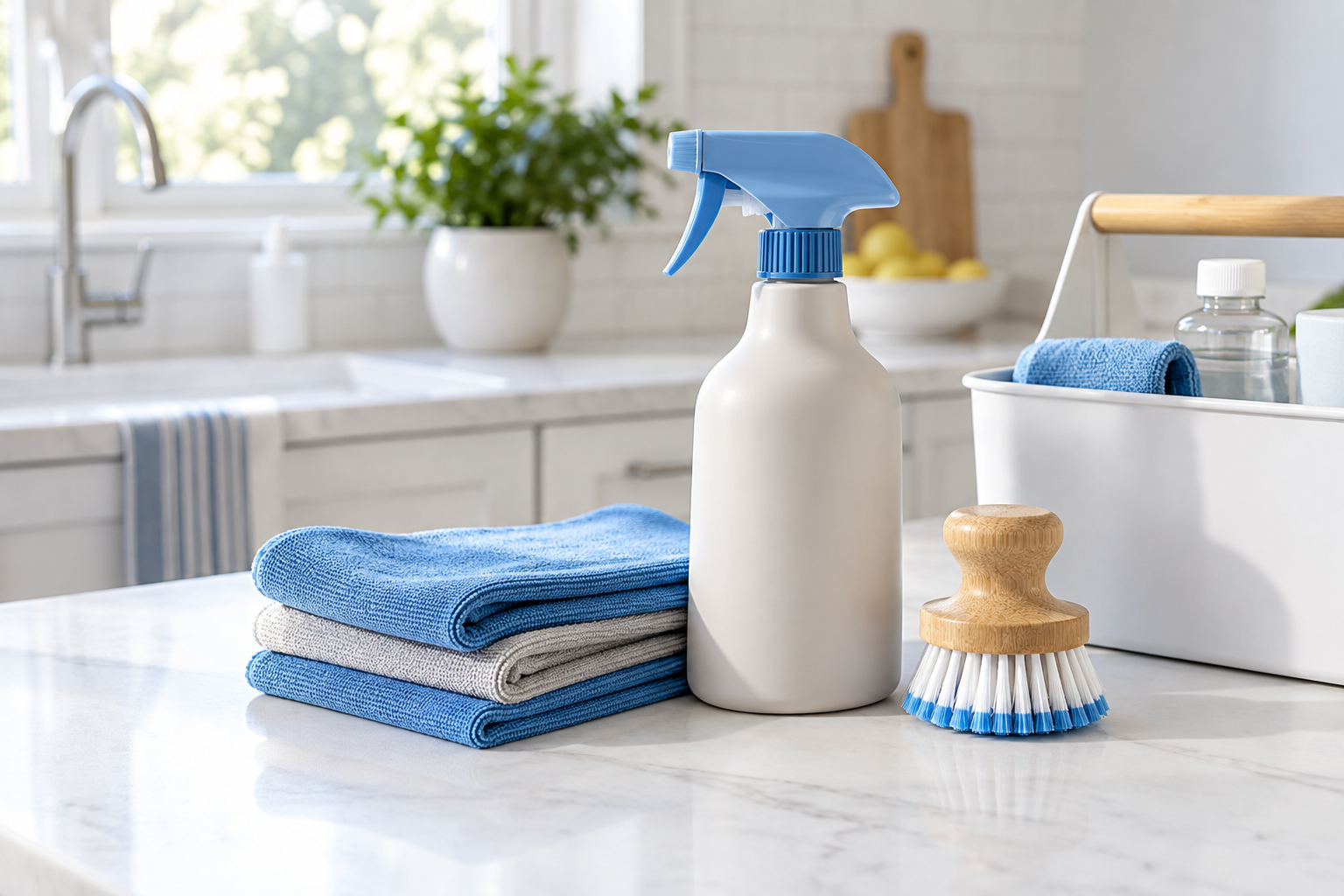
For example, if the bathroom task includes replacing an empty cleaning product, agree on who checks stock, what the shared budget is, and how a purchase is approved. A shared basket of existing tools may be enough; you do not need to buy a new set to make an agreement work. If you do need supplies, choose products suitable for your surfaces, follow their labels, and never mix cleaners.
If your shared home is still missing the basics, the beginner’s cleaning kit for a first home or apartment can help you think through useful supplies. Check what you already own together before adding anything to the shopping list.
Decide how reminders and swaps will work
Choose one place for the plan that everyone can actually use: a shared note, paper sheet, or calendar. Ask before putting a chart on a shared wall. A visual chart may be convenient for one person and inaccessible or distracting for another; a text or spoken summary can work too.
Agree on the reminder, not just the chore. “Send one message in the house chat if the task is still unfinished after the agreed time” is a possible option. It should be mutually accepted rather than assigning one roommate permanent supervisor duties.
A swap also needs a clear handoff: name the replacement task or date and get agreement from the person taking it on. An unanswered message is not proof that someone accepted responsibility. If the trial needs changing halfway through, record the new agreement where everyone can see it.
Download the free review worksheet
Download the first-month roommate cleaning review worksheet (PDF). Free to use, with no sign-up required.
The two-page worksheet has a short discussion agenda and space to record one real example, the agreed trial, ownership, reminders, and the review result. You can use it together or each jot down a few points first. It is a practical conversation aid, not a contract or a requirement to disclose personal information.
Review the Trial and Keep What Works

Ask whether the shared space became easier to use
At your agreed review time, read the actual trial sentence. Did the change happen? Did it make the original problem easier? Was the effort reasonable for everyone? Ask each person before deciding that a quieter house chat means everyone is happy.
Keep a change that helped. Adjust one part if the result was useful but the timing was awkward. Retire an arrangement that made extra work without solving the problem. You do not have to rewrite every chore agreement because one task needs a better handoff.
For instance, if trash checks worked but new liners were often forgotten, put the agreed liners in an accessible place and clarify that replacing the bag is part of the finish. If nobody could meet the chosen time, choose a realistic time instead of adding more warnings. If one person repeatedly covered the other, discuss that openly rather than calling the trial successful.
Stanford’s Roommate Guide encourages regular conversations about expectations and seeking support when recurring problems cannot be resolved. A resident adviser, housing support service, or suitable independent mediator may help with a stuck discussion. Choose support appropriate to your living arrangement; do not assume a private rental has campus resources.
Keep the routine small enough to repeat
Once the trial settles, agree on a light check-in that suits your home. It might be a brief monthly conversation or a review when work schedules change. Keep a place for new concerns so they do not all appear during a rushed morning. A check-in is a chance to adjust the plan, not an inspection of another adult’s character.
If you want help building your own manageable habits alongside the shared agreement, you can explore the Cleaners Clubhouse. Use the free worksheet first, then choose additional routine support if it would be useful for you.

CLEANERS CLUBHOUSE
Turn Small Daily Habits Into a Cleaner Home
Make cleaning feel more achievable by sharing simple routines and building habits that stick. The Cleaners Clubhouse includes the 7-Day Daily Habits Bootcamp, printable support and motivating monthly challenges.
End by confirming the next step aloud: “We are trying the new kitchen finish until Sunday the 13th, and we’ll review it after dinner.” Add a specific thank-you for something that helped. You can leave the conversation with a workable next step even when the whole house is not perfectly tidy.
Sources and further reading
- UCLA Residential Life: Living with Roommates – specific, respectful discussion and support options for campus residents.
- Stanford Graduate Life Office: Roommate Guide – shared expectations, check-ins, and conflict support.
- Georgia Tech: Cleaning Agreement and Roommate Resources – written cleaning plans and ways to share responsibilities.
Research checked November 26, 2026. The agenda, scripts, worksheet, and household examples are original practical suggestions, not a tested guarantee of a particular outcome.