
THIS POST MAY CONTAIN AFFILIATE LINKS. PLEASE READ MY DISCLOSURE FOR MORE INFO.
Hydrogen peroxide can have a useful place in a cleaning cabinet, but the right job depends on the product in your hand. A pharmacy bottle, a peroxide-based laundry treatment, and a registered surface disinfectant can all contain hydrogen peroxide while having very different instructions.
The simplest approach is to choose a product labeled for the task, check the surface, use it on its own, and put it away as soon as you finish. You do not need to turn every cleaning session into a disinfecting session or make a homemade mixture to get a comfortably clean home.
This guide explains practical hydrogen peroxide cleaning uses, the checks that come first, and the shortcuts to leave alone. Keep the actual product label beside you; its directions take priority over a general cleaning guide.
Disclosure: This post may contain affiliate links. As an Amazon Associate, Clean Home Challenge earns from qualifying purchases. If you make a purchase through these links, we may earn a small commission at no extra cost to you. This helps us keep creating practical cleaning tips, routines and resources for busy families! 🧽
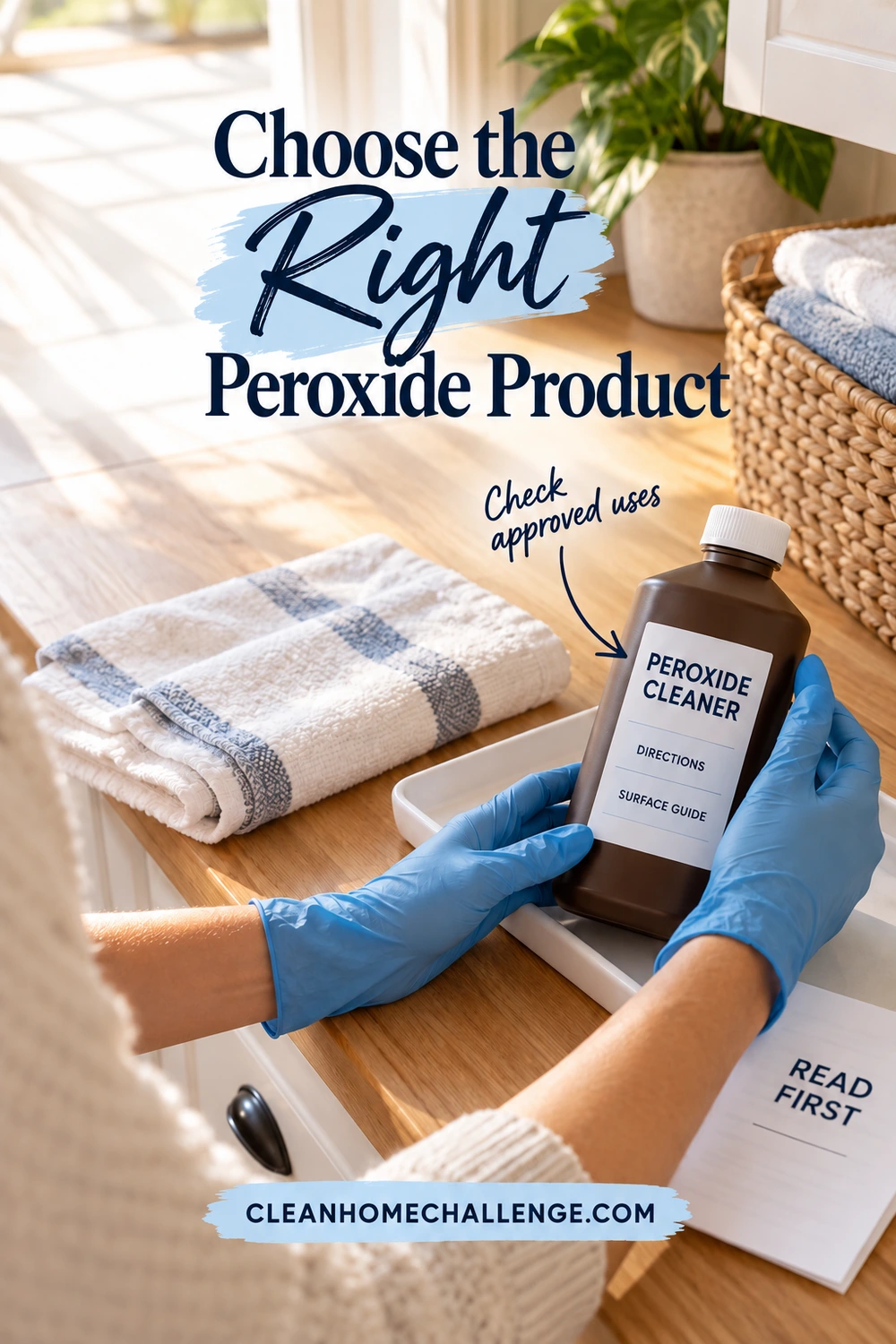
Choose the Right Peroxide Product
Start by deciding what you want to accomplish. Are you removing everyday dirt, treating a laundry stain, or disinfecting an appropriate hard surface? Those are separate jobs, even when a bottle promises more than one of them.
Understand the three common product types
- Household 3% hydrogen peroxide: Often sold in an opaque pharmacy bottle. Check the stated uses. A first-aid label does not automatically provide directions for disinfecting your kitchen or treating upholstery.
- Peroxide-based cleaning or laundry products: These contain a formulated combination of ingredients and have their own surface, fabric, dilution, and application directions. Use the complete product as instructed.
- Registered peroxide disinfectants: When surface disinfection is needed in the US, look for an EPA registration number and directions covering the surface and purpose. A familiar ingredient alone does not establish a disinfecting claim.
EPA explains how to identify registered disinfectants and use their approved directions. Outside the US, use your local regulator’s equivalent guidance.
Do not buy concentrated peroxide to dilute for household cleaning. Poison Control distinguishes ordinary 3% household peroxide from stronger hair-processing, industrial, and so-called food-grade products; concentrated products can cause serious burns. The phrase “food grade” does not mean safe to drink or casually use around food. Poison Control’s hydrogen peroxide guidance is a useful starting point.
Before opening a bottle, find the intended use, compatible materials, preparation directions, protective equipment, and expiration information. If the label is missing or unreadable, set the product aside for disposal advice rather than guessing. For a closer walkthrough, see how to read a cleaning product label.
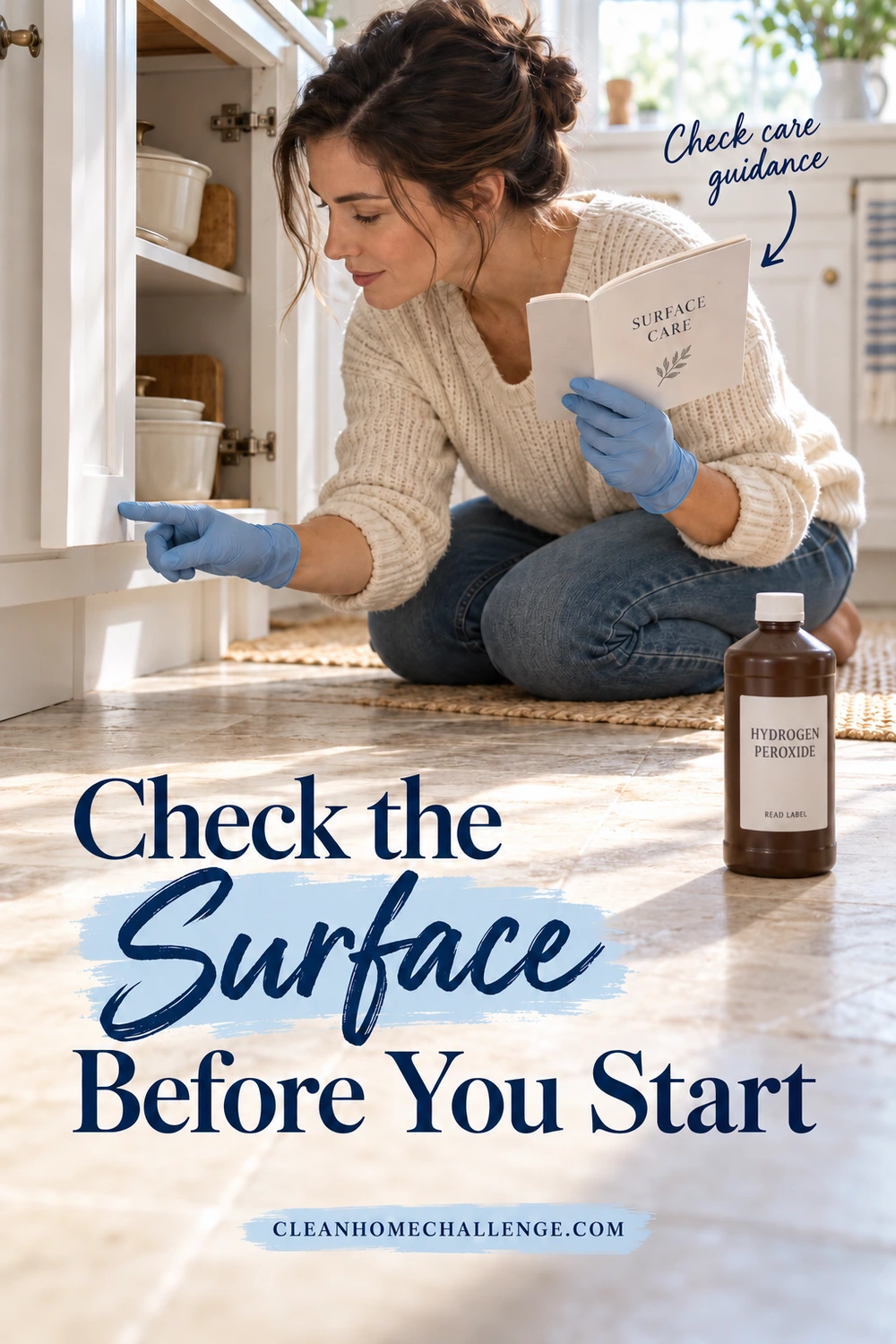
Check the Surface Before You Start
The surface and its finish matter as much as the cleaner. Two pale countertops may be made from completely different materials. A white towel may have colored embroidery. A smooth-looking tabletop may be painted, laminated, or coated with a finish you cannot identify by sight.
Use this check before treating a new item:
- Identify it. Look for the care label, appliance manual, countertop brand, flooring paperwork, or maker’s instructions.
- Compare the instructions. Both the cleaner and the item’s care guidance need to support the proposed use. “Hard surfaces” on a bottle is not permission to treat every hard object.
- Check the condition. Cracks, worn finishes, loose seams, and exposed edges make a surface a poor place to experiment.
- Test only an otherwise approved method. If a hidden-area test is recommended, follow the product directions, finish any required rinsing, and let it dry before looking for color or finish changes.
- Stop when uncertain. Use the manufacturer’s routine cleaning method or ask its support team. A patch test does not override an explicit prohibition.
Keep peroxide away from screens and electronics unless the device maker specifically allows the exact product. For example, Apple advises against products containing hydrogen peroxide for its general cleaning guidance. A wipe that is appropriate for a bathroom fixture may be wrong for your phone.
For natural stone, wood, specialty metal finishes, carpet, and upholstery, do not assume generic peroxide is suitable. Seek instructions for that particular material and finish. Likewise, do not pour peroxide into a dishwasher, washing machine, coffee machine, or drain as an improvised maintenance treatment. Follow that appliance’s directions instead.
Quick decision: If you cannot identify the surface or find a supported use, skip peroxide today. You can still clear clutter or complete another straightforward cleaning job.
Prepare a Small, Safe Workspace
Work on one contained task instead of putting several open cleaners around a room. A few minutes spent clearing the area makes it much easier to finish the job without interruptions.
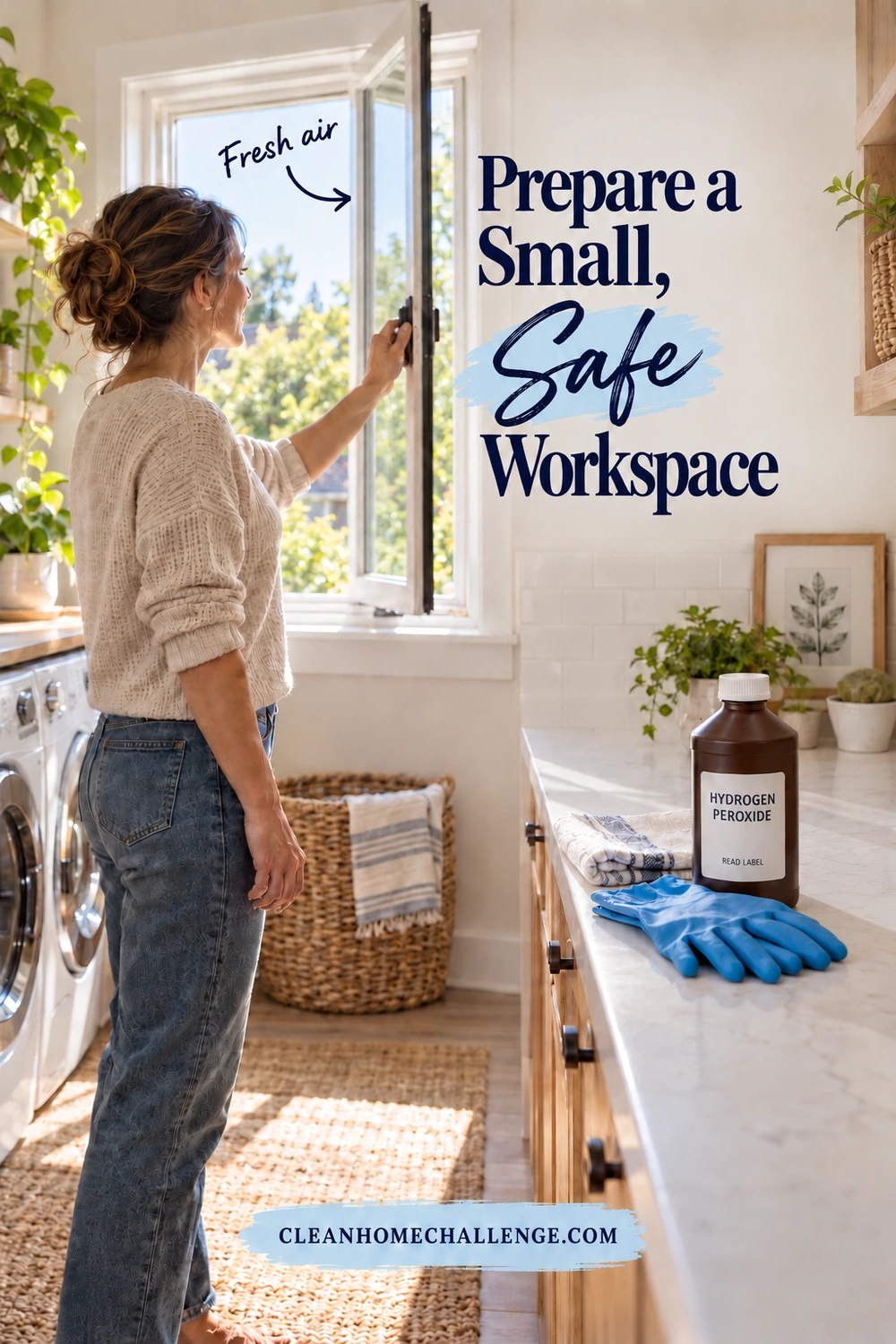
Gather the product in its original container, its instructions, suitable clean cloths, any label-required protective equipment, and a timer if the directions include a waiting period. Have water available when the label calls for rinsing. Keep clean tools separate from tools already used with another cleaner.
Move food, dishes, personal-care items, and unnecessary objects away from the work area. Arrange for children and pets to stay elsewhere while the product is in use and until any label-specified re-entry, rinsing, or drying requirements are met. Avoid leaving an open bottle on the floor or the edge of a counter while you answer a door or phone.
Follow ventilation and protective-equipment directions. Opening a window may help when outdoor conditions permit, and an appropriate exhaust fan can be useful. Do not spray into the air to “freshen” a room. The CDC’s household cleaning guidance emphasizes label directions, ventilation, and recommended protection such as gloves or goggles.
Keep your setup modest. You do not need a collection of decorative spray bottles for this job. Original containers make it easier to identify the product and find first-aid instructions quickly.
If time is tight, make preparation today’s task: identify the surface, read the label, and gather clean supplies. You can do the actual treatment when you have enough uninterrupted time to complete it properly.
The general cleaning collection below includes refillable containers. Keep hydrogen peroxide in its original labeled bottle; do not use those refillable containers for peroxide.

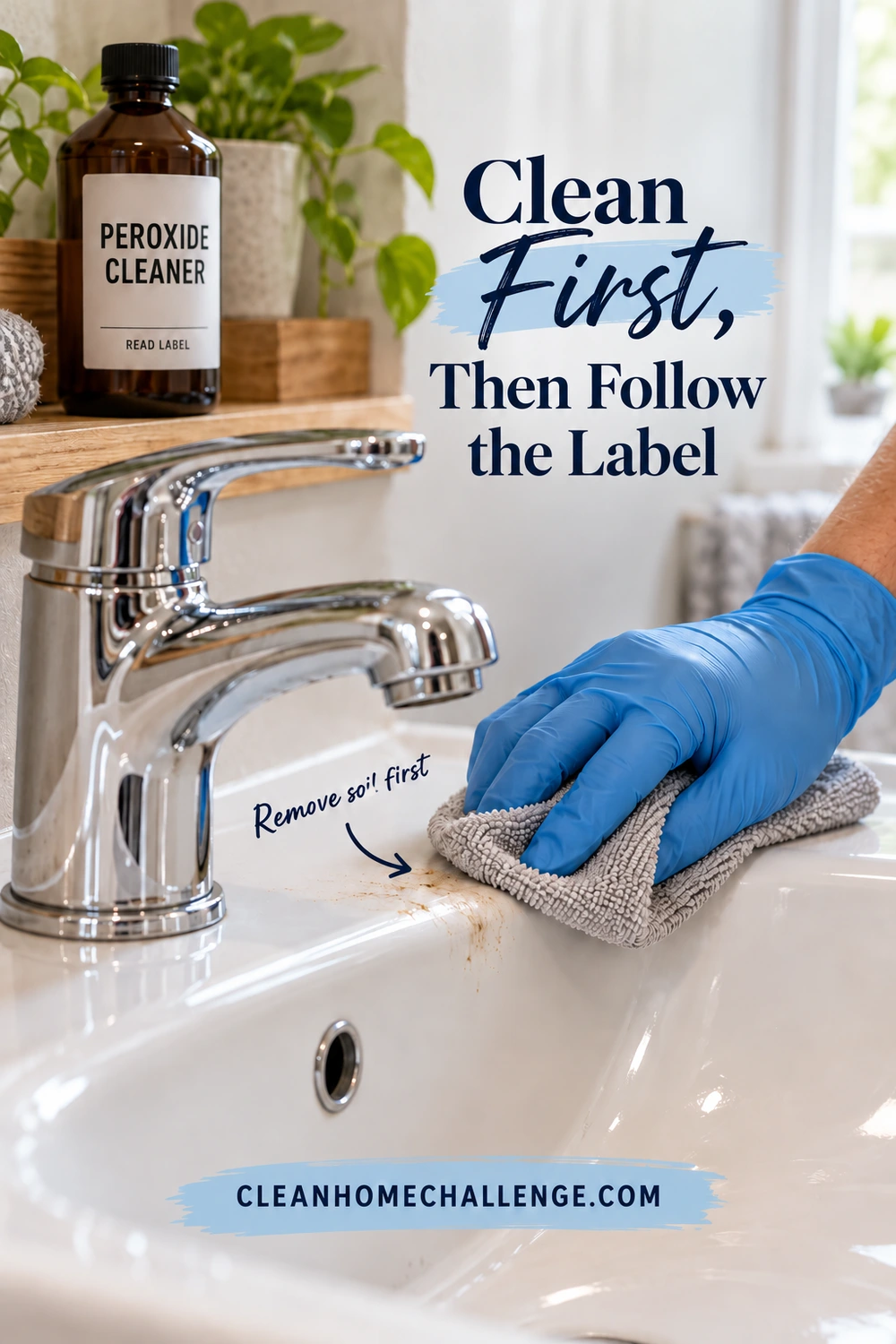
Clean First, Then Follow the Label
For everyday dust, crumbs, and ordinary grime, start with the surface’s usual cleaning method. The CDC notes that routine cleaning is often enough; disinfection becomes more relevant when someone is sick or has a weakened immune system. Do not add peroxide simply because a surface has been touched.
When you have an appropriate peroxide-based surface product, use this order:
- Clear the area. Remove loose debris and move objects that would prevent access.
- Remove visible soil. Follow the surface and product instructions for pre-cleaning. If another cleaner was used, fully remove its residue as directed before moving to the next stage; do not apply products over one another.
- Apply the selected product as labeled. A ready-to-use formulation stays at its supplied strength unless its directions say otherwise. Do not invent a dilution or transfer instructions from a different brand.
- Follow the correct waiting step. For disinfection, keep the approved surface visibly wet for the full contact time listed for that use. Set a timer after the application is complete.
- Finish exactly as directed. Some uses require wiping, rinsing, or air-drying. Food-contact instructions deserve particular attention.
- Put supplies away. Deal with used cloths appropriately and wash your hands after removing gloves.
There is no single “peroxide time” that works for every bottle, germ, and surface. EPA’s explanation of cleaning, sanitizing, and disinfecting highlights the importance of following the specific label and contact time.
Food-contact surfaces need their own directions
Do not assume a product approved for a bathroom can be used on a cutting board or kitchen countertop. Check for the exact food-contact use and any required rinse. EPA’s food-contact product labeling guidance distinguishes how products must be removed or allowed to drain and dry. “No rinse” is a product-specific direction, never a general property of peroxide.
If your goal is simply to remove a sticky mark, stop when the appropriate cleaning method has done the job. Extra applications do not make an unsupported treatment safer.
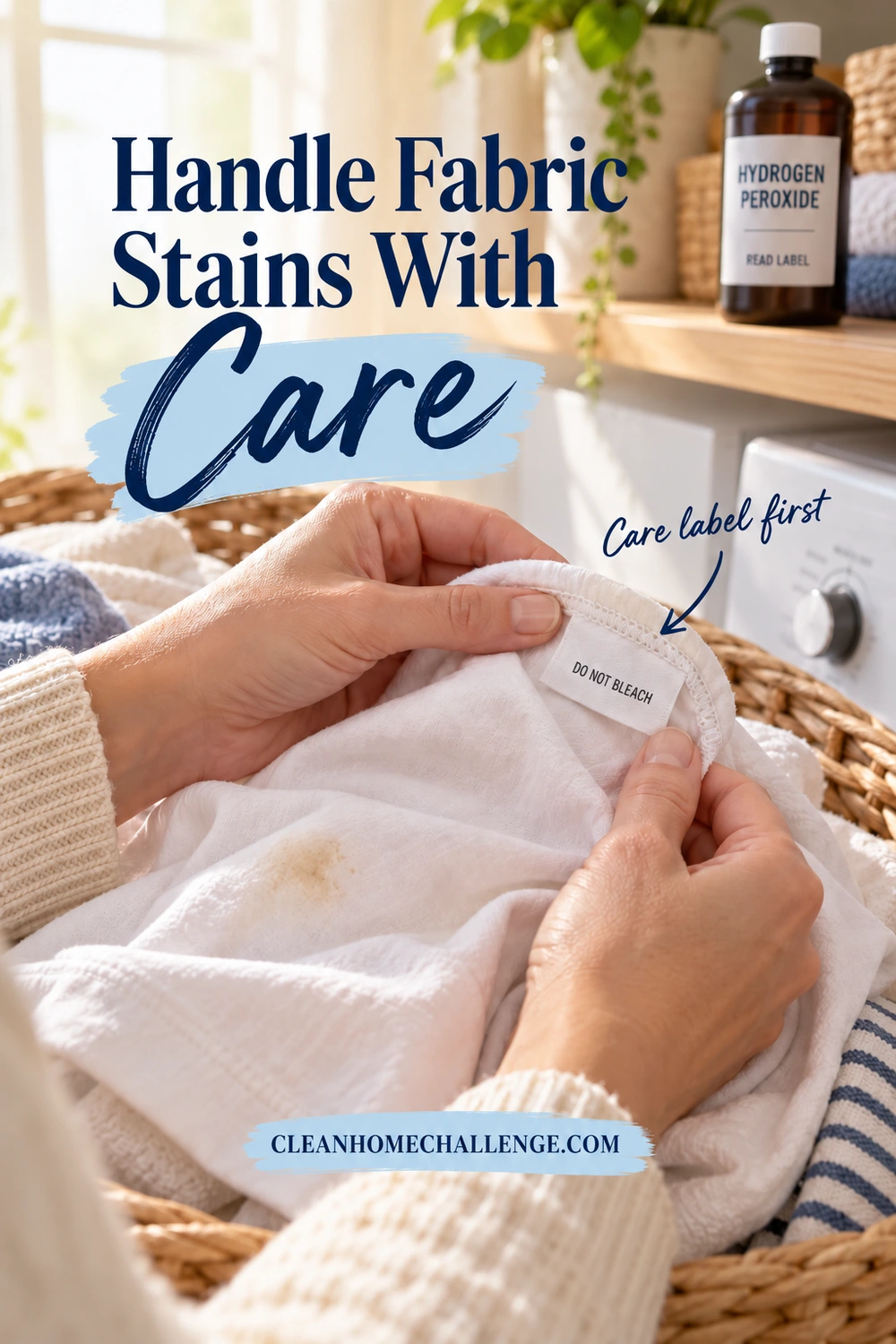
Handle Fabric Stains With Care
Peroxide-based laundry products can be useful for certain stains, but your favorite shirt is not a good testing ground for an internet recipe. Start with the fabric care label and choose a stain treatment intended for that fabric and stain.
“Color-safe bleach” describes a formulated laundry product. It does not mean every hydrogen peroxide solution is safe on every dye, trim, or fabric. Clorox explains the role of peroxide-based color-safe bleach and the need to follow product and garment directions.
For a washable item, use this practical sequence:
- Remove the garment and lay it on a suitable work surface. Do not treat clothing while someone is wearing it.
- Check the care label, including bleaching restrictions and any special trim or finish.
- Follow the stain product’s colorfastness test before applying it to the visible area.
- Treat only as directed, observing the maximum treatment time and whether the product must remain damp.
- Wash and dry according to the garment and product instructions. Inspect the result before repeating a treatment.
As one product-specific example, the current directions for Clorox 2 for Colors Max Performance Stain Remover allow a 5–10 minute pretreatment for small laundry stains and warn against letting it dry on the fabric. Those instructions apply to that named formulation, not to pharmacy peroxide or another stain remover. Check your own bottle because directions and formulas can change.
For a rug, upholstered chair, or mattress, the item’s care instructions may be more restrictive. Do not soak it or assume that a product suitable for washable clothing is suitable for that furnishing. When the care guidance is unclear, contact the manufacturer or a qualified cleaner before trying peroxide.
You can keep laundry moving without treating everything at once. Set aside one suitable stained item for a properly supervised treatment rather than starting several timers you will struggle to track.
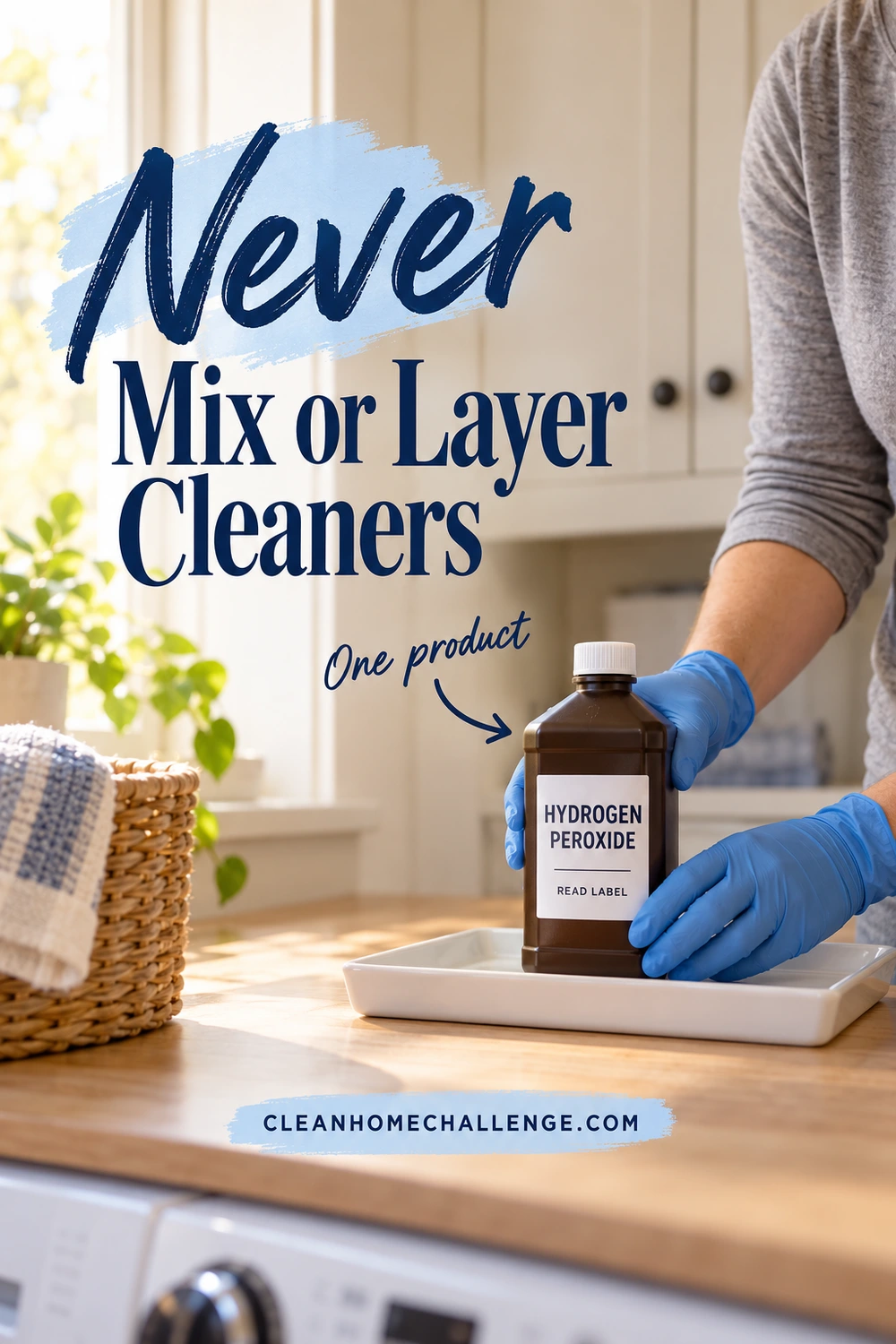
Never Mix or Layer Cleaners
Use a household peroxide product on its own, exactly as directed. Do not create a stronger-looking mixture by adding vinegar, chlorine bleach, ammonia, alcohol, baking soda, essential oils, or another cleaner. Do not combine leftover products in a bottle or bucket.
The same rule applies to the surface. Spraying a second product onto a still-wet first product can mix them outside the bottle. If you need to change methods, finish and remove the first product according to its directions, check compatibility, and get manufacturer advice when uncertain. Keeping one product and one set of clean tools at the work area helps prevent accidental mixing.
This is also why a bubbling reaction is not a cleaning plan. It does not show that the correct concentration, surface compatibility, or required disinfecting conditions have been achieved. Judge the result by the approved procedure and the condition of the surface, not the amount of fizz.
The CDC explicitly advises against mixing cleaning chemicals. Keep that simple rule even when a recipe is described as natural, homemade, or chemical-free.
Know what to do after an exposure
If peroxide splashes into an eye, start rinsing with plenty of room-temperature running water for 15–20 minutes and remove contact lenses if present. Then obtain poison-control advice. See Poison Control’s eye-exposure first aid.
For other exposure concerns, stop the task and follow the label’s first-aid directions. In the US, call Poison Control at 1-800-222-1222 for advice; outside the US, use your local poison information service. Do not induce vomiting. If someone has trouble breathing, collapses, has a seizure, or cannot be awakened, call emergency services immediately. These warning signs are covered by Poison Control’s emergency guidance.
Do not attempt to fix a chemical mixture by adding another ingredient.
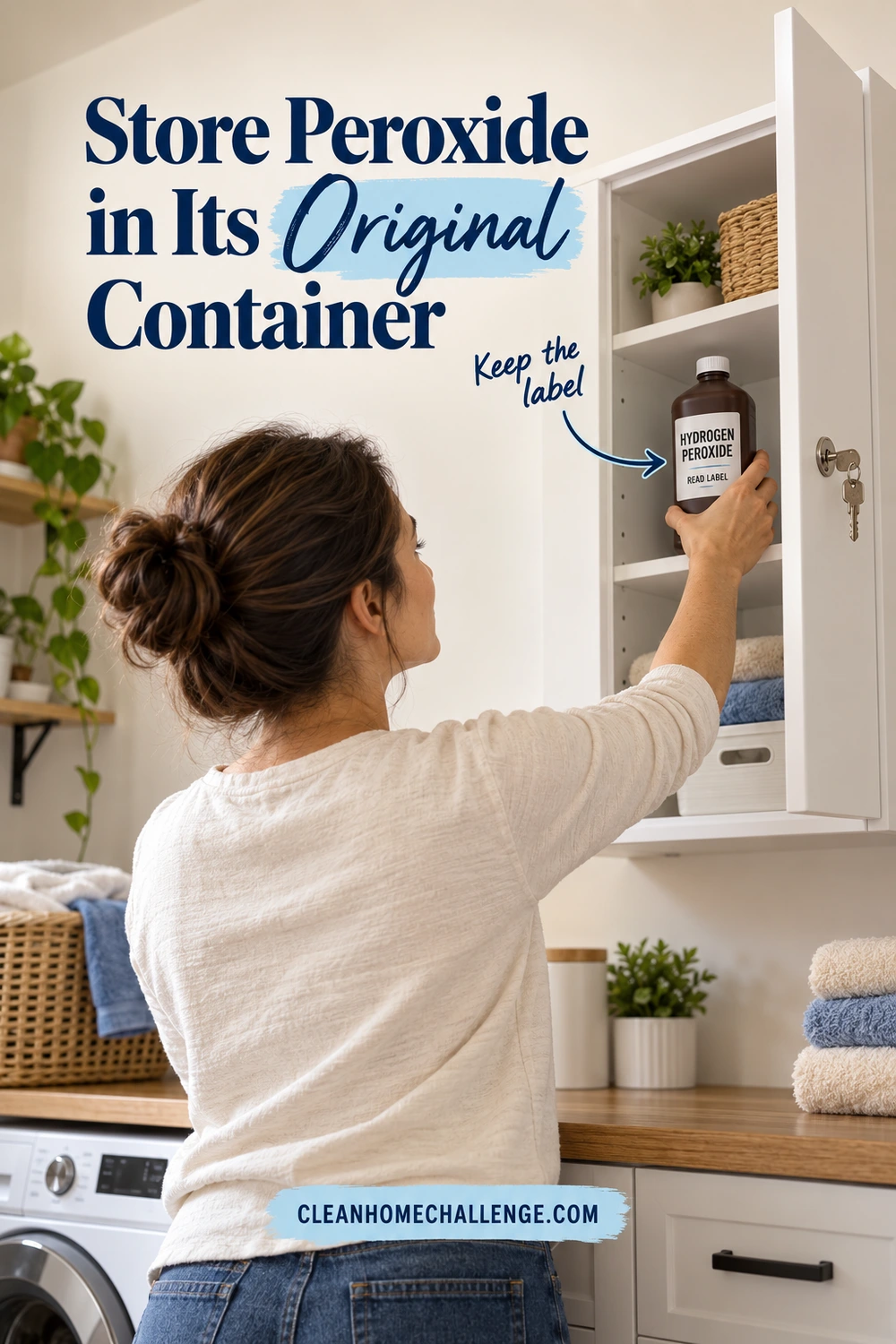
Store Peroxide in Its Original Container
Leave peroxide in the container supplied by its manufacturer, with its readable label and original closure. An opaque bottle helps protect ordinary household peroxide from light. Poison Control specifically recommends original opaque storage and keeping it away from children. A stylish clear spray bottle loses that important safeguard.
Keep the container upright in a secure location according to its temperature and storage directions, away from food and drinks. Follow the label’s guidance about heat and light. Store it out of children’s sight and reach, preferably in a locked cleaning cabinet, and do not rely on height alone when children can climb.
After each use, check that the closure is secure and the outside of the bottle is clean. Do not transfer peroxide into another bottle, top up an old bottle with a new product, or leave a small amount in a drinking cup for later.
Check dates without improvising a strength test
Read the expiration date and any after-opening instructions. If you cannot establish that a product is still suitable for its intended use, replace it rather than guessing its disinfecting strength from bubbles. Buy an amount you can realistically use while it remains in date.
For leftovers, damaged containers, or expired products, follow the label and your local waste authority’s advice. Do not mix chemicals together for disposal or automatically pour them down a drain. The EPA’s household hazardous waste guidance recommends original labeled containers and checking local disposal arrangements.
Make this a brief cabinet check during your regular reset: readable label, sound container, valid date, secure storage. It is a useful habit even in weeks when you do not use peroxide at all. For more setup ideas, see safe cleaning-product storage in a family home.
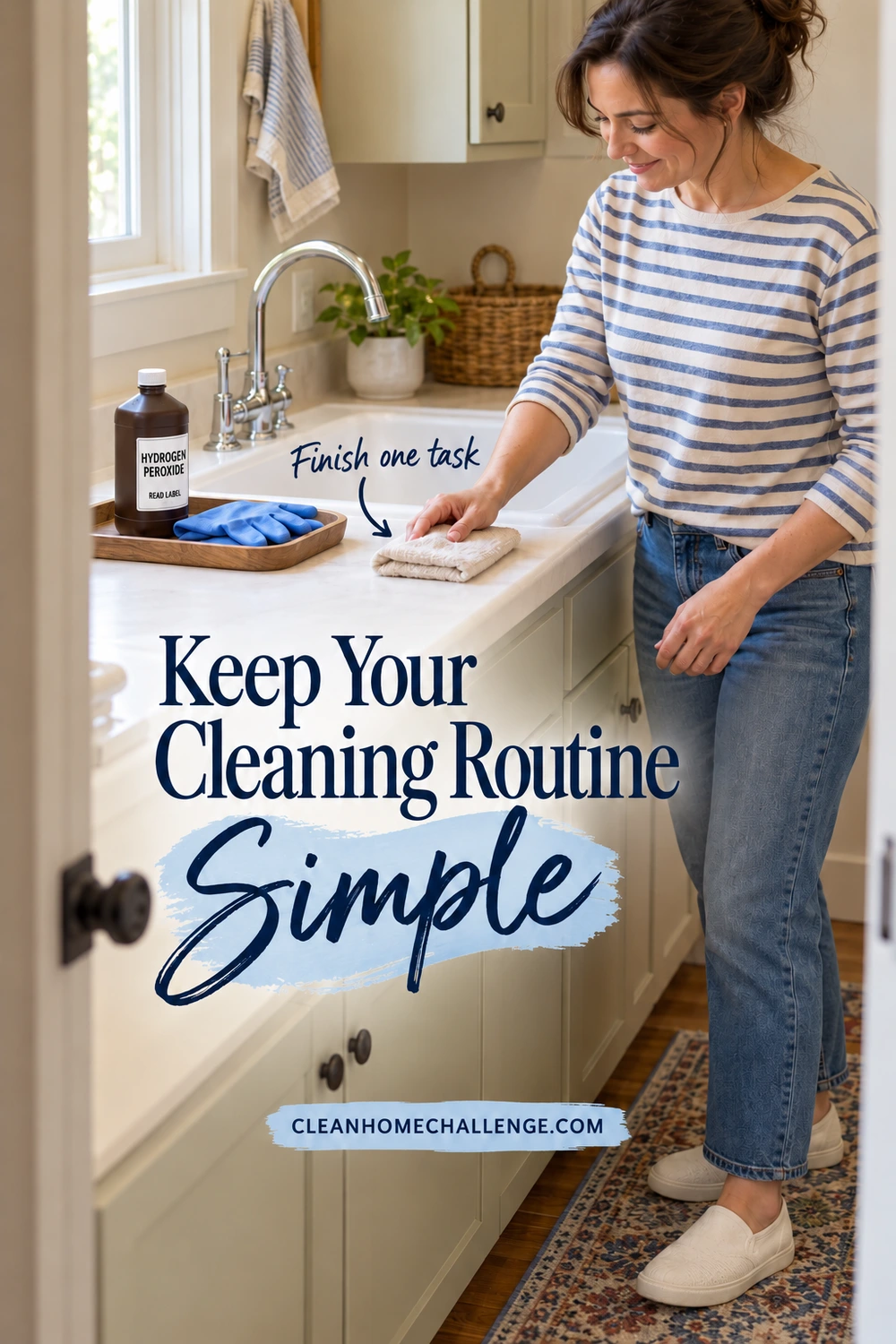
Keep Your Cleaning Routine Simple
Hydrogen peroxide does not need to become your all-purpose answer. Give each product a clear job and keep the routine easy enough to repeat on a busy week.
On kitchen day, focus on food spills and the cleaning methods suited to your surfaces. On bathroom day, use the appropriate product for the particular buildup. On laundry catch-up day, handle a small number of stains with enough time to follow the instructions. Add a peroxide product only where its label and the item both support that use.
A quick check before each use
- I know what I am trying to clean or treat.
- The product label supports this use.
- The item’s care instructions allow it.
- I have checked any required test, protection, timing, and rinse.
- No other cleaner or chemical residue will be mixed with it.
- I can keep the area secure and finish before walking away.
- I have a safe place to put the original bottle back.
If one of those answers is unclear, pause that treatment. Read the instructions, choose a supported alternative, or ask the manufacturer. Completing a smaller, straightforward job is better than creating surface damage or an unfinished chemical task.
For ongoing help, the Cleaners Clubhouse offers practical routines and printable support to make cleaning feel more manageable. Start with one sensible habit: check the label before the first wipe, and put the product away after the last one.
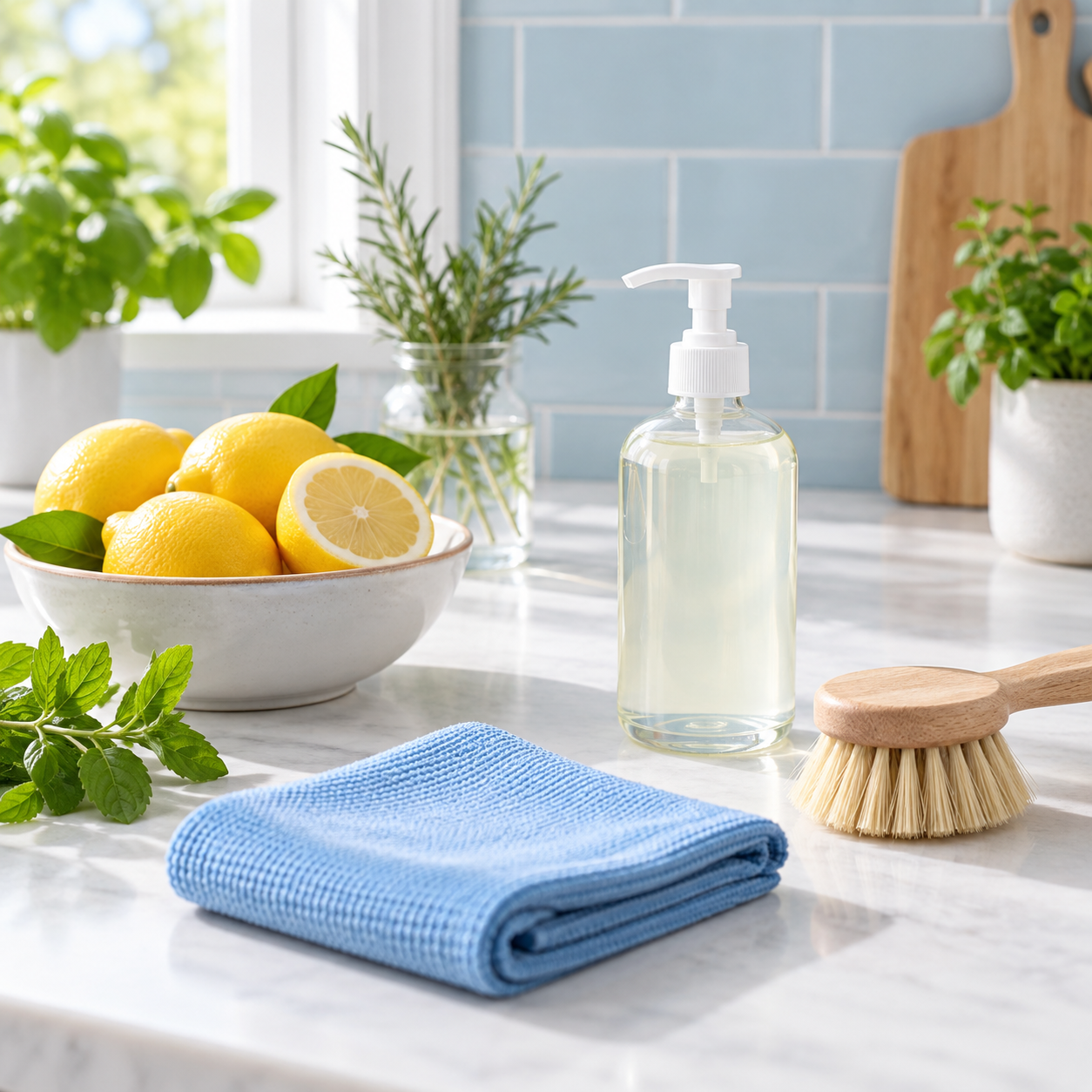
The Clubhouse illustration shows general cleaning supplies. Its refillable container is not for hydrogen peroxide, which should remain in its original labeled bottle.
CLEANERS CLUBHOUSE
Build a Safer, Simpler Cleaning Routine
Clean confidently with practical guidance that helps you choose sensible products and use them correctly. The Cleaners Clubhouse combines safer cleaning support with realistic routines, worksheets and challenges.