

THIS POST MAY CONTAIN AFFILIATE LINKS. PLEASE READ MY DISCLOSURE FOR MORE INFO.
A pillow can come out of the wash looking clean and still feel like a bag of uneven little bundles. Before you blame the washer, check what is inside the pillow, how much room it had, and whether the middle is actually dry. Those details matter more than adding another laundry product.
The most useful approach to how to wash pillows is simple: confirm the care instructions, avoid crowding, use the approved gentle wash, and give drying the attention it needs. Then redistribute the filling with light handling. A washable pillow may recover well, but washing cannot repair worn-out fibers, damaged foam, or broken internal construction.
This guide focuses on keeping the fill comfortable and troubleshooting clumps. If discoloration is your main concern, use our separate guide to removing yellow stains from pillows and bedding.
Start with one suitable laundry load. You do not need to strip every bed or turn pillow care into a whole-house project.
Disclosure: This post may contain affiliate links. As an Amazon Associate, Clean Home Challenge earns from qualifying purchases. If you make a purchase through these links, we may earn a small commission at no extra cost to you. This helps us keep creating practical cleaning tips, routines and resources for busy families! 🧽
Check the Label and Pillow Fill
Read the label on the pillow itself, not just the removable pillowcase. Look for the cleaning method, water temperature, drying method, and any restrictions. A cotton shell does not mean the material inside can be washed like a cotton sheet.
If the tag is missing, search the manufacturer’s site using the exact model or contact its care team. Keep the pillow dry while you check. Guessing from its softness, weight, or price is unreliable.
Choose the right route before adding water
- Polyester or down-alternative fill: Many designs are washable, but construction and equipment requirements vary. Confirm the exact product instructions.
- Down or feather fill: Some pillows allow washing; others need specialist care. Check permitted detergent and drying settings as well as the wash symbol.
- Solid memory foam or latex: Do not put the insert in a washer or soak it unless its maker explicitly permits that treatment. Cleaning a removable cover is a separate job.
- Shredded foam, adjustable, or layered designs: Each layer can have different instructions. A washable cover does not authorize washing the filling.
- Wool, buckwheat, kapok, and other specialty fillings: Look up the specific care method. Do not borrow instructions from a different material.
Manufacturer examples show why this check matters. Tempur-Pedic says its TEMPUR-material pillows are not washable, although the removable cover can be cleaned as directed. Brooklinen’s current pillow care guide specifies commercial washing and drying equipment for relevant washable pillows. Neither rule can be replaced by a general social-media tip.
Take a quick photo of the label so you can refer to it while the pillow is in the machine. Check both pillows if washing a pair; matching pillowcases can hide completely different fillings.
Finally, assess the pillow before cleaning. Notice any flat corners, firm patches, leaking fill, or seams pulling apart. A quick note about its starting condition helps you distinguish a new washing problem from an older comfort problem. Stop if the shell is damaged or filling is escaping, and ask the manufacturer what to do next.

Prepare Pillows Before Washing
Set up the drying route before starting the wash. Do you have access to the approved dryer, enough space, and time to check the load? If the label permits only a drying method you cannot manage today, wash the cases and protectors instead and save the insert for another day.
There is no dependable universal finishing time. The wash cycle is only one part of this task, and thick filling may need more drying than the outside suggests. Starting close to bedtime can leave you choosing between an unfinished pillow and an uncomfortable night. Have a clean spare available if you can.
Gather a small, useful kit
- The pillow’s care instructions and your washer and dryer manuals
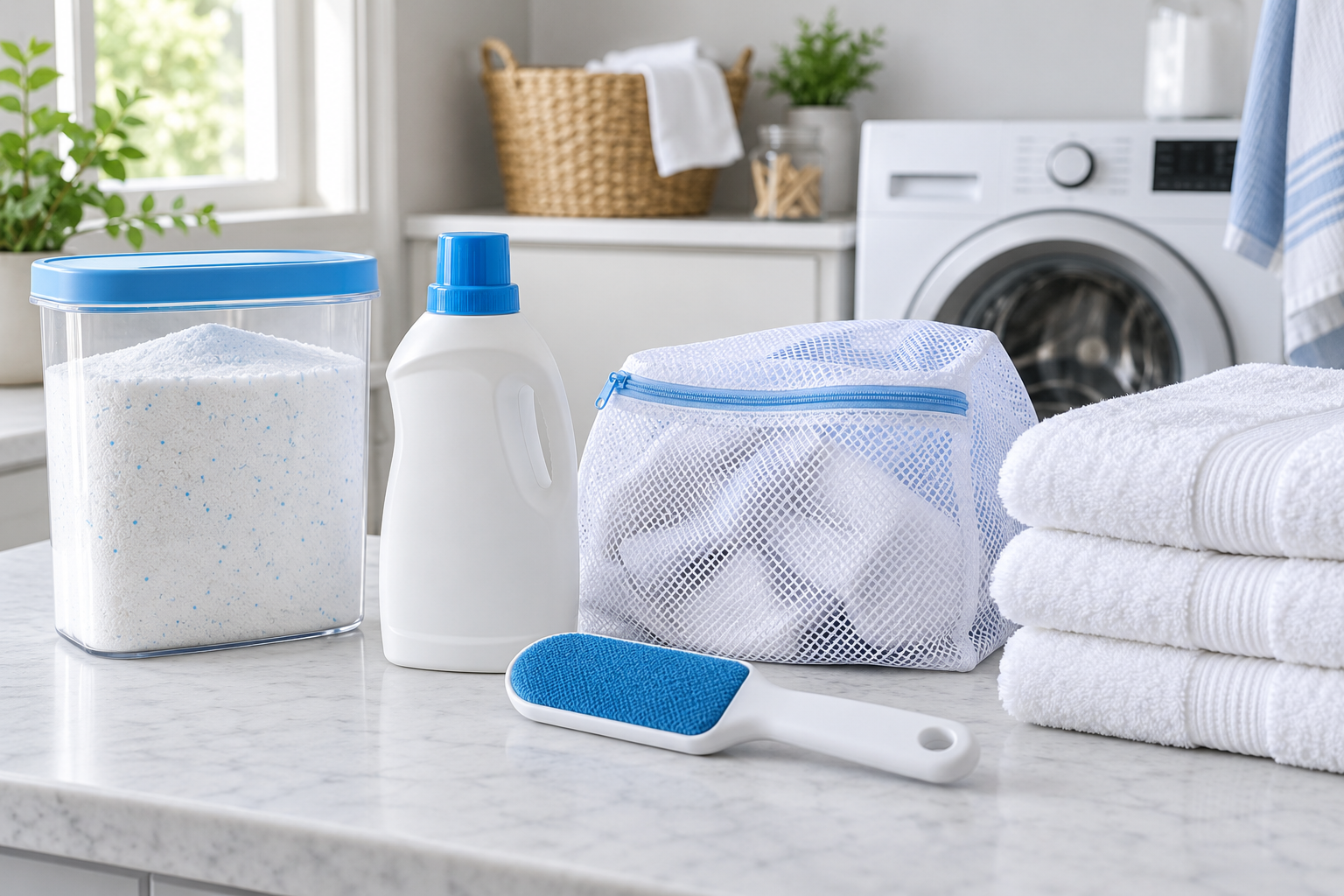
- A detergent suitable for the pillow and machine, with its measuring cap
- Clean towels or a clean surface for supporting the wet pillow
- Dryer balls only if permitted by the pillow and dryer instructions
- Fresh pillowcases and clean, fully dry protectors
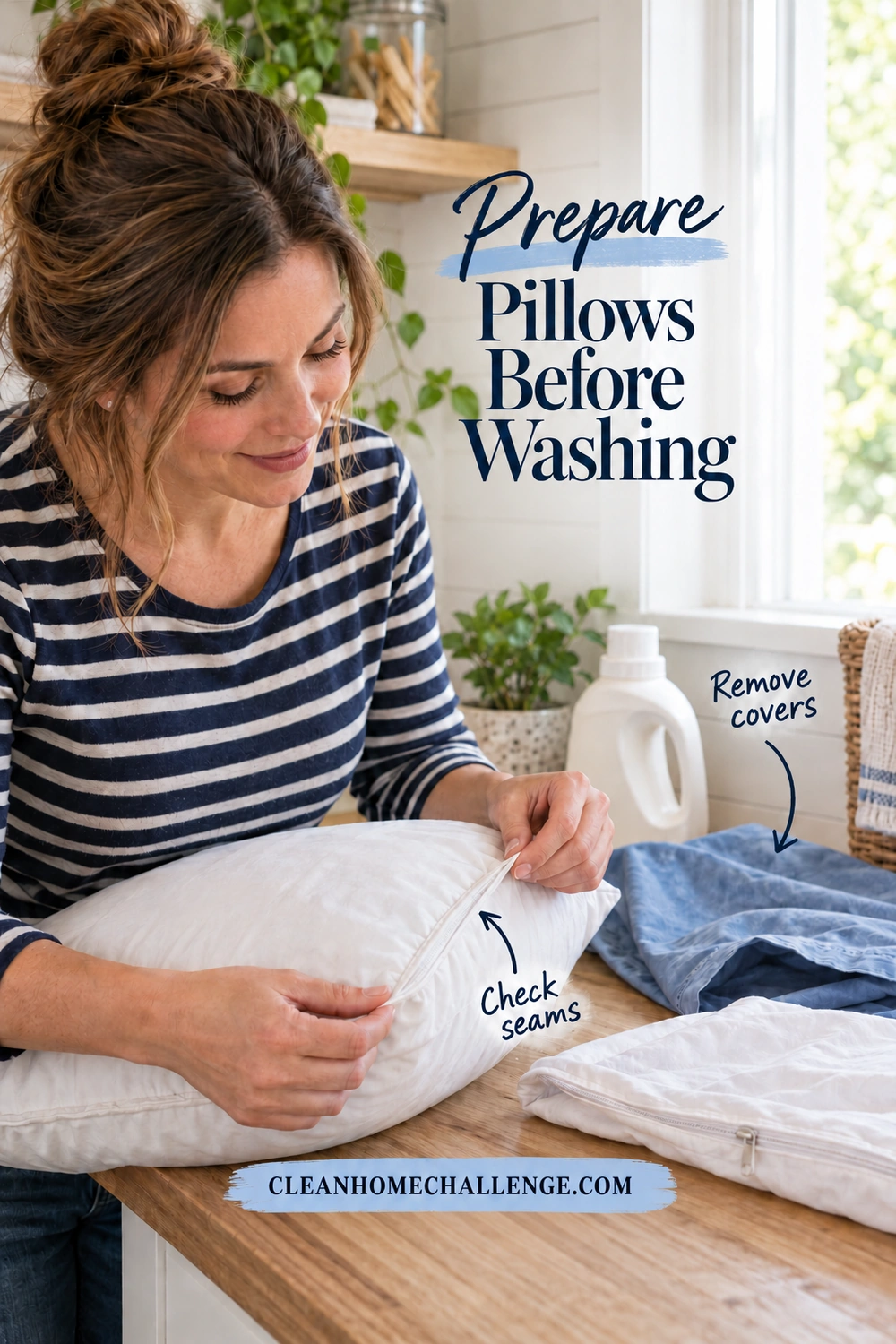
Remove the pillowcase and protector. Check whether a zippered layer is a removable cover or the enclosure holding loose filling. Open only the parts the manufacturer intends you to open. Keep an adjustable fill compartment closed and secure its closure exactly as directed; do not improvise with pins or ties.
Check the shell in good light, especially corners, piping, and the area beside a zipper. Empty the washer of forgotten clothing or small objects. Clear a landing space next to the dryer so a heavy, wet pillow will not have to balance on a tiny shelf or trail across the floor.
If the pillow has a small mark, follow its approved localized treatment rather than soaking it just for appearance. Keep stain-removal products out of this process unless both the pillow and product instructions permit them. Fragrance, whiteness, and fluffiness are different things; adding extra products does not solve a crowded drum or damp filling.
A manageable first step: On a busy day, spend a few minutes checking labels and washing the removable layers. That prepares the job without leaving a wet insert waiting for attention.
Wash Machine-Safe Pillows Gently
Use this method only after confirming that the entire pillow, or the particular component you are loading, is machine washable. Follow the pillow’s instructions alongside the machine’s guidance for bulky items.
Give the load enough space
Two compatible pillows can help balance some loads, but two is not a requirement that overrides capacity. Both must fit loosely and suit the same wash settings. Do not squash a second pillow into a full drum, sharply fold a large pillow around an agitator, or force the door closed.
A larger approved machine may be the better option for a king-size or especially full pillow. If using a laundry service, show the complete label and explain that the fill needs thorough drying. Ask for the labeled care method; professional service does not automatically mean dry cleaning.
Follow the wash in a sensible order
- Load as the appliance manual directs. Distribute items evenly, leaving room for movement. Do not assume adding heavy towels will solve every balance problem.
- Measure the correct detergent. Follow its dose for the load and water conditions, plus any pillow-specific restriction. Use HE detergent where required. Avoid guessing with a large pour or using a universal tablespoon rule for every concentrated formula.
- Choose an approved cycle and temperature. A gentle or delicate program is common, but machine names differ. Check the manual instead of assuming that every bedding or bulky cycle is equally gentle.
- Rinse thoroughly. If the pillow instructions and machine allow an extra rinse, it can help remove detergent from thick filling. Use the approved spin setting rather than automatically choosing maximum speed.
- Move promptly to drying. Support the pillow from underneath with both hands. Do not lift a water-heavy pillow by one corner or twist it to wring out moisture.
Whirlpool’s pillow-washing guide supports gentle washing, restrained detergent use, and an optional extra rinse for suitable pillows. Your pillow’s own directions still decide which settings are allowed.
If the washer thumps, stops, or reports an imbalance, pause it using its controls and wait until it is safe to open. Redistribute the load according to the manual. Maytag explains that uneven bulky loads can interrupt spinning. Repeatedly restarting a struggling cycle is a signal to reassess the load or equipment, not squeeze in more items.

Care for Foam and Specialty Pillows
A foam pillow needs its own plan. Do not move it from the washer to a bathtub on the assumption that hand washing is automatically gentler. Some inserts should not be wet-cleaned at all.
Start by separating what is actually removable. Wash a removable case or cover according to its label, then keep it off until completely dry. Leave a nonwashable core in a clean, dry place while you work. Do not put it through a dryer cycle borrowed from another pillow’s instructions.
Check each layer individually
Saatva’s Latex Pillow guidance describes a washable cotton outer cover and fiber layer, with a shredded latex core that must be removed and not washed. Naturepedic’s adjustable latex pillow instructions distinguish the washable outer encasement from an inner pillow that is spot-clean only. These are product examples, not permission to dismantle every latex pillow.
For a model that allows spot cleaning, use the manufacturer’s method and the smallest affected area. A clean cloth helps you control moisture. Blot rather than scrub hard, and avoid saturating the insert. If liquid cleaning is prohibited, do not apply water, detergent, or a homemade spray to the foam.
Adjustable designs deserve extra care. Photograph the layers before removing approved components so reassembly is straightforward. Work over a clean surface, keep loose fill contained, and keep children and pets away from any removed filling. Reinsert components only when every cleaned layer is dry.
What if the foam was accidentally washed?
Stop using wash-and-dry instructions meant for fiber or down. Check the exact model’s guidance and ask its manufacturer whether the insert can be recovered. Do not try high heat, forceful wringing, or repeated washing to make it spring back. A torn, crumbling, misshapen, or persistently damp core may need replacement.
A cover-only clean is still useful. Put on a fresh case, check the protector, and leave the core alone when its care rules require that. Following the intended method is a better result than making the whole pillow wet simply because the laundry is already running.

Dry Pillows All the Way Through
Drying is where a pillow can appear finished before it really is. A dry shell and a warm surface do not prove that moisture has left the thickest part of the filling. Plan to inspect it rather than rely on the end-of-cycle chime.
Choose the method and heat setting on the pillow’s label. Low heat and no heat are different settings; neither is suitable for every pillow. Dryer air-fluff means tumbling without added heat, while air drying means drying outside the machine. Do not substitute one for the other without checking.
Make room for movement and checks
If tumble drying is permitted, give the pillow space to turn and loosen rather than remain wedged against the drum. A pair that fit in the washer may need separate dryer loads. Clean the lint filter as the dryer manual directs, and use dryer balls only when the relevant instructions allow them.
Pause the dryer at appropriate intervals, following the appliance’s controls. Take out the pillow, support it, and gently loosen obvious clusters through the shell. Change its position when returning it to the drum. For down, Pacific Coast’s drying guide emphasizes checking the center and allowing enough time at the labeled setting.
Check beyond the outside fabric
When the pillow seems ready, let surface warmth fade before assessing it. Feel the middle, corners, edges, and any thicker sections through the shell. Look for cool damp areas, compact wet-feeling patches, or unusual heaviness compared with the rest of the pillow. An unexpected moisture-related smell also calls for another check.
These are practical warning signs, not a laboratory moisture test. If you cannot confidently establish that the filling is dry, keep the pillow off the bed and continue only with its approved drying method. A lack of odor alone is not proof of dryness.
There is no fixed number of minutes or cycles that covers every pillow and dryer. A dense pillow, a small drum, and different materials change the job. Do not raise the temperature just because dinner is ready or the next laundry load is waiting.
If the label allows air drying, follow its positioning and ventilation instructions, turn or reposition as directed, and check the interior as well as the exposed side. Do not cover or store the pillow while damp. If drying is not progressing normally, seek manufacturer advice rather than leaving it enclosed in a basket.

Fix Clumps Without Rough Handling
Before trying to restore the shape, decide what kind of lump you are feeling. Damp filling, dry filling gathered in one area, and worn filling need different responses. Start with the drying checks above so you are not judging loft while the pillow is still wet inside.
Try a gentle fill reset
For a fully dry, loose-filled pillow whose instructions allow fluffing:
- Lay it on a clean, flat surface and notice where the filling has gathered.
- Use your fingertips through the shell to ease apart small clusters. Work lightly and avoid pulling the fabric in opposite directions.
- Guide movable fill toward a thinner area in the same compartment. Internal seams or chambers are boundaries, not obstacles to force through.
- Hold the pillow at opposite sides, gently compress and release, then repeat from the ends. Give the filling room to spread.
- Set it down again and reassess the shape before repeating. Stop if seams strain, filling escapes, or the material feels damaged.
Pacific Coast’s care guidance recommends gentle redistribution for clumped filling and warns against opening non-adjustable pillows. The aim is an even, comfortable shape, not a perfectly sculpted showroom pillow.
Match the next step to the problem
- A cluster still feels damp: Return to the approved drying process. Do not hide it inside a fresh case.
- Dry fill is gathered toward one end: Work it back gradually through the shell, within its intended chamber.
- The whole pillow is evenly flat: Check for longstanding wear. More detergent will not replace lost resilience.
- Hard areas will not loosen: Stop aggressive handling and check with the maker. Some damage or matting cannot be reversed.
- A seam opens or fill leaks: Stop laundering and altering it. Ask about repair or replacement before continuing.
Do not beat the pillow against furniture, pull it apart by the corners, or open stitching to chase one stubborn lump. Do not add unfamiliar filling to a sealed pillow. An adjustable model may allow fill changes, but those directions are specific to its construction.
It is reasonable to stop when a fully dry pillow remains uncomfortable after its approved care and gentle reshaping. Cleaning can maintain usable bedding; it cannot guarantee a like-new feel. Keep replacement decisions based on condition and comfort rather than an invented deadline for every material.

Avoid Common Pillow-Washing Mistakes
Most avoidable problems start with a shortcut that seems helpful at the time. Use this quick check before repeating a wash or trying a stronger treatment.
The shortcuts worth skipping
Washing by color instead of construction. Two white pillows can contain completely different materials. Read both labels before treating them as a matching load.
Overloading to finish every pillow at once. The door closing does not prove that the drum has enough usable space. Divide the job or use suitable larger equipment when needed.
Adding extra detergent for freshness. A stronger smell is not evidence of better cleaning. Measure the recommended dose; thick pillows already need careful rinsing.
Choosing hot water or high heat as a default. Use only permitted settings. Heat cannot safely compensate for the wrong method, and a care label’s restriction is not a suggestion to ignore when you are short on time.
Using a bag as protection against every risk. A laundry bag does not make a nonwashable insert washable or solve insufficient drum capacity. Use one only when the pillow and appliance instructions call for it.
Adding bleach, softener, vinegar, or a homemade mixture automatically. Keep the process simple unless the exact care instructions approve an additional product. Never mix cleaning products. A laundry additive cannot redistribute filling for you.
Assuming dryer balls guarantee fluffiness. They are an optional tool for approved loads. They do not repair damaged fibers, replace adequate space, or prove the center is dry.
Putting the case back on too soon. Complete the drying check first. Covering a damp pillow makes the unfinished job easier to overlook.
Should you wash a lumpy pillow again?
Not as the first response. Check for retained moisture and try permitted gentle redistribution first. If obvious detergent residue remains, consult the care instructions about a rinse rather than automatically starting another detergent wash. If the filling is damaged, repeated cleaning may add wear without improving comfort.
For a newly purchased pillow with unexpected clumps, photograph the issue and ask the retailer or manufacturer before cleaning or altering it. Care actions can affect return eligibility, and it is easier to resolve a product problem while its original condition is documented.

Keep Pillows Fresher Between Washes
The easiest next wash is often the one you do not create unnecessarily. Protect the pillow, clean its removable layers, and give the fill a little regular attention according to its own care rules.
Use a washable protector beneath the pillowcase if it suits the pillow, and follow the protector’s separate instructions. Check that it fits comfortably rather than compressing a larger pillow into a too-small cover. Keep a spare set together in the linen closet so changing the layers feels simple.
Build care into things you already do
- When making the bed: Gently reshape suitable loose-filled pillows. Leave solid foam alone unless its maker recommends a particular refresh method.
- When changing sheets: Check cases and protectors for marks, dampness, damaged zippers, or seams that need attention.
- On laundry day: Wash the removable layers as their labels direct, and put them back only when completely dry.
- When reviewing bedding: Check whether the pillow needs an approved full clean, localized care, or a conversation with the manufacturer.
Brooklinen recommends changing pillowcases at least weekly. Use that as a practical starting point for ordinary household laundry, adjusting for spills, visible soil, and the fabric’s own instructions. A protector and pillow insert may have different cleaning schedules.
How often should the pillow itself be washed?
There is no single schedule that suits all fills and constructions. Use the maker’s recommendation and the pillow’s condition. Write the model and care method in a household note if the tag is awkward to read, and keep the tag attached. A reminder can prompt a check without forcing an unnecessary wash.
For a low-energy laundry catch-up, choose one task: replace the cases, wash the protectors, or inspect two pillow labels. A complete insert wash can wait until you can also finish the drying properly.
The useful finish line is a pillow that has been cared for as directed, is dry all the way through, and still feels comfortable. Keep the process gentle, give the filling room, and let a small repeatable routine do more of the work between washes.


CLEANERS CLUBHOUSE
Make Laundry Catch-Up Feel More Manageable
Use Saturday to catch up without letting laundry take over the whole weekend. Inside the Cleaners Clubhouse, practical routines and printable support help you keep washing, folding and household jobs moving.