
THIS POST MAY CONTAIN AFFILIATE LINKS. PLEASE READ MY DISCLOSURE FOR MORE INFO.
A backpack in the hallway, towels on the bathroom floor, and clean clothes still sitting in a basket can make the house feel permanently unfinished. Keeping house clean with teenagers becomes more manageable when everyone knows which jobs matter, what a finished task looks like, and when it needs to happen.
Start with a small agreement: keep shared spaces usable, deal with food and wet laundry promptly, and give each person a realistic contribution. Include the adults. Then make the supplies, storage, and reminders easy to use.
The aim is a home where people can find what they need and comfortably use the kitchen, bathroom, and living room. Your teenager can learn useful household skills while still having schoolwork, friendships, downtime, and a bedroom that feels like their own. Here is a practical way to build that balance.
Disclosure: This post may contain affiliate links. As an Amazon Associate, Clean Home Challenge earns from qualifying purchases. If you make a purchase through these links, we may earn a small commission at no extra cost to you. This helps us keep creating practical cleaning tips, routines and resources for busy families! 🧽
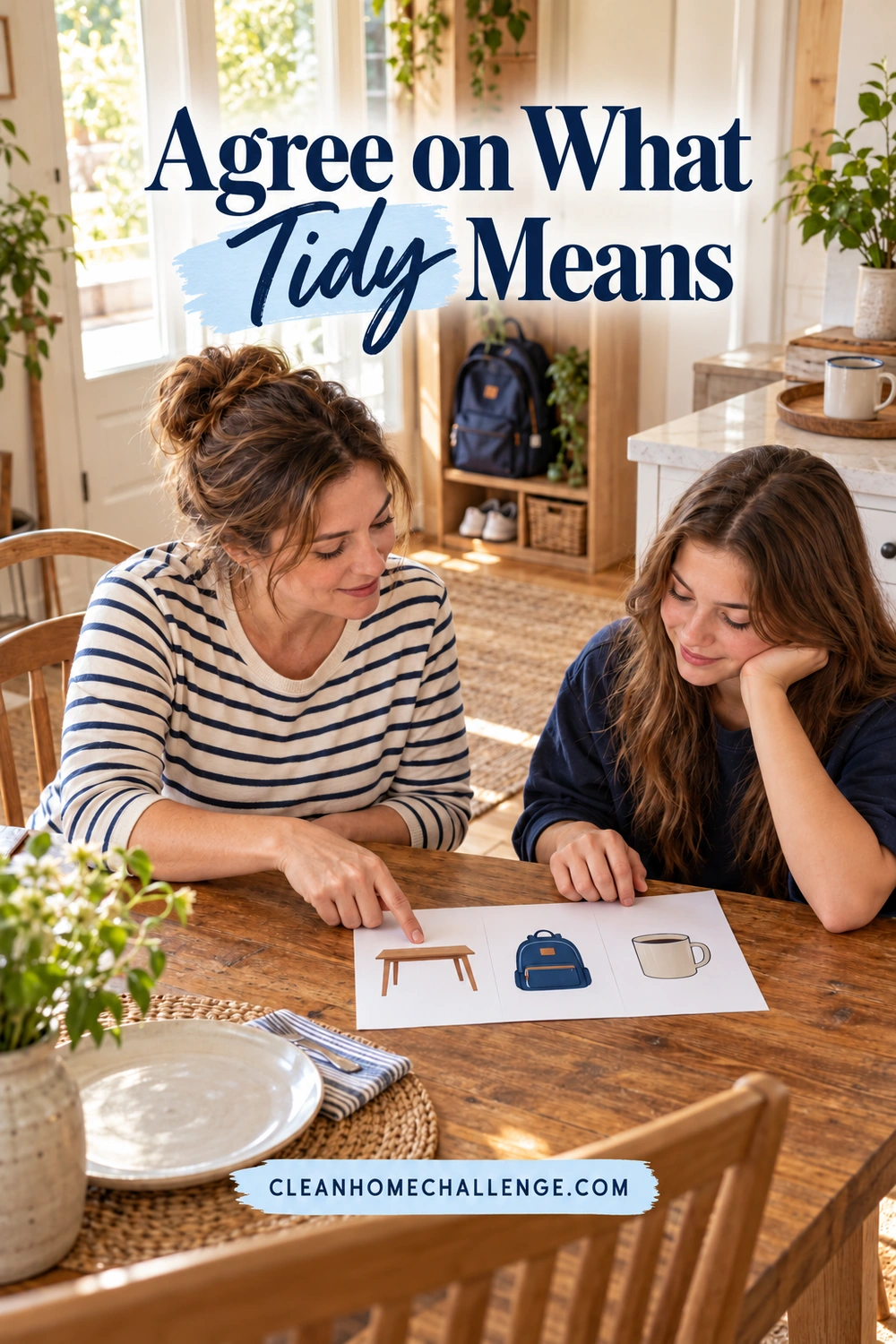
Agree on What Tidy Means
Choose a calm moment for the first conversation. Around 15 minutes is a useful starting allowance, but you can split it into two shorter chats. Bring a piece of paper and ask each person which household snag most often gets in their way. Someone may need the dining table clear for homework; someone else may be tired of finding no clean mugs.
Keep three kinds of expectations separate:
- Everyday usability: clear walking routes, a place to sit, space to prepare food, and shared items returned where others can find them.
- Cleaning and hygiene: food mess dealt with, used dishes washed, damp textiles managed, and dirty surfaces cleaned appropriately.
- Personal preferences: color-sorted shelves, perfectly arranged cushions, or a bed made a particular way.
Choose a few shared essentials before discussing appearance. A stack of schoolbooks on a private desk does not need the same response as spilled food on a kitchen counter.
Cleaning also has a specific meaning. It removes dirt and germs from surfaces; it is different from putting belongings away. The CDC explains when cleaning, sanitizing, and disinfecting are appropriate. Routine tidying alone cannot replace necessary cleaning, and a neat-looking room does not automatically need disinfectant everywhere.
Write three expectations people can follow
A starter agreement might be:
- After eating, bring dishes to the kitchen and complete the agreed dishwashing step.
- After showering, hang the towel to dry and leave the floor clear and dry.
- Before the evening ends, move personal belongings out of shared walkways and off the family table.
Ask what would make each expectation easier. A closer hamper, another towel bar, or permission to finish homework before the reset may solve a problem that repeated reminders have not.
Agree on the reason and deadline, then allow reasonable choice within them. For example: “The table needs to be clear before dinner. Would you rather move your project now or at five?” Protect ongoing projects with a designated shelf or tray when possible.
Put the agreement somewhere the family already looks. Adults follow the same shared-space expectations, including clearing their own cups and work materials. Review this first version after a week rather than adding every possible rule immediately.
Give Every Chore a Clear Finish
Teen chores work best when the assignment is specific enough to act on. “Help more” leaves the person guessing. “Empty the dishwasher after breakfast and put the dishes in their cupboards” names both the job and its finish.
The American Academy of Pediatrics describes household chores as a way for teens to contribute and develop practical skills. Match responsibilities to experience, ability, available time, and the safety of the task. A birthday alone does not tell you whether someone can use equipment confidently.
Give each job four details
A paper list, reusable chore board, or shared reminder can record:
- Owner: who is responsible this time, including an adult where appropriate
- Task: the exact action
- When: a cue or realistic deadline
- Done: the visible result, including putting tools away
For example: “Teen: clear the living room after dinner; cups in the kitchen, personal items put away, walkway open.” An adult’s entry might be: “Adult: finish kitchen cleanup after dinner; food stored, dishes handled, counters cleaned.”
Start with one manageable shared responsibility alongside personal pickup. Add another only when the first fits comfortably. Avoid assigning every teen the same number of jobs when their time, support needs, or job difficulty differs. Adults remain responsible for making sure essential household work is covered.
Teach the job before expecting independence
Show the steps once, explain any safety points, and let your teen practice while you are available. Ask them to show you how they will know the job is finished. A short written sequence can help without turning the chore into a lesson every day.
Offer a meaningful choice between two suitable jobs, or let them choose the time within an agreed window. Rotate unpopular tasks if the household prefers. Use neutral feedback: “The dishes are put away; the rack still needs sliding in,” rather than commenting on effort or character.
For new chemical or equipment tasks, an adult checks the instructions and decides what supervision is needed. Dry pickup, folding clean towels, and returning books are straightforward starting options. Leave unfamiliar chemicals, sharp waste, heavy lifting, and specialist cleaning to an adult.
Choose one agreed reminder, such as a kitchen note or a phone alert your teen sets. If it fails, adjust the cue together. For younger siblings, our age-appropriate chore guide offers more starting points; for the adults, a fairer division of household cleaning helps keep the workload visible.

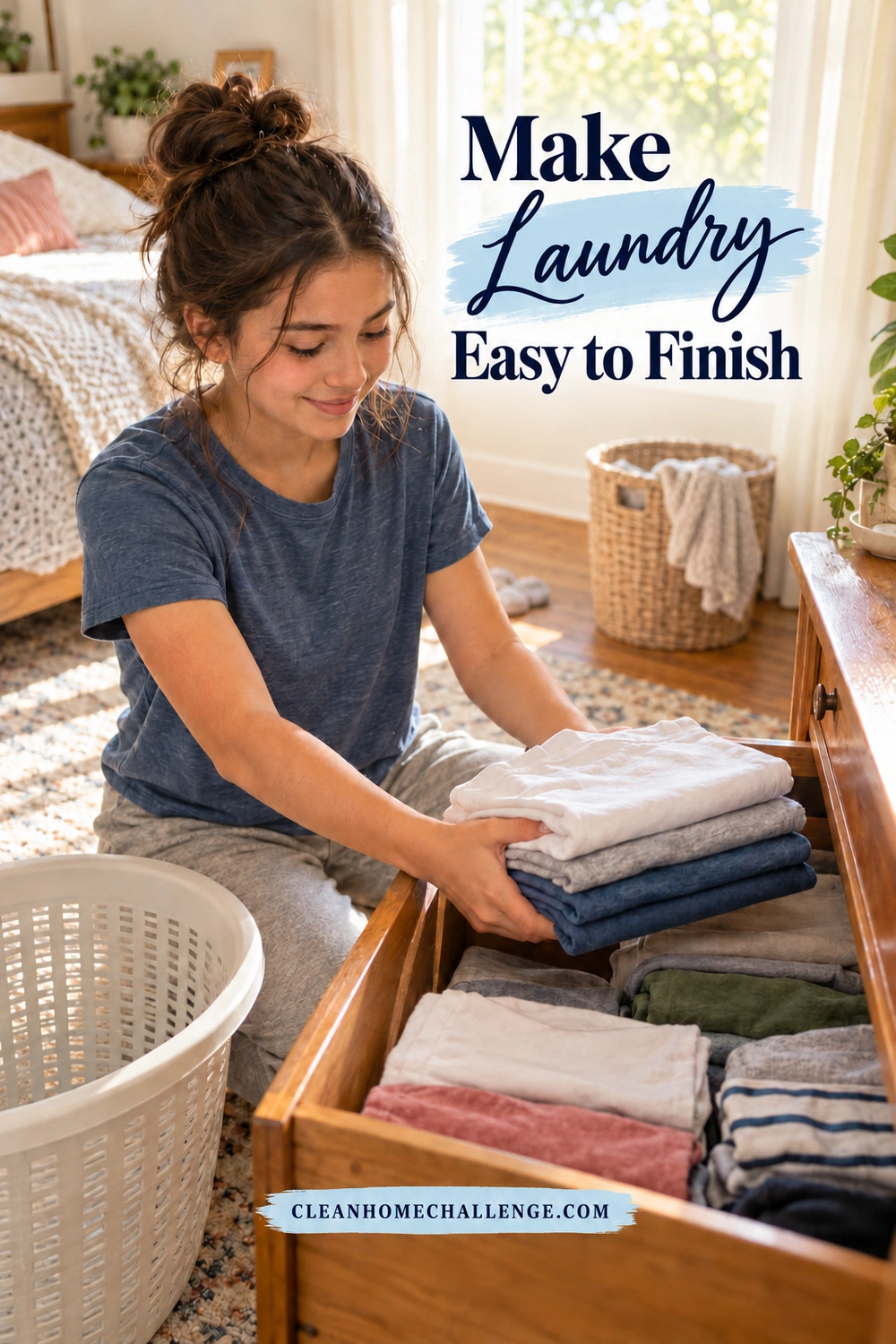
Make Laundry Easy to Finish
Laundry creates several separate jobs: collecting, sorting, washing, drying, and putting away. A family agreement needs to say which of those steps belongs to whom. Putting a load in the washer is a start, but the clothes still need a route back to the drawer.
Use what you already own first: a hamper, a clean basket, access to a drying rack or dryer, and enough drawer or hanging space. If clothes land beside the hamper, check its location and opening before buying a more elaborate sorter. A light, easy-to-carry basket can be more practical than a large one that becomes too heavy.
Teach one ordinary load from start to finish
Choose familiar everyday clothes for the first practice load. Keep delicate, stained, or specialist items aside for an adult to review.
- Collect and check. Empty pockets and read care labels. Separate items that need different treatment.
- Choose the load. Sort compatible colors and fabrics, following garment guidance. Leave room for the load to move rather than cramming in the whole hamper.
- Wash correctly. Use the detergent type, amount, dispenser, and cycle specified by the detergent and appliance instructions.
- Plan the transfer. Set a reminder for the end of the cycle. Move the load to an appropriate drying method.
- Finish the clothes. Once completely dry, fold or hang them and return them to their storage.
Whirlpool’s laundry guide explains care labels, sorting, loading, and drying choices. Your own machine manual and garment labels take priority over a generic cycle recommendation.
An adult should demonstrate detergent handling and appliance safety before handing over the job. Keep laundry products in their original packaging and stored securely away from younger children and pets. Decorative jars are unsuitable storage for detergent packets; the American Cleaning Institute’s safe-storage guidance explains why.
Give the system a workable schedule
Agree on a regular laundry slot and a backup slot that fit school, work, and shared-machine access. Allow for the machine cycle and drying time; the hands-on work and elapsed time are different. One wash day may suit one household, while sports clothing or limited uniforms may need more frequent loads.
If an adult washes combined family loads, a teen can own collection and put-away instead. In a laundromat household, divide sorting, carrying manageable loads, and returning dry clothes to drawers.
Hang damp towels and sportswear so they can dry safely rather than burying them in a closed pile. Provide a separate hook for clothing that is still suitable to wear again. Keep that space small enough to review easily. When clean clothes repeatedly stay in baskets, check whether the drawers are overfull and simplify the storage together.
Build a Shared Bathroom Routine
A shared bathroom needs two layers of care: a small reset after use and a scheduled clean. Keeping them separate makes it clear that hanging a towel is everyone’s responsibility, while cleaning the basin can be an assigned task.
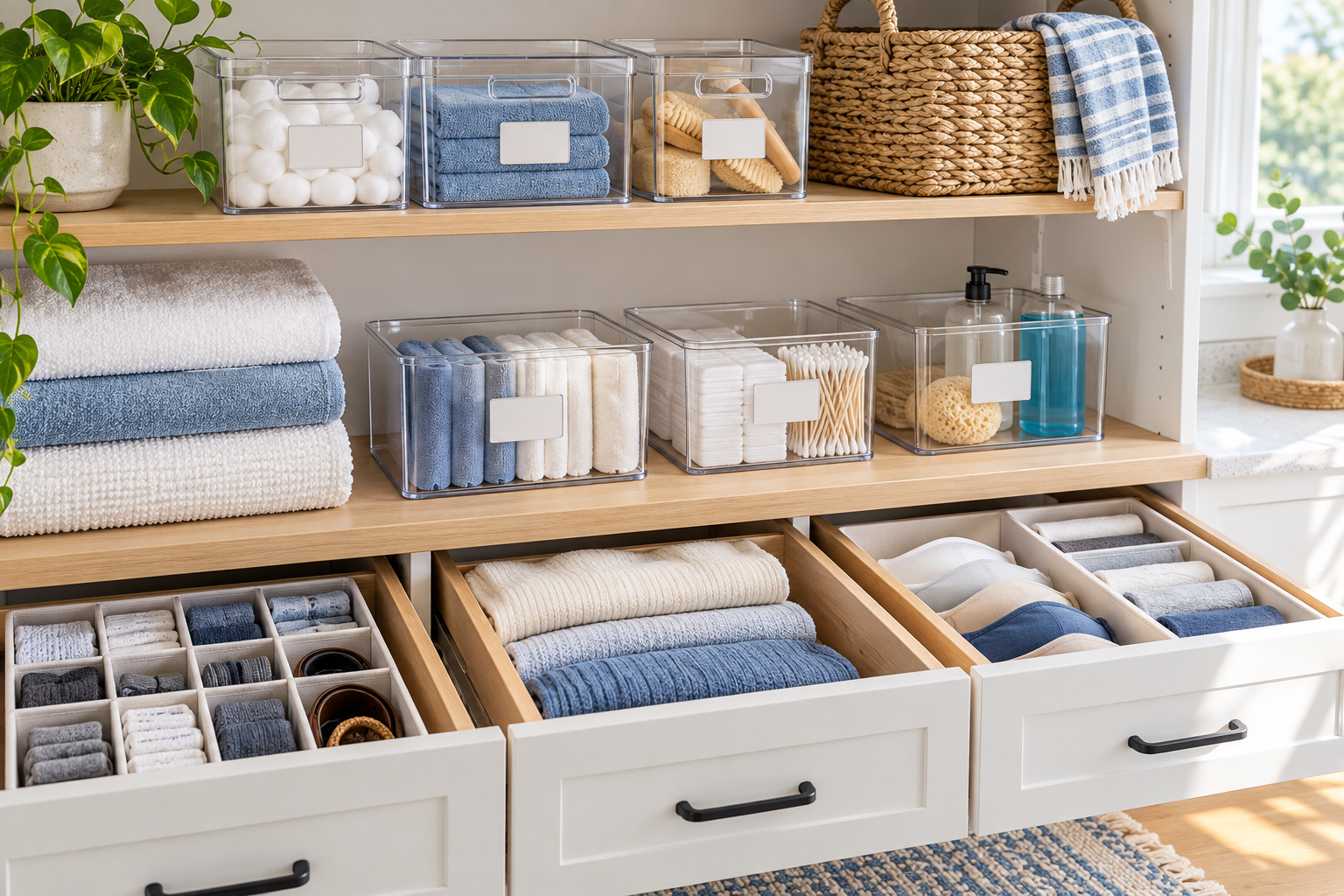
Start with the layout. Give each person a place for their toiletries and enough hanging space to spread out a towel. Add a lined wastebasket and keep spare toilet paper accessible. A portable caddy can help when several people use one small counter. Avoid buying matching organizers until you know which items actually need a home.
Use a short after-use reset
Before leaving the bathroom:
- Return toiletries to their shelf, drawer, or caddy
- Rinse away your toothpaste residue and deal with your own splashes
- Hang your towel so it can dry
- Put clothing in its agreed place and leave the floor dry and clear
- Replace an empty toilet-paper roll if a spare is available
These are shared bathroom expectations for adults and teens alike. If space or mobility makes a step difficult, adjust the equipment or get help rather than insisting on an awkward reach.
Assign a separate cleaning slot
Begin with a weekly check of the bathroom and clean sooner wherever needed. This is a planning example, not a rule that every bathroom stays clean for seven days. High use, visible soil, spills, and illness can change the work required.
For a teen learning basin cleaning, have an adult choose a surface-compatible product and demonstrate it. Clear the area, remove loose debris, clean according to the label, rinse if directed, and leave the surface dry where appropriate. Put the products away afterward. Use a separate cloth for toilet surfaces and do not carry that cloth into the kitchen. An adult can handle the toilet or other chemical tasks until training and supervision are appropriate.
The CDC’s home-cleaning guidance advises cleaning high-touch surfaces regularly and other surfaces when visibly dirty. Disinfection may also be needed when someone is sick or has a weakened immune system. Follow illness-specific advice when applicable.
If disinfecting, an adult should select the correct product and follow its label, including surface compatibility, protective equipment, ventilation, and the full wet contact time. Store chemicals securely and wash hands after cleaning. Never mix cleaning products. In particular, the CDC warns against combining bleach with other cleaners or disinfectants. Do not add vinegar, ammonia, or another cleaner to bleach.
A quick wipe should never be described as disinfection unless the correct product and its complete instructions were followed.

Reset Shared Spaces in Ten Minutes
Try a short reset at a point that already exists in your evening, such as after dinner. Ten minutes is a useful boundary for an experiment, not a promise that the entire home will be clean. Use a timer only if your household finds it helpful.
Give each person a small area or job so everyone is not circling the same table. One person can collect dishes, another can return personal belongings, and an adult can handle food storage and necessary kitchen cleaning.
Work in a simple order
- Deal with food and dishes. Bring plates and cups back to the kitchen and follow the family’s washing or dishwasher routine. Food storage and unsafe spills take priority.
- Collect ordinary trash. Empty wrappers go into the appropriate bin. Leave broken glass, sharp items, or unfamiliar spills for an adult.
- Return belongings. Put shoes, chargers, books, and bags in their actual homes.
- Restore usable surfaces. Clear the dining table and seating needed that evening. Keep an agreed project tray intact.
- Finish at the stopping point. Put the basket or tools away and identify any essential job that still needs attention.
A carrying basket can help move items between rooms, but empty it during the reset. Otherwise it becomes another collection point for everyone to search tomorrow.
Put storage where the transition happens. A backpack hook near the entrance and a low shoe shelf may be more useful than a distant bedroom closet. Shared chargers need a safe location away from water and walking routes. Adults’ bags and mail need a home too.
On a late practice night, try a smaller version: return dishes, remove food trash, and clear the walking route. Save decorative tidying for another day. Anyone who arrives later can complete their personal pickup separately rather than keeping everyone awake for a group session.
Avoid expanding the timer into an unexpected deep clean. If a shelf needs sorting or a room needs a longer clean, put that on the weekly plan. A predictable stopping point makes the request easier to understand and fit around the rest of the evening.

Respect Bedrooms and Set Hygiene Basics
A teen’s bedroom often holds several roles at once: sleeping space, study area, hobby corner, and somewhere to be alone. Agree on the practical basics while allowing room for personal taste and an arrangement you would not choose yourself.
Raising Children Network’s guidance on privacy and trust recommends discussing boundaries and respecting personal space, including knocking before entering. A cleaning agreement can work within those boundaries.
Define the bedroom minimum together
Choose a short list that addresses the actual room:
- Used dishes and food waste leave the room at an agreed daily point
- Dirty laundry reaches the hamper, and damp items are dealt with promptly
- Doorways, exits, and the route to the bed remain clear
- Household dishes, towels, and other shared items return when needed
- The floor and accessible surfaces get an appropriate regular clean
An unmade bed, an unconventional display, or a few books on the desk can be a separate conversation about preferences. Do not make every difference in taste part of the hygiene agreement.
Plan a short weekly reset or split it across several days. A useful order is dishes, trash, laundry, belongings, then cleaning. The length will depend on the room, buildup, and support needed. Begin with one category if the whole room feels too much.
Agree on how help and checks will work
Ask whether your teen wants company to get started, a written list, or time alone. If a check is needed, arrange it in advance and review the agreed results together. Keep private drawers, journals, and personal messages outside an ordinary cleaning check. Explain any genuine safety concern directly and deal with it as a safety issue.
Do not photograph or share the room to embarrass them. Avoid throwing belongings away as a tidying tactic. Put uncertain items aside for a decision with their owner; a school project or sentimental object may look disposable to someone else.
When the same clutter returns, look for a practical obstacle. The hamper may be too far away, a shelf may require moving six things first, or there may be no storage for a new hobby. Let the teen help change the setup. For families supporting younger children too, our kids’ bedroom cleaning guide gives a more hands-on starting routine.

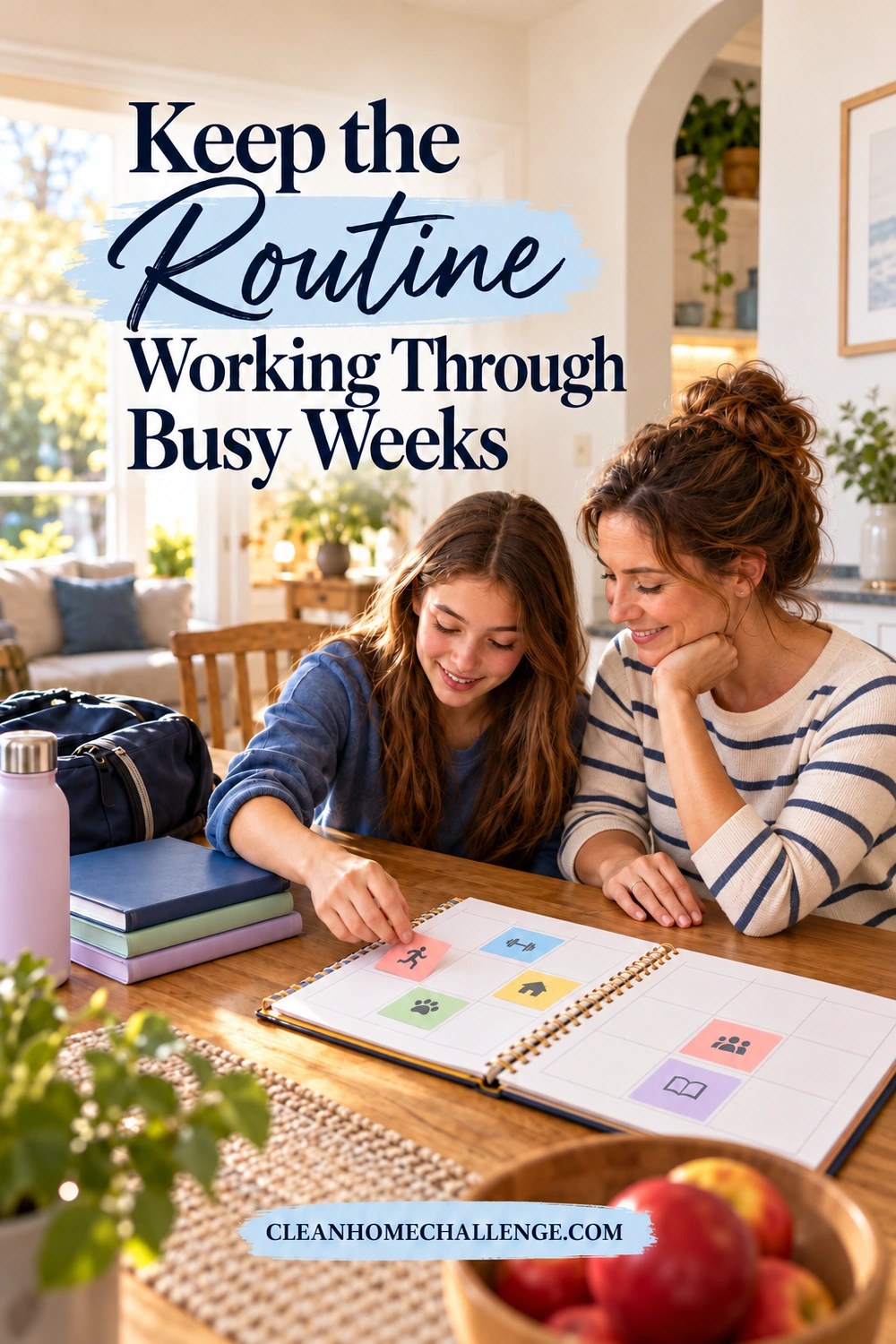
Keep the Routine Working Through Busy Weeks
A household plan needs room for exams, work shifts, sports, illness, and adults having difficult weeks too. Build an ordinary version and a smaller busy-week version before the schedule gets crowded.
For example, the ordinary version might include personal pickup each evening, an assigned dish task, a regular laundry slot, and one weekly shared cleaning job. The smaller version could keep dishes, food waste, essential laundry, and clear routes while moving a nonurgent organizing project to another day. Arrange who covers time-sensitive cleaning rather than silently leaving it for one person.
Have a short weekly check-in
Try five minutes at a convenient point in the week. Ask:
- Which part of the routine worked without much effort?
- Which job got stuck, and at what step?
- Does anyone need help, a different deadline, or a temporary swap?
Pick one adjustment. If laundry was washed but never put away, add a put-away cue or reduce the amount waiting. If the bathroom reset keeps failing, check towel space and toiletry storage. If a deadline clashes with practice, move it before deciding the person is unwilling.
The American Academy of Pediatrics’ time-management guidance encourages teens to choose tools, break larger tasks into smaller steps, and take part in regular planning. A reminder system can be a paper note, an alarm, or a simple board; it only needs to fit the person using it.
Respond to missed jobs without restarting the argument
Name the unfinished task and ask for a workable next step: “The clean towels are still in the basket. When can you put them away?” If the same problem continues, revisit the workload, instructions, and support. Take a wider change in a teen’s ability to cope seriously and check in about how they are doing, rather than assuming a messy room tells you why.
Notice useful contributions specifically: “Thanks for clearing the table. We can sit down together now.” Adults can acknowledge their own missed jobs and make a plan to finish them too.
For this week, choose one shared-space expectation, one laundry improvement, and one short check-in. Repeat the parts that help. Keeping a home tidy with teenagers is a household skill you can build together, with enough structure to share the work and enough flexibility to live in the home.
CLEANERS CLUBHOUSE
Make Your Cleaning Routine Easier to Follow
Stop wondering what to clean next. Inside the Cleaners Clubhouse, you’ll get a practical 12-month cleaning calendar, printable worksheets and monthly challenges to help you keep moving without trying to do everything at once.