
THIS POST MAY CONTAIN AFFILIATE LINKS. PLEASE READ MY DISCLOSURE FOR MORE INFO.
Reusable cleaning cloths and washable mop pads can lower your regular cleaning costs, especially when you use them often and wash them efficiently. They also bring an upfront purchase, laundry, drying, and eventual replacement. A bargain pack that never makes it back into your cleaning basket will not save much.
When comparing reusable cleaning products vs disposable options, the most useful question is: what does it cost to finish the same job in your home?
You do not need to replace every paper towel or wipe. A small collection of reusable tools for everyday cleaning, with disposables available for suitable jobs, can be a practical starting point. Here is how to compare the numbers, choose useful products, and build a routine that works on an ordinary busy week.
Disclosure: This post may contain affiliate links. As an Amazon Associate, Clean Home Challenge earns from qualifying purchases. If you make a purchase through these links, we may earn a small commission at no extra cost to you. This helps us keep creating practical cleaning tips, routines and resources for busy families! 🧽
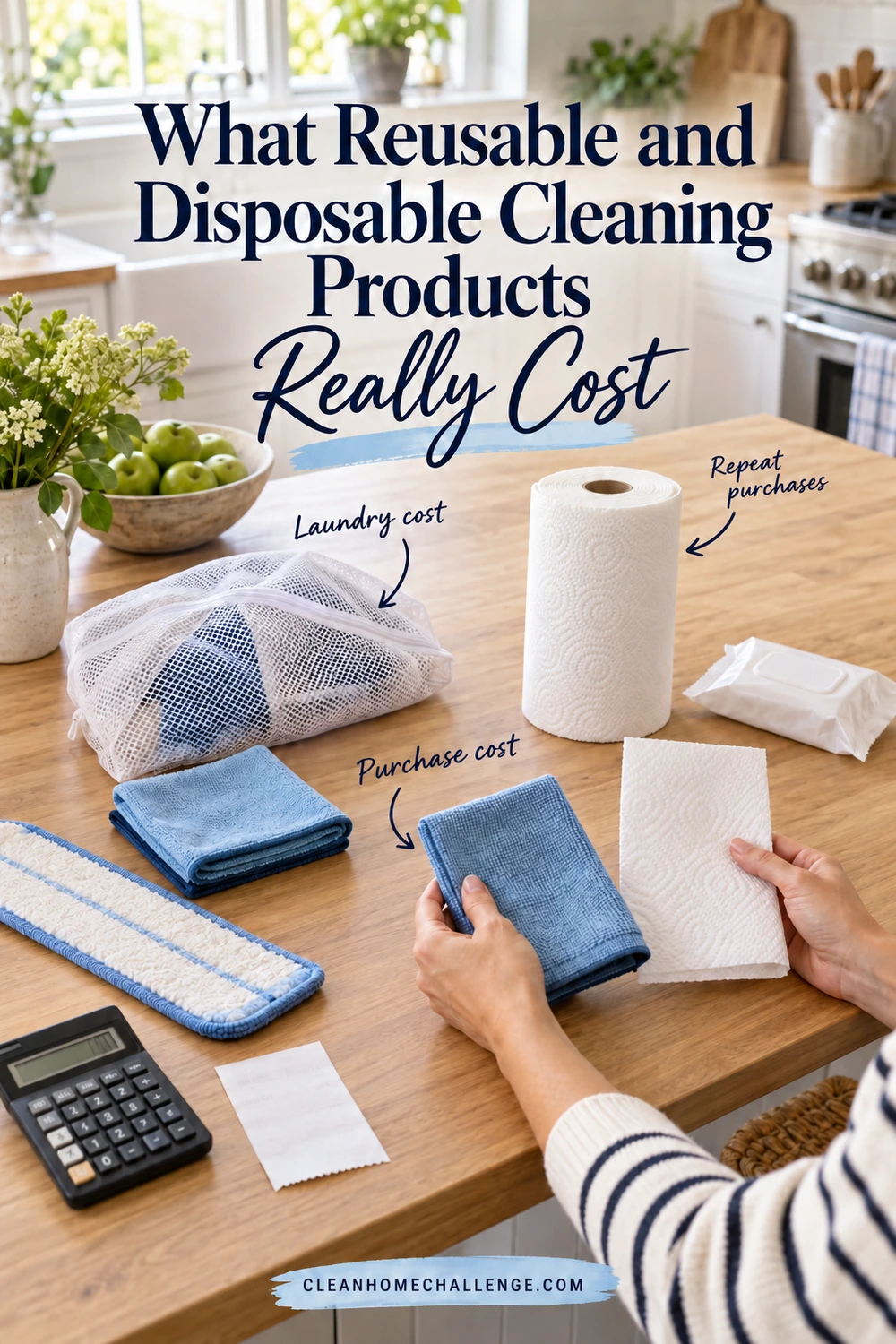
What Reusable and Disposable Cleaning Products Really Cost
The shelf price tells you what you pay today. The cost per completed cleaning job tells you more about long-term value.
For disposable products, count the sheets, pads, or wipes you actually use. A large paper towel roll may contain different sheet sizes from another brand. One floor may need several disposable pads. A wipe that dries out before you finish its tub has a cost even though it never cleaned anything.
For reusable products, include the starter set, replacement pieces, detergent, water, energy, and any paid washing or drying. Add a new mop handle if the pad swap requires one. If the two options need different amounts of cleaning solution, include that difference too.
Use this short comparison checklist:
- Paper towels versus cloths: What does one spill or counter-cleaning session use, and how many clean cloths does your household need between washes?
- Disposable floor pads versus washable mop pads: How many pads cover the same floor area, and does the washable version fit your current mop?
- Disposable dusters versus washable dusting tools: Can the reusable tool reach the same places, and is maintaining it manageable?
- Cleaning wipes versus a cloth and cleaner: Are you comparing routine cleaning with routine cleaning, or does one product have a separate sanitizing or disinfecting purpose?
Keep cash cost and effort separate. A reusable option might save a few dollars while adding handling that is difficult with your schedule, mobility, or laundry access. That matters. You can choose convenience for one task and reusables for another.
For a fair first check, save one receipt and track use for seven days. Record how many disposable items were needed rather than estimating from memory. Include the awkward jobs and the hurried mornings. Those are part of your real cleaning routine.
Then choose a comparison period, such as three months or a year. Comparing a reusable kit’s entire purchase price with a single disposable refill pack makes the reusable option look expensive before it has had a chance to do repeated work.
Calculate Your Break-Even Point Before You Buy
A break-even point is the number of cleaning sessions needed for avoided disposable purchases to cover the reusable setup. It is a planning estimate, not a guarantee.
The figures below are illustrative US-dollar amounts, not current retailer prices or promised savings. Replace them with your receipts, laundry charges, and actual product use.
Imagine one defined daily cleaning session that usually uses six paper towel sheets:
- Paper towels cost $12 for 600 sheets, or $0.02 per sheet.
- Six sheets cost $0.12 per session.
- A starter set of 12 reusable cloths costs $18 in total.
- You use one fresh cloth for that same session and then launder it.
- The allocated washing and drying cost is $0.03 per cloth-use.
Each reusable session avoids $0.12 of paper towels but adds $0.03 of laundry, leaving $0.09 toward the initial purchase. Divide $18 by $0.09: the kit breaks even after 200 sessions, or about 200 days if you complete that job daily.
After 365 sessions, the illustrative totals are:
- Disposable: 365 × $0.12 = $43.80.
- Reusable: $18 + (365 × $0.03) = $28.95.
- Difference: $14.85 saved, assuming no replacement purchase and equivalent cleaning results.
The example excludes cleaner because it assumes the same cleaner cost for both methods. It includes the full reusable purchase upfront. Add tax, shipping, extra equipment, and replacements wherever they apply to your own totals.
Give laundry a realistic cost
Estimate detergent, water, electricity or gas, and drying for a compatible load. Allocate a reasonable share to the cleaning items. For example, a hypothetical $1.20 load containing 40 similar-size cloths works out to $0.03 each. This is a calculation example, not a reason to buy 40 cloths or wait too long to wash soiled ones.
If the cloths cause an additional wash that you otherwise would not run, count that additional load’s full cost across those cloths. Do not automatically call washing free because you already own a machine. Coin-operated laundry, handwashing water, and dryer charges can change the result substantially.
If laundry rises to $0.07 per use in the example, the saving becomes $0.05 per session and break-even moves to 360 sessions. At $0.12 or more per use, there is no cash payback under these assumptions. Using two cloths where you previously used six paper sheets also changes the calculation.
For your own estimate, divide the extra upfront reusable cost by the disposable cost avoided per session minus the reusable running cost per session. If that running-cost difference is zero or negative, look for a different swap rather than forcing the numbers to work.

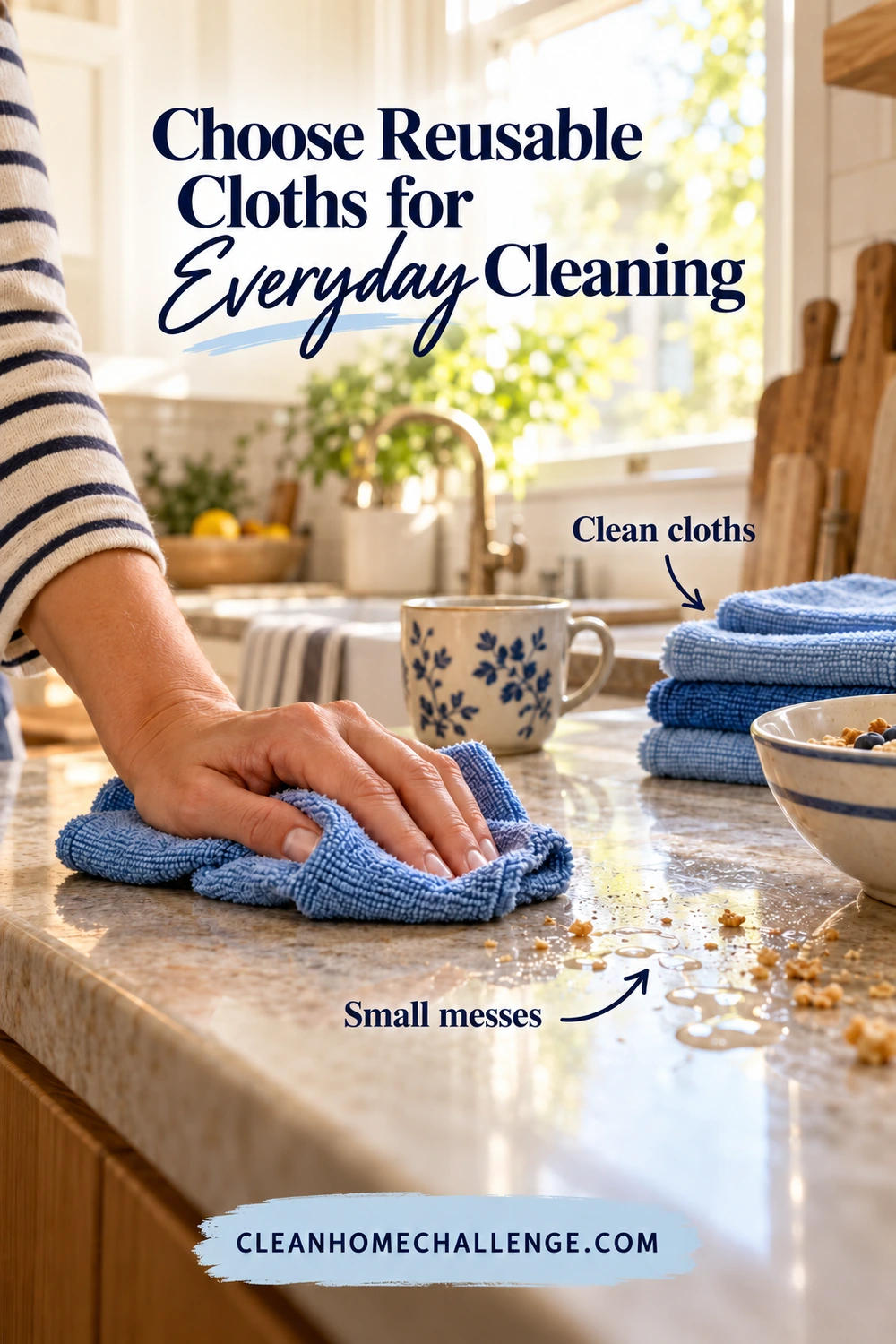
Choose Reusable Cloths for Everyday Cleaning
Start with a job you repeat often: wiping ordinary counter spills, dusting shelves, or cleaning a compatible mirror. Choose a cloth suited to that task and its laundering requirements.
Cotton cloths or small towels can be useful for absorbing ordinary spills. A clean, worn household towel may give you a low-cost trial. Check for scratchy trim, loose threads, or trapped grit, and keep it away from delicate surfaces if its suitability is uncertain.
Microfiber cloths come in different textures and constructions. A general-purpose cloth, glass cloth, and heavy-duty scrubbing cloth are not automatically interchangeable. Match the product to the surface, especially on coated screens, polished finishes, or easily scratched materials.
Cellulose or sponge-style reusable cloths have their own washing, drying, and replacement instructions. Do not assume every product can go in a dishwasher, washing machine, or microwave because a similar-looking one can. Read the actual care label before buying.
Look for a few practical details:
- A size you can comfortably hold and wring out.
- Care instructions that fit your laundry setup.
- Enough absorbency for the job without several replacements midway through.
- An easy way to tell kitchen, bathroom, and general-use cloths apart.
- Replacement pieces available without buying another whole kit.
For a normal wipe-down, start with a clean cloth and a surface-appropriate method. Fold the cloth to expose fresh faces as you work, then switch cloths when it becomes soiled. Folding is a way to manage the wiping surface; it does not make a contaminated cloth safe for another area.
Buy a small trial set before committing to a cupboard full. A cloth you dislike touching or cannot dry easily is unlikely to stay in regular use.
Treat lifespan claims as product-specific. For example, E-Cloth currently describes a one-year or 100-wash promise for its US General Purpose Cloth when cared for as directed. That does not establish how long every reusable cloth will last in your household. Check conditions, care instructions, and actual performance. E-Cloth’s product care guidance explains its own requirements.
Make Washable Mop Pads Work for Your Floors
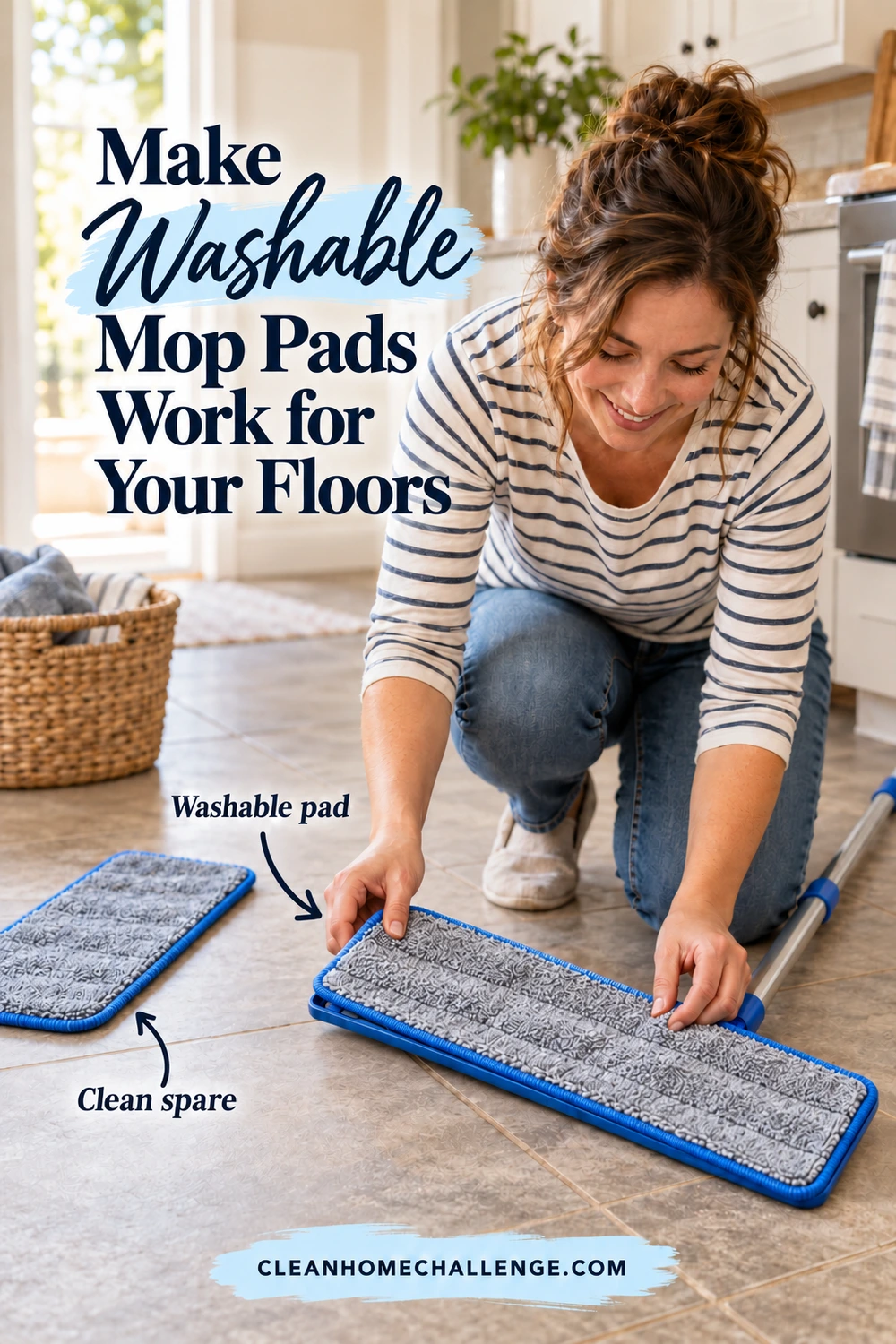
Washable mop pads are worth comparing if you frequently buy floor-pad refills. Check compatibility first: measure the mop head, identify the attachment system, and confirm the pad is intended for that model and cleaning method.
A pad that slips, bunches, or exposes the mop base is a poor bargain. Do not improvise a cloth attachment on a powered mop or specialist machine unless the manufacturer permits it.
You also need to match the method to the floor. A washable pad does not make extra water, steam, or an unsuitable cleaning solution safe for wood, laminate, stone, or other finishes. Follow the floor and mop manufacturers’ directions, including cleaner dilution and moisture limits.
For a simple flat-mop routine:
- Vacuum or sweep loose dirt and grit first.
- Attach a clean pad and prepare the approved cleaner as directed.
- Work in small areas, using controlled pull-back strokes so you can gather remaining debris rather than repeatedly pushing it across the room.
- Change the pad when it becomes dirty or stops picking up well. Keep bathroom-floor pads separate from kitchen-floor pads during the cleaning session.
- Remove the used pad, launder it according to its label, and let it dry fully before storage.
Keeping a clean spare can prevent the familiar problem of needing to mop while the only pad is still wet. Start with the smallest rotation that covers your floor areas and drying time.
Care instructions vary. O-Cedar tells ProMist MAX owners to wash the microfiber refill in warm water without bleach or fabric softener, then lay it flat or hang it to dry. Check your own product rather than applying those instructions to every pad. O-Cedar’s use-and-care page provides the model-specific details.
Run a separate cost comparison for floors. For example, with an illustrative $16 reusable-pad setup, $0.30 of disposable pads avoided per session, and $0.10 laundry per session, break-even is 80 sessions, assuming no replacement pads or other extra costs before then. Buying a new mop would lengthen that period. Cleaning twice a week reaches the same number of sessions sooner than cleaning once a week.
If your floor still feels tacky, investigate soil and cleaner residue before replacing the tool. Our guide to mopping without sticky residue covers that problem in more detail.
Keep Cleaning Cloths Hygienic Between Uses
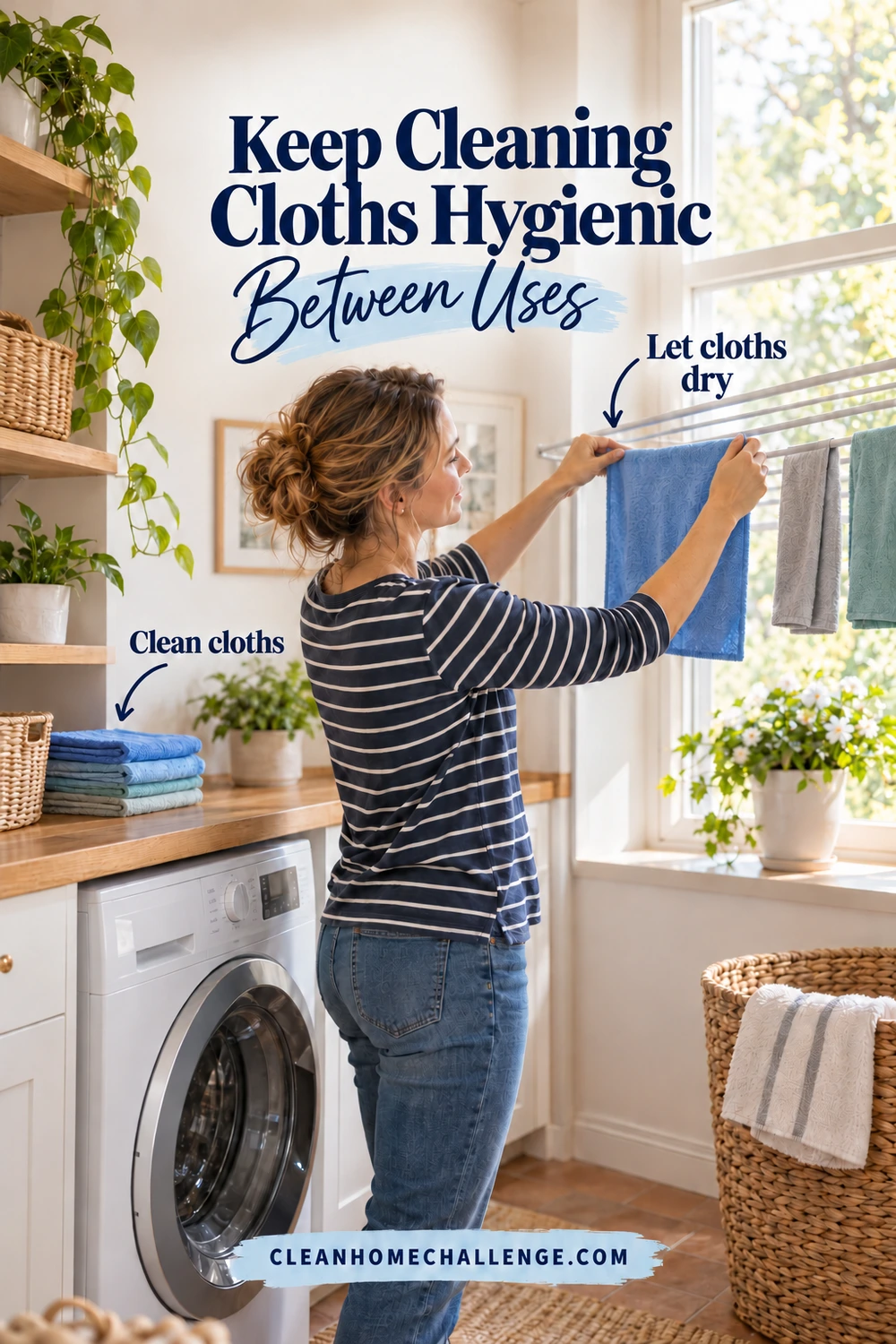
A reusable system needs a clear route from clean storage to the job, then to washing and complete drying. Leaving one damp cloth beside the sink indefinitely defeats that system.
Use separate cloths for kitchen surfaces, bathroom fixtures, toilet areas, and general dusting. Choose labels or colors that your household can remember. The particular color does not matter; keeping the jobs separate does. A cloth used around the toilet should not move to the sink or kitchen counter.
During cleaning, change to a fresh cloth after a dirty task or when the cloth becomes visibly soiled. Avoid repeatedly dipping a dirty cloth into a container of solution intended for the rest of the job. A quick rinse is not the same as laundering, sanitizing, or disinfecting.
For ordinary used cloths, remove loose debris as appropriate, keep them away from clean supplies, and wash promptly. If there is a short wait before washing, spread them on a dedicated rack where they can dry safely instead of leaving a wet bundle in a sealed container. This is temporary handling, not permission to leave heavily soiled cloths for a weekly catch-up.
Follow both the cloth’s care instructions and the needs of the job. USDA recommends washing kitchen dishcloths often on a hot washing-machine cycle. If your chosen cloth cannot tolerate the washing method needed for its task, choose a more suitable cloth or use a disposable option. See USDA’s kitchen-cleanliness guidance.
For microfiber, check detergent amount, temperature, dryer settings, and restrictions on fabric softener or bleach. Do not add stronger products or mix laundry chemicals to try to make a cloth “extra clean.” Dry cloths completely before returning them to clean storage, and wash your hands after handling dirty cleaning materials.
Retire a cloth from its current task if it retains grit, develops holes, sheds excessively, stops absorbing well, or remains unpleasant after correct washing. A lingering odor deserves attention, but the absence of odor is not proof that a cloth is hygienic. Staining alone also does not tell you whether it is clean.
For a fuller storage and replacement routine, see reusable cleaning cloth hygiene.
Know When Disposable Products Make Sense
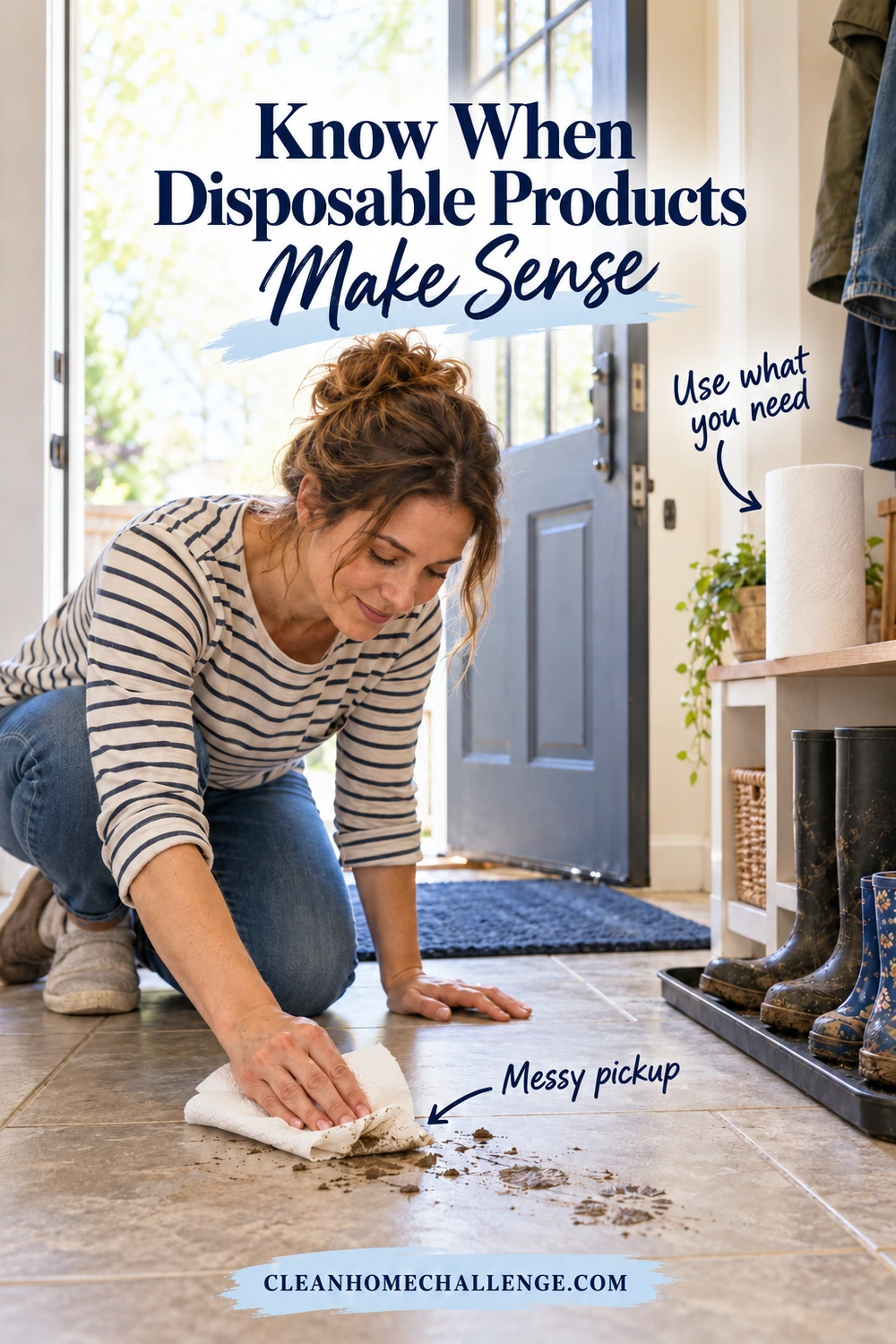
There are reasonable reasons to keep some paper towels, suitable wipes, or disposable pads available. You may have limited laundry access, need an easier option during a demanding week, or face a cleanup that needs specific handling.
For raw meat or poultry juices, paper towels can make the initial removal straightforward. Discard them promptly, then clean and sanitize the affected food-contact surface with a suitable product according to its directions. Wiping up the visible liquid alone does not finish that job. CDC distinguishes this food-preparation situation from everyday cleaning in its home cleaning guidance.
Illness-related vomit or diarrhea needs particular care. CDC’s norovirus guidance calls for gloves, paper towels for the cleanup, bagging the waste, and appropriate disinfection. Follow the complete instructions and the disinfectant label, including suitability for the surface and the relevant organism. Do not assume every disinfecting wipe is suitable for norovirus. Use the CDC’s norovirus cleanup instructions rather than treating this as an ordinary spill.
Disposable surface wipes also vary. Some are cleaners; others have sanitizing or disinfecting directions. Read what the label actually authorizes. When disinfection is needed, the surface must remain visibly wet for the product’s specified contact time. A large surface may need more than one wipe. Include that actual use in the cost comparison. The EPA’s disinfectant guidance explains why the label and intended use matter.
Use ventilation and protective equipment when directed. Never mix cleaners, and keep chemicals out of reach of children and pets. Do not use surface wipes on skin unless the product is specifically intended for that use.
Disposables can also be a sensible temporary choice while traveling, moving, or dealing with an unusable washer. Your routine can change with the week you are having.
A mixed system can still reduce regular refill spending. Reserve disposables for the situations where they are useful, and let washable tools handle the ordinary jobs you can maintain comfortably.
Build a Low-Laundry Family Cleaning Routine
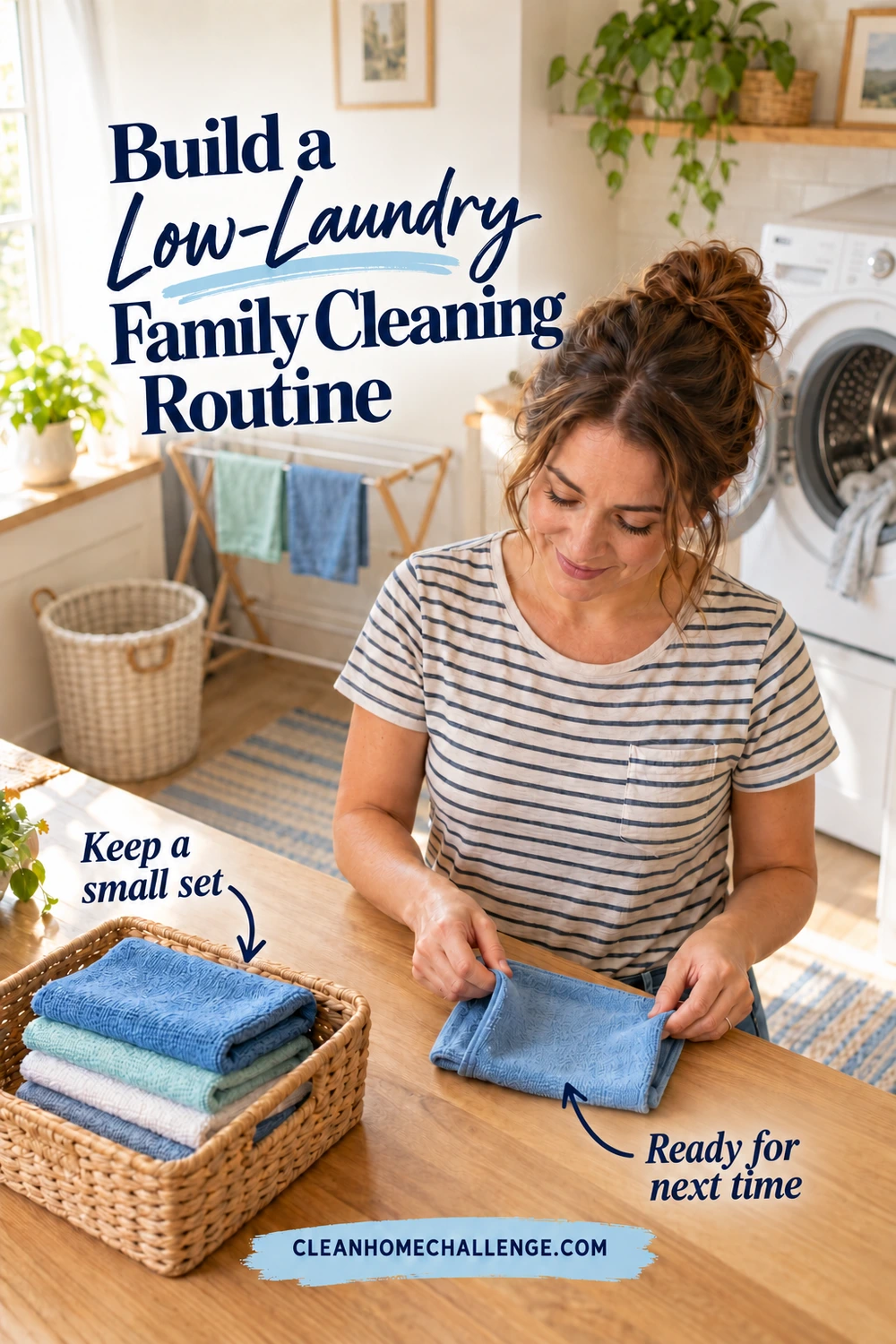
The easiest reusable system makes three things obvious: where to get a clean tool, where a used one goes, and who returns the clean supply.
Begin with a small, labeled basket near the relevant cleaning area. Keep cloths for surfaces separate from dish-drying towels, hand towels, and personal washcloths. Store cleaning chemicals securely even if you leave a basket of clean cloths within easy reach.
Estimate your starting supply from actual use. If one particular routine needs two fresh cloths a day and you wash them every two days, four cloths cover that interval. Add a modest spare allowance for drying time or an unexpected mess. This is a stock-planning example, not a rule to delay washing contaminated cloths.
Then give the routine a simple rhythm:
- After the job: Put the used cloth in the designated handling area, away from food and clean supplies. Deal with heavily soiled items promptly.
- At the laundry check: Confirm which cleaning items can be washed together according to fabric, soil, chemical residues, and care instructions. Do not automatically add every cleaning rag to a clothing load.
- After washing: Dry everything fully using an approved method, then return it to its labeled basket.
- Once a week: Check that clean spares are available and that the used-cloth area is itself clean.
Make the wash schedule fit hygienic handling. You can align an appropriate load with your regular laundry routine, but do not leave contaminated cloths waiting just to fill a machine. ENERGY STAR recommends full loads where practical and air-drying where suitable. Avoid overloading, and do not lower a required wash temperature simply to reduce costs. ENERGY STAR’s laundry tips explain the efficiency side of the decision.
For the CHC weekly rhythm, check kitchen cloths after Monday’s kitchen clean, bathroom supplies after Tuesday’s bathroom clean, and mop pads after Friday’s floors. Saturday’s laundry catch-up can replenish suitable ordinary cleaning textiles already being handled correctly.
Share the reset as well as the cleaning. One family member can restock cloths while another handles the wash. Younger helpers can fold clean, dry cloths with appropriate supervision; adults should handle contaminated materials and cleaning chemicals.
Start With One Swap and Track Your Savings
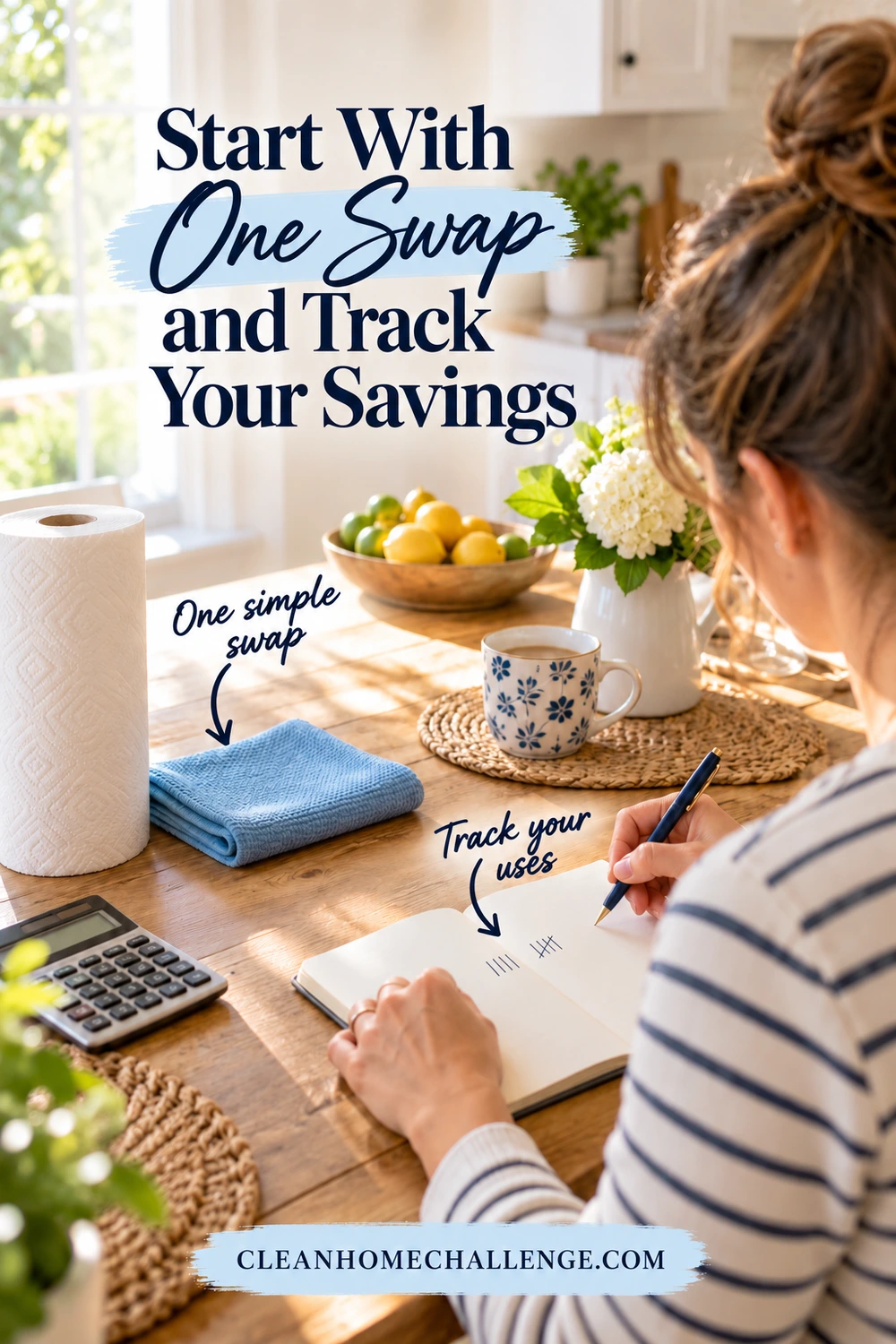
Choose one frequent, low-complication job for a two-week trial. Everyday dusting or an ordinary wipe-down is easier to evaluate than replacing your entire cleaning cupboard at once.
Use suitable cloths you already own if possible. Otherwise, buy a small set after checking care instructions. Keep your usual disposable option available while you learn what works.
Make a short record with five details:
- The job and how often you did it.
- Disposable sheets or pads you would normally use for that job.
- Reusable pieces actually used and any extra cleaner needed.
- Washing, drying, and replacement costs.
- Any practical snag, such as slow drying or running out of clean spares.
Two weeks will help you test convenience and usage; it will not prove a cloth’s full lifespan. Keep the replacement assumption cautious when projecting annual savings. Revisit the numbers when a pad wears out, laundry prices change, or your routine changes.
If the trial is awkward, adjust the storage, product, or chosen task before buying more. Good maintenance helps you get use from what you already own; our guide to storing and maintaining cleaning tools is a useful next step.
If you want to reduce cleaning waste, using washable tools repeatedly can reduce the disposable items going into your trash. That alone is not a complete environmental comparison: manufacturing, materials, laundering, lifespan, and disposal also matter. EPA’s life-cycle explanation of sustainable materials management describes why the whole product life matters. Avoid buying a large new collection simply because it is marketed as greener.
The most useful savings come from a swap you actually keep using. Start small, include laundry in the math, protect hygiene, and keep the combination of tools that makes your home easier to care for.
CLEANERS CLUBHOUSE
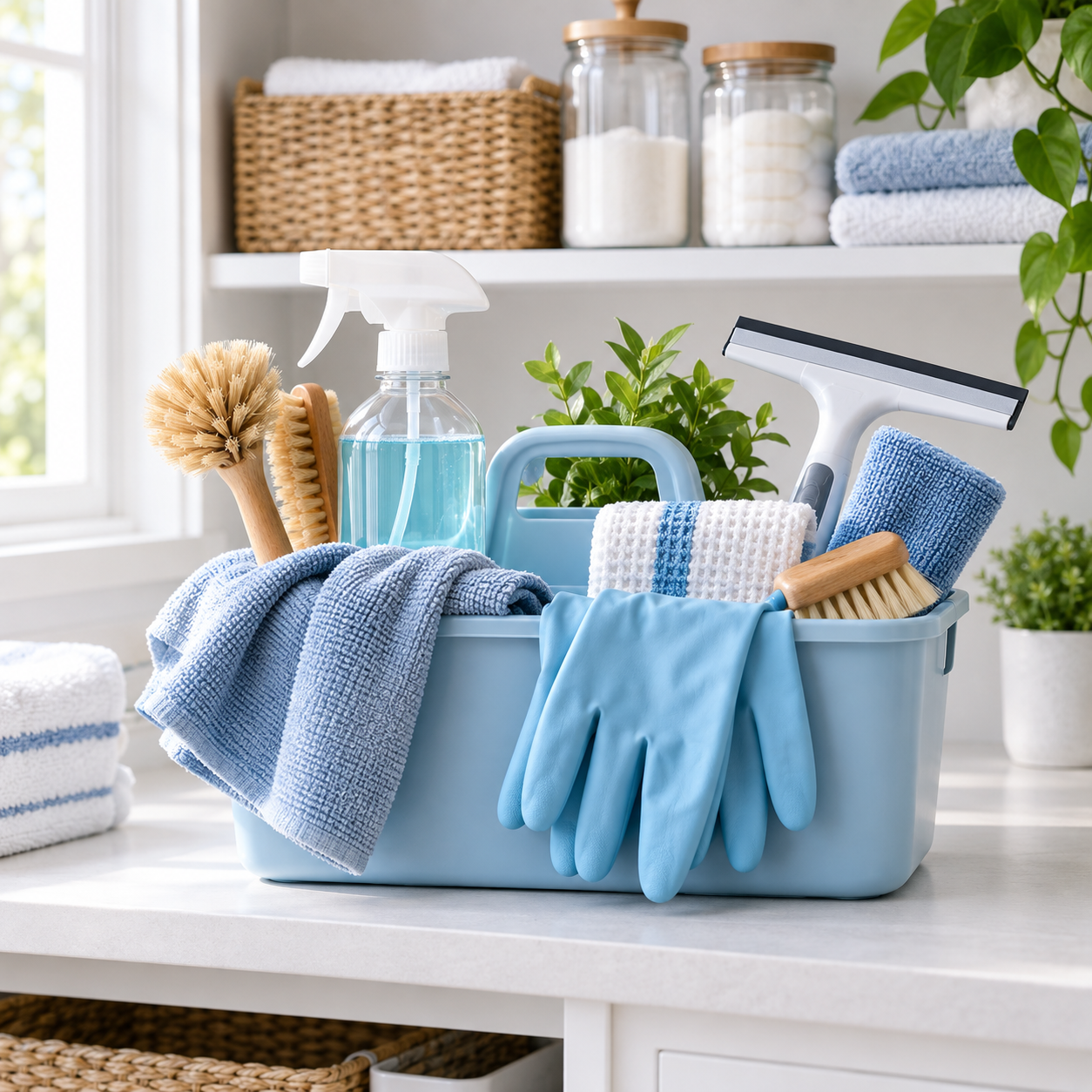
Use the Right Tools With a Routine That Works
Good cleaning tools work best when you know where and when to use them. Inside the Cleaners Clubhouse, recommended products sit alongside practical routines, printable worksheets and monthly challenges.